


Unique Defect Characteristics of Antimony Chalcogenide Photovoltaic MaterialsClick to copy article linkArticle link copied!
- Xiaoqi PengXiaoqi PengDepartment of Materials Science and Engineering, School of Chemistry and Materials Science, University of Science and Technology of China, Hefei, Anhui 230026, P. R. ChinaInstitute of Deep Space Sciences, Deep Space Exploration Laboratory, Hefei 230088, ChinaMore by Xiaoqi Peng
- Zichen RuanZichen RuanDepartment of Materials Science and Engineering, School of Chemistry and Materials Science, University of Science and Technology of China, Hefei, Anhui 230026, P. R. ChinaInstitute of Deep Space Sciences, Deep Space Exploration Laboratory, Hefei 230088, ChinaMore by Zichen Ruan
- Changfei ZhuChangfei ZhuDepartment of Materials Science and Engineering, School of Chemistry and Materials Science, University of Science and Technology of China, Hefei, Anhui 230026, P. R. ChinaMore by Changfei Zhu
- Shangfeng YangShangfeng YangDepartment of Materials Science and Engineering, School of Chemistry and Materials Science, University of Science and Technology of China, Hefei, Anhui 230026, P. R. ChinaMore by Shangfeng Yang
- Tao Chen*Tao Chen*E-mail: [email protected]Department of Materials Science and Engineering, School of Chemistry and Materials Science, University of Science and Technology of China, Hefei, Anhui 230026, P. R. ChinaInstitute of Deep Space Sciences, Deep Space Exploration Laboratory, Hefei 230088, ChinaState Key Laboratory of Advanced Glass Materials, Hefei 230000, Anhui, P. R. ChinaMore by Tao Chen

Abstract
Conspectus
Antimony chalcogenides, including Sb2S3, Sb2Se3 and alloyed Sb2(S,Se)3, have emerged as promising new generation solar cell materials owing to their excellent stability, tunable bandgap in 1.1–1.8 eV, and high extinction coefficient. Different from all the previous solar cell materials, the crystal structures of this class of semiconductors are composed of quasi-one-dimensional ribbons, which renders efficient directional carrier transport along the one-dimensional Sb4(S/Se)6 ribbon. This ribbon structure could generate inert grain boundaries since there is no dangling bond at the side of the ribbons. With these unique properties, it has attracted intense interests in solar cell applications. Over the past decades, device efficiencies have increased from ∼1% to above 11%. The advances in film fabrication, defect passivation and orientation control contribute to the efficiency breakthrough. However, there is still a large gap between current performance and the theoretical efficiency limit of ∼33%. It has been realized that the deep-level point defect plays critical role in increasing the efficiency. In this case, a comprehensive understanding of defect formation and passivation is essential for the fabrication of high quality Sb2(S,Se)3 films for further efficiency breakthrough.
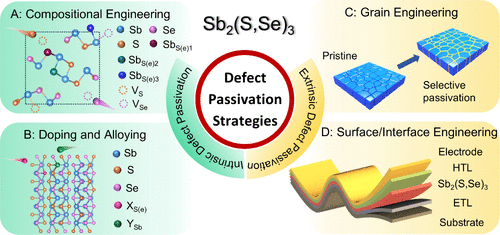
Building on the foundational work from our research, this Account presents a unified conceptual framework that traces the defect chemistry of Sb2(S,Se)3 from their quasi-one-dimensional ribbon structures to multidimensional collaborative passivation strategies for device optimization. We first describe how the anion chemical potential and S/Se ratio regulate the formation of vacancies and antisite defects. These factors shape local bonding and lattice strain, which, in turn, influence defect energetics and carrier lifetime. We then examine how controlled chemical modification can adjust short-range coordination environments. Such adjustments refine the electronic structure and can transform harmful deep states into electronically benign ones. We also emphasize strategies that target grain boundaries and surfaces, where deep defects often concentrate due to ribbon termination and structural disorder. Well-designed passivation treatments can reconstruct these regions, reduce under-coordinated atoms, and improve interfacial band alignment. Finally, we discuss recrystallization approaches that promote favorable ribbon orientation and suppress chalcogen loss, a key source of deep donor states. Together, these directions have enabled the power conversion efficiency to exceed 11%. By establishing a unified chemical framework for understanding and controlling point defects, this Account provides guiding principles for advancing Sb2(S,Se)3 materials in terms of sophisticated defect-engineering.
Cited By
This article has not yet been cited by other publications.

Article Views
Altmetric
Citations
Article Views are the COUNTER-compliant sum of full text article downloads since November 2008 (both PDF and HTML) across all institutions and individuals. These metrics are regularly updated to reflect usage leading up to the last few days.
Citations are the number of other articles citing this article, calculated by Crossref and updated daily. Find more information about Crossref citation counts.
The Altmetric Attention Score is a quantitative measure of the attention that a research article has received online. Clicking on the donut icon will load a page at altmetric.com with additional details about the score and the social media presence for the given article. Find more information on the Altmetric Attention Score and how the score is calculated.