


Progress in Self-Assembled Extracellular Matrix Structural Protein Mimetic Peptides: From Rational Design and Assembly Pathways to Biomedical ApplicationsClick to copy article linkArticle link copied!
- Linyan YaoLinyan YaoState Key Laboratory of Animal Disease Control and Prevention, College of Veterinary Medicine, Lanzhou University, Lanzhou 730000, ChinaGansu Province Research Center for Basic Disciplines of Pathogen Biology, Lanzhou 730000, ChinaMore by Linyan Yao
- Jianxi Xiao*Jianxi Xiao*Email: [email protected]State Key Laboratory of Natural Product Chemistry, College of Chemistry and Chemical Engineering, Lanzhou University, Lanzhou 730000, ChinaGansu Province Research Center for Basic Disciplines of Pathogen Biology, Lanzhou 730000, ChinaMore by Jianxi Xiao

Abstract
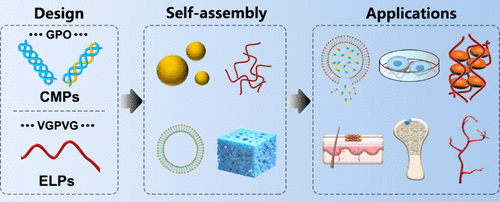
The extracellular matrix (ECM) is a critical three-dimensional scaffold that maintains the structural integrity and physiological function of tissues and organs. While native ECM structural proteins like collagen and elastin have been widely studied for their ECM-mimetic properties, their clinical translation faces challenges such as pathogen transmission, immunogenicity, and batch variability. Self-assembling peptides, particularly collagen-mimetic peptides (CMPs) and elastin-like peptides (ELPs), offer a promising alternative due to their reproducibility, low immunogenicity, and tunable properties. Recent advances in peptide design have enabled precise mimicry of the ECM’s composition, hierarchical structure, nanoscale morphology, and biological function. These peptides can controllably self-assemble into nanofibers, hydrogels, and 3D scaffolds that recapitulate key aspects of the native ECM microenvironment, broadening their utility in biomedical applications. This review summarizes progress in the design and application of ECM-mimetic peptides, focusing on their roles in tissue engineering, regenerative medicine, and drug delivery. We also discuss emerging challenges and future directions to advance the field toward clinical implementation.
Cited By
This article has not yet been cited by other publications.

Article Views
Altmetric
Citations
Article Views are the COUNTER-compliant sum of full text article downloads since November 2008 (both PDF and HTML) across all institutions and individuals. These metrics are regularly updated to reflect usage leading up to the last few days.
Citations are the number of other articles citing this article, calculated by Crossref and updated daily. Find more information about Crossref citation counts.
The Altmetric Attention Score is a quantitative measure of the attention that a research article has received online. Clicking on the donut icon will load a page at altmetric.com with additional details about the score and the social media presence for the given article. Find more information on the Altmetric Attention Score and how the score is calculated.