


Seeing the Invisible-Understanding Thermoelectric Materials through Scanning Transmission Electron MicroscopyClick to copy article linkArticle link copied!
- Yukun LiuYukun LiuDepartment of Materials Science and Engineering, Northwestern University, Evanston, Illinois 60208, United StatesInternational Institute of Nanotechnology (IIN), Northwestern University, Evanston, Illinois 60208, United StatesMore by Yukun Liu
- Patricia E. MezaPatricia E. MezaDepartment of Materials Science and Engineering, Northwestern University, Evanston, Illinois 60208, United StatesInternational Institute of Nanotechnology (IIN), Northwestern University, Evanston, Illinois 60208, United StatesMore by Patricia E. Meza
- Zhi LiZhi LiDepartment of Materials Science and Engineering, Northwestern University, Evanston, Illinois 60208, United StatesMore by Zhi Li
- Xiaobing HuXiaobing HuDepartment of Materials Science and Engineering, Northwestern University, Evanston, Illinois 60208, United StatesMore by Xiaobing Hu
- Roberto dos ReisRoberto dos ReisDepartment of Materials Science and Engineering, Northwestern University, Evanston, Illinois 60208, United StatesInternational Institute of Nanotechnology (IIN), Northwestern University, Evanston, Illinois 60208, United StatesMore by Roberto dos Reis
- Christopher WolvertonChristopher WolvertonDepartment of Materials Science and Engineering, Northwestern University, Evanston, Illinois 60208, United StatesInternational Institute of Nanotechnology (IIN), Northwestern University, Evanston, Illinois 60208, United StatesMore by Christopher Wolverton
- Vinayak Dravid*Vinayak Dravid*Email: [email protected]Department of Materials Science and Engineering, Northwestern University, Evanston, Illinois 60208, United StatesInternational Institute of Nanotechnology (IIN), Northwestern University, Evanston, Illinois 60208, United StatesDepartment of Chemistry, Northwestern University, Evanston, Illinois 60208, United StatesMore by Vinayak Dravid

Abstract
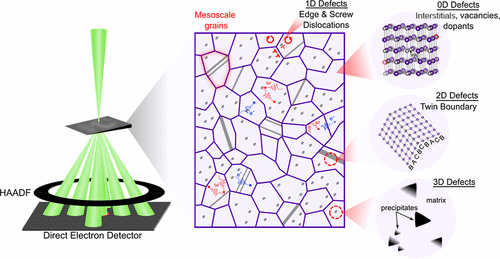
Understanding the intricate relationship between the structure and transport properties is central to advancing thermoelectric materials. Scanning transmission electron microscopy (STEM) provides multiscale and multimodal characterization that enables direct correlation among the atomic structure, chemical composition, and functional behavior. Through its ability to probe defects, interfaces, and compositional complexity across multiple length scales, STEM has become an essential platform for revealing how local structural features influence charge and heat transport. This review summarizes recent progress in advanced STEM methodologies for thermoelectric research. Aberration-corrected STEM allows for direct imaging of atomic configurations and defect structures with high spatial precision. Four-dimensional STEM extends this capability to quantitative mapping of orientation, phase, and strain distributions, while differential phase contrast imaging provides access to potential variations and local electrostatic fields. Emerging techniques such as electron ptychography, atomic-resolution energy dispersive spectroscopy, vibrational electron energy loss spectroscopy, and data-driven analysis are also discussed for their potential to enhance spatial resolution and extract new physical insights. Collectively, these developments establish STEM as a powerful framework for understanding structure–property relationships and guiding the design of next-generation thermoelectric materials.
Cited By
This article has not yet been cited by other publications.
Article Views
Altmetric
Citations
Article Views are the COUNTER-compliant sum of full text article downloads since November 2008 (both PDF and HTML) across all institutions and individuals. These metrics are regularly updated to reflect usage leading up to the last few days.
Citations are the number of other articles citing this article, calculated by Crossref and updated daily. Find more information about Crossref citation counts.
The Altmetric Attention Score is a quantitative measure of the attention that a research article has received online. Clicking on the donut icon will load a page at altmetric.com with additional details about the score and the social media presence for the given article. Find more information on the Altmetric Attention Score and how the score is calculated.