


Bifunctional Electrocatalysts with High-Entropy Alloys: Bridging Hydrogen Evolution and Oxygen ReductionClick to copy article linkArticle link copied!
- Jialu LiJialu LiProgram of Materials Science and Engineering, University of California San Diego, La Jolla, California 92093, United StatesMore by Jialu Li
- Jianzhuo WuJianzhuo WuAiiso Yufeng Li Family Department of Chemical and Nano Engineering, University of California San Diego, La Jolla, California 92093, United StatesMore by Jianzhuo Wu
- Abdulrahman AllangawiAbdulrahman AllangawiCenter for Renewable Energy and Storage Technologies (CREST), Physical Science and Engineering Division, King Abdullah University of Science and Technology (KAUST), Thuwal 23955-6900, Saudi ArabiaMore by Abdulrahman Allangawi
- Yu LiYu LiAiiso Yufeng Li Family Department of Chemical and Nano Engineering, University of California San Diego, La Jolla, California 92093, United StatesMore by Yu Li
- Honglin LiHonglin LiAiiso Yufeng Li Family Department of Chemical and Nano Engineering, University of California San Diego, La Jolla, California 92093, United StatesMore by Honglin Li
- Yongfeng GuoYongfeng GuoAiiso Yufeng Li Family Department of Chemical and Nano Engineering, University of California San Diego, La Jolla, California 92093, United StatesMore by Yongfeng Guo
- Huabin Zhang*Huabin Zhang*Email: [email protected]Center for Renewable Energy and Storage Technologies (CREST), Physical Science and Engineering Division, King Abdullah University of Science and Technology (KAUST), Thuwal 23955-6900, Saudi ArabiaMore by Huabin Zhang
- Wan-Lu Li*Wan-Lu Li*Email: [email protected]Program of Materials Science and Engineering, University of California San Diego, La Jolla, California 92093, United StatesAiiso Yufeng Li Family Department of Chemical and Nano Engineering, University of California San Diego, La Jolla, California 92093, United StatesMore by Wan-Lu Li

Abstract
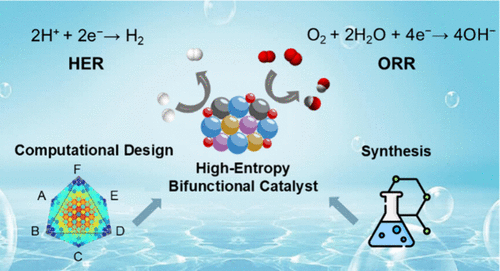
High-entropy alloys (HEAs) have emerged as a promising class of bifunctional electrocatalysts capable of simultaneously driving the hydrogen evolution reaction (HER) and the oxygen reduction reaction (ORR) with high activity and durability. Their near-equiatomic multicomponent compositions give rise to unique physicochemical characteristics, including lattice distortion, sluggish diffusion, high-entropy stabilization, and pronounced electronic heterogeneity, that collectively generate diverse and synergistic active sites inaccessible in conventional alloys. This review summarizes recent progress in HEA-based bifunctional electrocatalysis, with a focus on the fundamental mechanisms governing HER and ORR activity, stability, and selectivity. We discuss advances in synthesis strategies, ranging from confined growth and step-alloying to scalable continuous-flow methods, that enable precise control over composition, size, and surface structure. Complementary computational and data-driven approaches, including density functional theory, machine-learning-assisted screening, and descriptor development, are highlighted as essential tools for navigating the vast HEA design space and establishing structure–property relationships. Particular attention is paid to adsorption-energy distributions, multisite cooperativity, and environmental effects under realistic electrochemical conditions. Finally, we outline current challenges and future opportunities for integrating mechanistic understanding with AI-guided, closed-loop design frameworks to accelerate the discovery of next-generation HEA bifunctional electrocatalysts for sustainable energy conversion.
Cited By
This article has not yet been cited by other publications.
Article Views
Altmetric
Citations
Article Views are the COUNTER-compliant sum of full text article downloads since November 2008 (both PDF and HTML) across all institutions and individuals. These metrics are regularly updated to reflect usage leading up to the last few days.
Citations are the number of other articles citing this article, calculated by Crossref and updated daily. Find more information about Crossref citation counts.
The Altmetric Attention Score is a quantitative measure of the attention that a research article has received online. Clicking on the donut icon will load a page at altmetric.com with additional details about the score and the social media presence for the given article. Find more information on the Altmetric Attention Score and how the score is calculated.