


Emission Characteristics and Suppression Measures of Dust from Open-Pit Coal Mine: A ReviewClick to copy article linkArticle link copied!
- Liu LinLiu LinKey Laboratory of Environmental Pollution Control and Remediation at Universities of Inner Mongolia Autonomous Region, College of Resources and Environmental Engineering, Inner Mongolia University of Technology, Hohhot 010051, ChinaMore by Liu Lin
- Yaoqiang Huo*Yaoqiang Huo*Email: [email protected]Key Laboratory of Environmental Pollution Control and Remediation at Universities of Inner Mongolia Autonomous Region, College of Resources and Environmental Engineering, Inner Mongolia University of Technology, Hohhot 010051, ChinaMore by Yaoqiang Huo
- Lingling TianLingling TianOrdos Ecological Environment Monitoring and Control Center, Ordos 017000, ChinaMore by Lingling Tian
- Yongjiang Liu
- Yanan Song
- Uudam HuUudam HuKey Laboratory of Environmental Pollution Control and Remediation at Universities of Inner Mongolia Autonomous Region, College of Resources and Environmental Engineering, Inner Mongolia University of Technology, Hohhot 010051, ChinaMore by Uudam Hu
- Mingqi LiuMingqi LiuKey Laboratory of Environmental Pollution Control and Remediation at Universities of Inner Mongolia Autonomous Region, College of Resources and Environmental Engineering, Inner Mongolia University of Technology, Hohhot 010051, ChinaMore by Mingqi Liu
- Guoqing YangGuoqing YangKey Laboratory of Environmental Pollution Control and Remediation at Universities of Inner Mongolia Autonomous Region, College of Resources and Environmental Engineering, Inner Mongolia University of Technology, Hohhot 010051, ChinaMore by Guoqing Yang
- Yue GaoYue GaoKey Laboratory of Environmental Pollution Control and Remediation at Universities of Inner Mongolia Autonomous Region, College of Resources and Environmental Engineering, Inner Mongolia University of Technology, Hohhot 010051, ChinaMore by Yue Gao
- Wei LiuWei LiuKey Laboratory of Environmental Pollution Control and Remediation at Universities of Inner Mongolia Autonomous Region, College of Resources and Environmental Engineering, Inner Mongolia University of Technology, Hohhot 010051, ChinaMore by Wei Liu
- Yingnan CaoYingnan CaoKey Laboratory of Environmental Pollution Control and Remediation at Universities of Inner Mongolia Autonomous Region, College of Resources and Environmental Engineering, Inner Mongolia University of Technology, Hohhot 010051, ChinaMore by Yingnan Cao
- Ying ZhuYing ZhuKey Laboratory of Environmental Pollution Control and Remediation at Universities of Inner Mongolia Autonomous Region, College of Resources and Environmental Engineering, Inner Mongolia University of Technology, Hohhot 010051, ChinaMore by Ying Zhu
- Jianguo LiuJianguo LiuKey Laboratory of Environmental Pollution Control and Remediation at Universities of Inner Mongolia Autonomous Region, College of Resources and Environmental Engineering, Inner Mongolia University of Technology, Hohhot 010051, ChinaMore by Jianguo Liu

Abstract
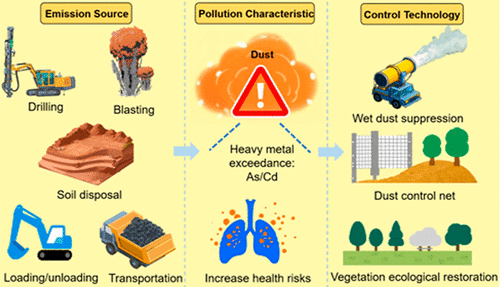
Open-pit coal mine (OPCM) generates substantial dust pollution, impairing local air quality and posing health risks to surrounding populations. Dust emissions in OPCM primarily originate from drilling, blasting, loading/unloading, transportation, and soil disposal operations. Dust from transportation constitutes the largest source, contributing to more than 70% of the total dust emissions. The heavy metals such as arsenic and cadmium in OPCM dust exceed the environmental standards and safety threshold. Drilling operations commonly employ combined dry-wet dust suppression techniques, integrating water injection and filtration systems to enhance dust control efficiency. Blasting operations utilize water-seal blasting and mist sprinklers for dust management, while wet methods such as high-pressure spraying and tire cleaning widely applied in mining, loading, and transportation processes. At the OPCM soil discharge dump, vegetation planting, ecological restoration, and dust suppression nets effectively reduce dust emissions. Dust suppressants generally categorized into wetting-, binding-, agglomeration-, composite-, and polymer-type suppressants based on their working mechanisms, with wetting agents being the most commonly employed in practice. These suppressants primarily function through droplet-particle collisional bonding, surface tension enhancement, particle wettability improvement, particle agglomeration and settlement. This review constructs a comprehensive dust pollution emission and control technology framework for OPCM, providing support to effectively manage mining dust pollution and improve the surrounding environment quality.
Cited By
This article has not yet been cited by other publications.

Article Views
Altmetric
Citations
Article Views are the COUNTER-compliant sum of full text article downloads since November 2008 (both PDF and HTML) across all institutions and individuals. These metrics are regularly updated to reflect usage leading up to the last few days.
Citations are the number of other articles citing this article, calculated by Crossref and updated daily. Find more information about Crossref citation counts.
The Altmetric Attention Score is a quantitative measure of the attention that a research article has received online. Clicking on the donut icon will load a page at altmetric.com with additional details about the score and the social media presence for the given article. Find more information on the Altmetric Attention Score and how the score is calculated.