


[Ru(bpy)3]2+: The Ongoing Story of a Photochemical IconClick to copy article linkArticle link copied!
- Céline BourgoisCéline BourgoisInstitute of Condensed Matter and Nanosciences (IMCN), Molecular Chemistry, Materials and Catalysis (MOST), UCLouvain, Place Louis Pasteur 1/L4.01.02, 1348 Louvain-la-Neuve, BelgiumMore by Céline Bourgois
- Ludovic Troian-Gautier*Ludovic Troian-Gautier*Email: [email protected]Institute of Condensed Matter and Nanosciences (IMCN), Molecular Chemistry, Materials and Catalysis (MOST), UCLouvain, Place Louis Pasteur 1/L4.01.02, 1348 Louvain-la-Neuve, BelgiumWel Research Institute, Avenue Pasteur 6, 1300 Wavre, BelgiumMore by Ludovic Troian-Gautier
- Winald R. Kitzmann*Winald R. Kitzmann*Email: [email protected]Chemistry Department, Massachusetts Institute of Technology, 32 Vassar St, Cambridge, Massachusetts 02139, United StatesMore by Winald R. Kitzmann

Abstract
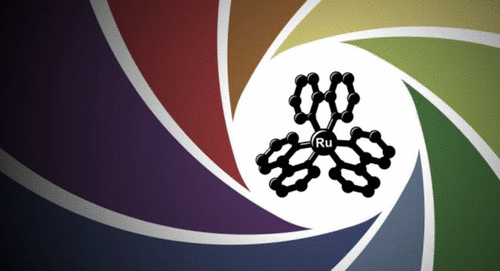
[Ru(bpy)3]2+ has long served as the archetypal coordination complex for probing inorganic photophysics and photochemistry. Its intense visible MLCT absorption, quantitative intersystem crossing, and microsecond 3MLCT lifetime established it as a benchmark photosensitizer across energy conversion, sensing, and catalysis. This review complements a recent historical perspective on [Ru(bpy)3]2+ by providing a contemporary view of its use as a versatile platform for advanced photochemical design. We first discuss updated views of its excited-state landscape, including refined descriptions of metal-centered states, minimum-energy crossing points, and photodissociation pathways, as well as the profound influence of counterions and microenvironments on excited-state energetics, stability, and reactivity. We then survey emerging applications, multiphoton solvated electron generation, mechanochemical ball-mill photoredox catalysis, and spin-forbidden red-light excitation. Next, we examine polynuclear complexes and dyads derived from the [Ru(bpy)3]2+ scaffold, emphasizing delocalized and antidissipative 3MLCT states, long-lived charge separation, and integration into biohybrid or supramolecular architectures. Finally, we outline “real-life” applications in industrial photoredox chemistry, electrochemiluminescence immunoassays, oxygen sensing, and photodynamic therapy, and we position [Ru(bpy)3]2+ alongside emerging photosensitizers based on earth-abundant metals. Rather than being superseded, [Ru(bpy)3]2+ now functions as both a robust technological workhorse and an indispensable reference for next-generation photocatalyst design.
Cited By
This article has not yet been cited by other publications.

Article Views
Altmetric
Citations
Article Views are the COUNTER-compliant sum of full text article downloads since November 2008 (both PDF and HTML) across all institutions and individuals. These metrics are regularly updated to reflect usage leading up to the last few days.
Citations are the number of other articles citing this article, calculated by Crossref and updated daily. Find more information about Crossref citation counts.
The Altmetric Attention Score is a quantitative measure of the attention that a research article has received online. Clicking on the donut icon will load a page at altmetric.com with additional details about the score and the social media presence for the given article. Find more information on the Altmetric Attention Score and how the score is calculated.