


Modification of Manganese Dioxide to Achieve Activity–Stability Trade-Off for Acidic Oxygen Evolution Reaction: A Critical ReviewClick to copy article linkArticle link copied!
- Changrui Feng*Changrui Feng*Email: [email protected]Hubei Key Laboratory of Pollutant Analysis & Reuse Technology, College of Chemistry and Chemical Engineering, Hubei Normal University, No. 11, Cihu Road, Huangshi, Hubei 435002, ChinaMore by Changrui Feng
- Yifan Zhou*Yifan Zhou*Email: [email protected]Graduate School of Science and Technology, Hirosaki University, 3-Bunkyocho, Hirosaki 036-8561, JapanMore by Yifan Zhou
- Huaguo WenHuaguo WenHubei Key Laboratory of Pollutant Analysis & Reuse Technology, College of Chemistry and Chemical Engineering, Hubei Normal University, No. 11, Cihu Road, Huangshi, Hubei 435002, ChinaMore by Huaguo Wen
- Yuxia JinYuxia JinGraduate School of Science and Technology, Hirosaki University, 3-Bunkyocho, Hirosaki 036-8561, JapanMore by Yuxia Jin
- Ziyuan YangZiyuan YangHubei Key Laboratory of Pollutant Analysis & Reuse Technology, College of Chemistry and Chemical Engineering, Hubei Normal University, No. 11, Cihu Road, Huangshi, Hubei 435002, ChinaMore by Ziyuan Yang
- Xiangyu ChenXiangyu ChenLongdu Laboratory for New Chemical Materials, Henan Province, Puyang 457000, ChinaMore by Xiangyu Chen
- Peng Zheng*Peng Zheng*Email: [email protected]Key Laboratory on Resources Chemicals and Materials of Ministry of Education, Shenyang University of Chemical Technology, Shenyang 110142, ChinaMore by Peng Zheng
- Zhengkun Xie*Zhengkun Xie*Email: [email protected]College of Chemistry, Zhengzhou University, Kexue Avenue 100, Zhengzhou, Henan 450001, ChinaMore by Zhengkun Xie

Abstract
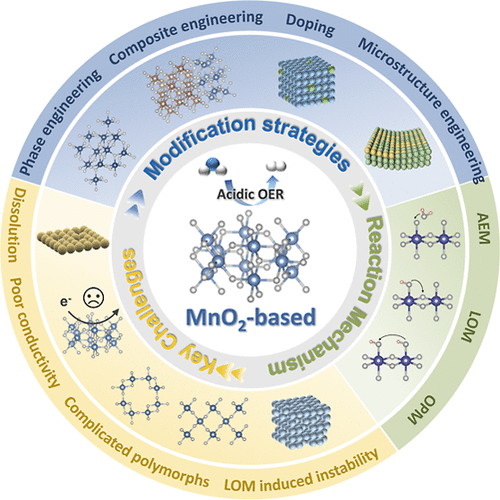
The acidic oxygen evolution reaction (OER) is a critical process in proton exchange membrane water electrolysis (PEMWE) for green hydrogen production. However, the harsh acidic and oxidative condition poses significant challenges to the achievement of activity–stability trade-off for electrocatalysts. While noble metal oxides (IrO2, RuO2) are always the benchmark materials, the high cost and scarcity hinder their widespread application. Manganese dioxide (MnO2) has emerged as a promising non-noble candidate due to its exceptional corrosion resistance, cost-effectiveness, and unique self-healing capability. Nevertheless, its practical utility is limited by modest intrinsic activity and dissolution at low pH values or high potentials. This review comprehensively summarizes the recent advances in modification strategies to enhance the OER performance of MnO2-based catalysts in acidic media. The OER mechanisms in acid are first delineated with a specific focus on the distinct catalytic pathway of MnO2. Subsequently, various engineering approaches, including phase engineering, composite engineering (with noble/non-noble metals), atomic array construction, and heteroatom doping, are systematically elaborated. These strategies are discussed in terms of how they optimize the electronic structure, enhance conductivity, stabilize the MnO2 lattice, and reinforce metal–support interactions to boost both activity and durability. Finally, a perspective on the remaining challenges and future research directions is provided, emphasizing the need for mechanistic insights, standardized evaluation protocols, and the transition toward practical PEMWE device integration.
Cited By
This article has not yet been cited by other publications.

Article Views
Altmetric
Citations
Article Views are the COUNTER-compliant sum of full text article downloads since November 2008 (both PDF and HTML) across all institutions and individuals. These metrics are regularly updated to reflect usage leading up to the last few days.
Citations are the number of other articles citing this article, calculated by Crossref and updated daily. Find more information about Crossref citation counts.
The Altmetric Attention Score is a quantitative measure of the attention that a research article has received online. Clicking on the donut icon will load a page at altmetric.com with additional details about the score and the social media presence for the given article. Find more information on the Altmetric Attention Score and how the score is calculated.