


Evolution of Particle Radiotherapy: From Physical to Dual Targeting in Precision MedicineClick to copy article linkArticle link copied!
- Heying YaoHeying YaoXiangya School of Pharmaceutical Sciences, Central South University, Changsha 410013, PR ChinaHunan Key Laboratory of Diagnostic and Therapeutic Drug Research for Chronic Diseases, Central South University, Changsha 410013, PR ChinaMore by Heying Yao
- Fan ZhengFan ZhengXiangya School of Pharmaceutical Sciences, Central South University, Changsha 410013, PR ChinaHunan Key Laboratory of Diagnostic and Therapeutic Drug Research for Chronic Diseases, Central South University, Changsha 410013, PR ChinaMore by Fan Zheng
- Yan ZhongYan ZhongZhejiang Cancer Hospital, The Affiliated Hospital of Zhejiang University School of Medicine, Hangzhou, Zhejiang 310000, ChinaMore by Yan Zhong
- Huanfeng TianHuanfeng TianXiangya School of Pharmaceutical Sciences, Central South University, Changsha 410013, PR ChinaHunan Key Laboratory of Diagnostic and Therapeutic Drug Research for Chronic Diseases, Central South University, Changsha 410013, PR ChinaMore by Huanfeng Tian
- Zhiyan LiZhiyan LiXiangya School of Pharmaceutical Sciences, Central South University, Changsha 410013, PR ChinaHunan Key Laboratory of Diagnostic and Therapeutic Drug Research for Chronic Diseases, Central South University, Changsha 410013, PR ChinaMore by Zhiyan Li
- Hua ZhuHua ZhuDepartment of Nuclear Medicine, State Key Laboratory of Holistic Integrative Management of Gastrointestinal Cancers, Beijing Key Laboratory of Carcinogenesis and Translational Research, Peking University Cancer Hospital & Institute, Beijing 100142, ChinaMore by Hua Zhu
- Zhi YangZhi YangDepartment of Nuclear Medicine, State Key Laboratory of Holistic Integrative Management of Gastrointestinal Cancers, Beijing Key Laboratory of Carcinogenesis and Translational Research, Peking University Cancer Hospital & Institute, Beijing 100142, ChinaMore by Zhi Yang
- Hong ZhangHong ZhangZhejiang Cancer Hospital, The Affiliated Hospital of Zhejiang University School of Medicine, Hangzhou, Zhejiang 310000, ChinaMore by Hong Zhang
- Mei TianMei TianHuashan Hospital & Human Phenome Institute, Fudan University, 825 Zhangheng Road, Shanghai 201203, ChinaMore by Mei Tian
- Wenbin Zeng*Wenbin Zeng*E-mail: [email protected]Xiangya School of Pharmaceutical Sciences, Central South University, Changsha 410013, PR ChinaHunan Key Laboratory of Diagnostic and Therapeutic Drug Research for Chronic Diseases, Central South University, Changsha 410013, PR ChinaMore by Wenbin Zeng

Abstract
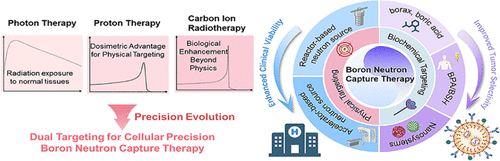
As cancer remains a formidable global health challenge, radiotherapy is evolving toward unprecedented levels of precision. Particle radiotherapy (PRT), utilizing charged particles such as protons and carbon ions, has emerged as a superior alternative to conventional photon-based approaches. While proton therapy (PT) achieves superior physical targeting via the Bragg peak and carbon ion radiotherapy (CIRT) adds biological potency through high linear energy transfer (LET), both modalities are fundamentally constrained by their primary reliance on spatial/macroscopic dose distribution. Against this backdrop, boron neutron capture therapy (BNCT) stands out as an innovative dual-targeting strategy in precision oncology. BNCT combines biochemical selectivity (achieved via tumor-specific boron-10 agents) with cellular-scale physical precision (realized by neutron-irradiation-triggered, locally confined high LET particles). This review delineates the latest progress in particle radiotherapy, specifically highlighting the crucial transition from the established physical targeting of PT and CIRT to the burgeoning dual-targeting innovation of BNCT. We provide an in-depth analysis of mechanistic principles, technological advancements in accelerator-based sources, the pharmacological evolution of boron delivery systems, and the resulting clinical applications. Future directions for the entire particle radiotherapy field center on reducing operational costs, optimizing therapeutic accuracy, conducting robust randomized trials, and exploring synergistic therapies. Critically, BNCT, with its unique dual-targeting mechanism, represents a potentially transformative precision therapy with significant potential for intractable malignancies.
Cited By
This article has not yet been cited by other publications.

Article Views
Altmetric
Citations
Article Views are the COUNTER-compliant sum of full text article downloads since November 2008 (both PDF and HTML) across all institutions and individuals. These metrics are regularly updated to reflect usage leading up to the last few days.
Citations are the number of other articles citing this article, calculated by Crossref and updated daily. Find more information about Crossref citation counts.
The Altmetric Attention Score is a quantitative measure of the attention that a research article has received online. Clicking on the donut icon will load a page at altmetric.com with additional details about the score and the social media presence for the given article. Find more information on the Altmetric Attention Score and how the score is calculated.