


Lithium-Ion Sieves for Selective Lithium Adsorption: A Review of Modifications, Shaping Strategies, and MechanismsClick to copy article linkArticle link copied!
- Shuaike GeShuaike GeCollege of Food Science and Light Industry, Nanjing Tech University, Nanjing 211816, ChinaMore by Shuaike Ge
- Cuie Wang*Cuie Wang*Email: [email protected]College of Food Science and Light Industry, Nanjing Tech University, Nanjing 211816, ChinaMore by Cuie Wang
- Tan LiuTan LiuCollege of Food Science and Light Industry, Nanjing Tech University, Nanjing 211816, ChinaMore by Tan Liu
- Aigang Zhen
- Kaiming Liao*Kaiming Liao*Email: [email protected]College of Chemical Engineering, Nanjing Tech University, Nanjing 211816, ChinaMore by Kaiming Liao

Abstract
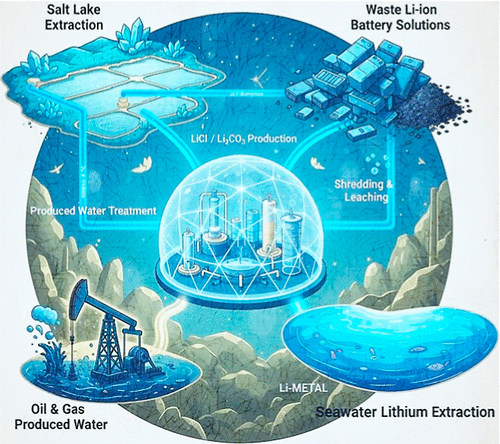
With the demand for lithium escalating in the energy storage and electric vehicle sectors, the extraction of lithium from unconventional and secondary sources has become an area of intensified focus. Lithium-ion sieves (LISs) have emerged as a highly promising technology, offering exceptional selectivity and high adsorption capacity. This review provides a systematic analysis of LIS technology, examining the fundamental structures and intercalation mechanisms of manganese-based, titanium-based, and electrochemical systems. Advanced modification strategies, such as elemental doping, surface coating, and hydrophilic modification, are critically examined for their role in enhancing performance and addressing inherent limitations. Furthermore, essential shaping technologies including granulation, gelation, membrane fabrication, and electrode integration are detailed as crucial steps for transitioning LIS from powders to practical, industrially viable forms with improved stability and recyclability. Finally, the review identifies persistent challenges and outlines future research priorities, underscoring the need for synergistic development of advanced materials and processes to secure a sustainable lithium supply.
Cited By
This article has not yet been cited by other publications.

Article Views
Altmetric
Citations
Article Views are the COUNTER-compliant sum of full text article downloads since November 2008 (both PDF and HTML) across all institutions and individuals. These metrics are regularly updated to reflect usage leading up to the last few days.
Citations are the number of other articles citing this article, calculated by Crossref and updated daily. Find more information about Crossref citation counts.
The Altmetric Attention Score is a quantitative measure of the attention that a research article has received online. Clicking on the donut icon will load a page at altmetric.com with additional details about the score and the social media presence for the given article. Find more information on the Altmetric Attention Score and how the score is calculated.