


Bone Tissue Engineering Strategies To Treat Critically Sized Defects in Compromised Wound Healing EnvironmentsClick to copy article linkArticle link copied!
- Sara E. MunkwitzSara E. MunkwitzUniversity of Miami Miller School of Medicine, Miami, Florida 33136, United StatesMore by Sara E. Munkwitz
- Hana ShahHana ShahUniversity of Miami Miller School of Medicine, Miami, Florida 33136, United StatesFlorida International University Herbert Wertheim College of Medicine, Miami, Florida 33199, United StatesMore by Hana Shah
- Nicholas J. IglesiasNicholas J. IglesiasDeWitt Daughtry Family Department of Surgery, University of Miami Miller School of Medicine, Miami, Florida 33136, United StatesMore by Nicholas J. Iglesias
- Michelle CamachoMichelle CamachoDepartment of Biochemistry and Molecular Biology, University of Miami Miller School of Medicine, Miami, Florida 33136, United StatesMore by Michelle Camacho
- Taylor FixTaylor FixDepartment of Biochemistry and Molecular Biology, University of Miami Miller School of Medicine, Miami, Florida 33136, United StatesMore by Taylor Fix
- Cesar PavonCesar PavonDepartment of Biochemistry and Molecular Biology, University of Miami Miller School of Medicine, Miami, Florida 33136, United StatesMore by Cesar Pavon
- Vasudev Vivekanand Nayak*Vasudev Vivekanand Nayak*Email: [email protected]Department of Biochemistry and Molecular Biology, University of Miami Miller School of Medicine, Miami, Florida 33136, United StatesDr. John T. Macdonald Foundation Biomedical Nanotechnology Institute (BioNIUM), University of Miami, Miami, Florida 33136, United StatesMore by Vasudev Vivekanand Nayak
- Lukasz WitekLukasz WitekBiomaterials and Regenerative Biology Division, NYU College of Dentistry, New York, New York 10010, United StatesDepartment of Biomedical Engineering, NYU Tandon School of Engineering, Brooklyn, New York 11201, United StatesHansjörg Wyss Department of Plastic Surgery, NYU Grossman School of Medicine, New York, New York 10016, United StatesDepartment of Oral and Maxillofacial Surgery, NYU College of Dentistry, New York, New York 10010, United StatesMore by Lukasz Witek
- Paulo G. CoelhoPaulo G. CoelhoDepartment of Biochemistry and Molecular Biology, University of Miami Miller School of Medicine, Miami, Florida 33136, United StatesDr. John T. Macdonald Foundation Biomedical Nanotechnology Institute (BioNIUM), University of Miami, Miami, Florida 33136, United StatesDeWitt Daughtry Family Department of Surgery, Division of Plastic Surgery, University of Miami Miller School of Medicine, Miami, Florida 33136, United StatesSylvester Comprehensive Cancer Center, University of Miami Miller School of Medicine, Miami, Florida 33136, United StatesMore by Paulo G. Coelho

Abstract
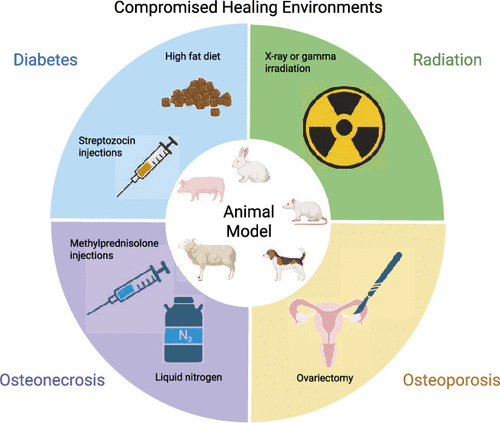
Critically sized bone defects are difficult to treat, necessitating tissue engineering strategies to restore form and function. However, translation of these approaches is often constrained by preclinical models that fail to replicate systemic comorbidities commonly seen in clinical practice, such as diabetes, prior irradiation, osteonecrosis, and osteoporosis, and instead favor healthy wound environments that may overestimate efficacy. This comprehensive review aimed to provide a detailed overview of in vivo bone regeneration strategies for critically sized defects specifically within compromised healing environments, summarizing how animal models are developed and how biomaterial, cellular, and drug delivery platforms are tailored to these disease states. Recent work has sought to address key pathological barriers including chronic inflammation, oxidative stress, poor vascularization, hypocellularity, and the limited efficacy of cell-seeding approaches through a range of bioengineered solutions. Strategies include nanoengineered drug delivery systems, bioactive ion-releasing scaffolds, immunomodulatory and antioxidant biomaterials, advanced cell provisioning, and extracellular vesicle-based therapies designed to restore redox balance, promote angiogenesis, and reestablish osteogenesis. Remaining challenges include heterogeneity and poor standardization of defect models, underrepresentation of multimorbidity and treatment-related injury, ethical and logistical barriers to large animal studies, and uncertainty in how best to bridge emerging platforms with regulatory expectations. Future directions will require coordinated refinement of disease-relevant models and development of multifunctional, context-responsive constructs to more reliably predict and improve clinical translation of bone tissue engineering therapies.
Cited By
This article has not yet been cited by other publications.

Article Views
Altmetric
Citations
Article Views are the COUNTER-compliant sum of full text article downloads since November 2008 (both PDF and HTML) across all institutions and individuals. These metrics are regularly updated to reflect usage leading up to the last few days.
Citations are the number of other articles citing this article, calculated by Crossref and updated daily. Find more information about Crossref citation counts.
The Altmetric Attention Score is a quantitative measure of the attention that a research article has received online. Clicking on the donut icon will load a page at altmetric.com with additional details about the score and the social media presence for the given article. Find more information on the Altmetric Attention Score and how the score is calculated.