


Engineering Magnetization with Photons: Nanoscale Advances in the Inverse Faraday Effect for Metallic and Plasmonic ArchitecturesClick to copy article linkArticle link copied!
- Chantal HareauChantal HareauSorbonne Université, CNRS, Institut des NanoSciences de Paris, INSP, Paris F-75005, FranceMore by Chantal Hareau
- Xingyu YangXingyu YangSorbonne Université, CNRS, Institut des NanoSciences de Paris, INSP, Paris F-75005, FranceMore by Xingyu Yang
- Maria Sanz-PazMaria Sanz-PazSorbonne Université, CNRS, Institut des NanoSciences de Paris, INSP, Paris F-75005, FranceMore by Maria Sanz-Paz
- Matthew SheldonMatthew SheldonDepartment of Chemistry, University of California, Irvine, California 92697, United StatesDepartment of Materials Science and Engineering, University of California, Irvine, California 92697, United StatesMore by Matthew Sheldon
- Mathieu Mivelle*Mathieu Mivelle*Email: [email protected]Sorbonne Université, CNRS, Institut des NanoSciences de Paris, INSP, Paris F-75005, FranceMore by Mathieu Mivelle

Abstract
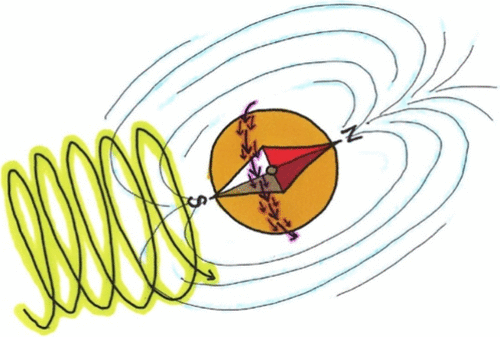
The inverse Faraday effect, the ability of light to act as a source of magnetism, is a cornerstone of modern ultrafast optics. Harnessing this effect at the nanoscale promises to transform data storage and spintronics, yet its predictive understanding remains elusive. This review synthesizes recent progress in engineering the IFE within plasmonic architectures. We bridge the theoretical foundations, from classical drift-current models to quantum descriptions, with the latest experimental milestones, including pump–probe studies that have verified the effect’s subpicosecond nature. Special emphasis is placed on how nanostructure design allows for unprecedented control, enabling functionalities like chiral or reversed magnetization by locally sculpting the optical spin density. Despite this progress, a crucial challenge pervades the field: a stark, often orders-of-magnitude, mismatch between predicted and measured magnetization values. We contend that resolving this discrepancy is paramount. The path forward requires the development of novel experimental probes capable of directly imaging these fleeting magnetic fields at their native length and time scales, ultimately unlocking the true potential of nanoscale optical magnetism.
Cited By
This article has not yet been cited by other publications.

Article Views
Altmetric
Citations
Article Views are the COUNTER-compliant sum of full text article downloads since November 2008 (both PDF and HTML) across all institutions and individuals. These metrics are regularly updated to reflect usage leading up to the last few days.
Citations are the number of other articles citing this article, calculated by Crossref and updated daily. Find more information about Crossref citation counts.
The Altmetric Attention Score is a quantitative measure of the attention that a research article has received online. Clicking on the donut icon will load a page at altmetric.com with additional details about the score and the social media presence for the given article. Find more information on the Altmetric Attention Score and how the score is calculated.