


Design and Optimization of Epitaxial and Chip Structures in AlGaN-Based Deep-Ultraviolet LEDs: Toward Enhanced Efficiency and ReliabilityClick to copy article linkArticle link copied!
- Yifang ChenYifang ChenSchool of Materials Science and Engineering, Jiangsu University, Zhenjiang 212013, ChinaMore by Yifang Chen
- Quanjiang Lv*Quanjiang Lv*[email protected]School of Materials Science and Engineering, Jiangsu University, Zhenjiang 212013, ChinaMore by Quanjiang Lv
- Tianpeng YangTianpeng YangEpiTop Optoelectronic Co., Ltd, Ma’anshan 243000, ChinaMa’anshan Jason Semiconductor Co., Ltd, Ma’anshan 243000, ChinaMore by Tianpeng Yang
- Tingting Mi
- Xiaowen Wang
- Junlin Liu*Junlin Liu*[email protected]School of Materials Science and Engineering, Jiangsu University, Zhenjiang 212013, ChinaMore by Junlin Liu

Abstract
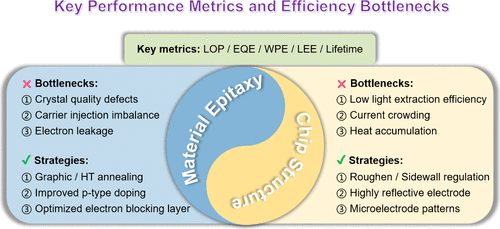
AlGaN-based deep-ultraviolet light-emitting diodes (DUV LEDs) demonstrate significant application potential and a broad market prospect in fields such as sterilization, disinfection, optical communication, sensing, agriculture, and food processing. These devices offer distinct advantages, including eco-friendliness, nontoxicity, low energy consumption, and tunable emission wavelengths. Over the past two decades, sustained research and development efforts have led to considerable improvements in luminous efficiency and device lifetime, advancing AlGaN-based DUV LEDs toward commercialization. Nevertheless, their overall performance still lags behind that of fully commercialized GaN-based blue LEDs, indicating ample room for further enhancement. This review begins with an overview of the current development status of AlGaN-based DUV LEDs and examines key methodologies for improving device performance. It then systematically summarizes recent research advances and optimization strategies, focusing on two critical areas: material epitaxial growth and chip structural design. Finally, it discusses current technical challenges and outlines future development opportunities in the field.
Cited By
This article has not yet been cited by other publications.

Article Views
Altmetric
Citations
Article Views are the COUNTER-compliant sum of full text article downloads since November 2008 (both PDF and HTML) across all institutions and individuals. These metrics are regularly updated to reflect usage leading up to the last few days.
Citations are the number of other articles citing this article, calculated by Crossref and updated daily. Find more information about Crossref citation counts.
The Altmetric Attention Score is a quantitative measure of the attention that a research article has received online. Clicking on the donut icon will load a page at altmetric.com with additional details about the score and the social media presence for the given article. Find more information on the Altmetric Attention Score and how the score is calculated.