


AI-Designed Peptides as Tools for BiochemistryClick to copy article linkArticle link copied!
- Lauren HongLauren HongDepartment of Bioengineering, University of Pennsylvania, Philadelphia, Pennsylvania 19104, United StatesMore by Lauren Hong
- Sophia VincoffSophia VincoffDepartment of Bioengineering, University of Pennsylvania, Philadelphia, Pennsylvania 19104, United StatesMore by Sophia Vincoff
- Pranam Chatterjee*Pranam Chatterjee*Email: [email protected]Department of Bioengineering, University of Pennsylvania, Philadelphia, Pennsylvania 19104, United StatesDepartment of Computer and Information Science, University of Pennsylvania, Philadelphia, Pennsylvania 19104, United StatesMore by Pranam Chatterjee

Abstract
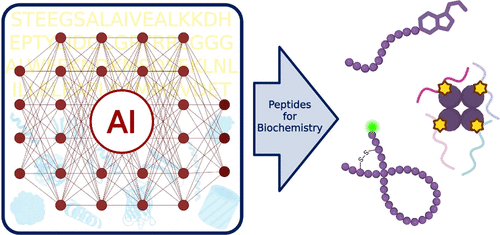
Peptides occupy a unique niche as biochemical tools: they are small, modular reagents capable of perturbing protein function with a precision that is often inaccessible to small molecules or antibodies. Historically, their broader use in biochemical research has been constrained by slow discovery workflows, limited control over specificity, and poor physicochemical properties. Recent advances in artificial intelligence have begun to change this landscape by enabling the rational, data-driven design of peptides tailored for specific experimental tasks. In this review, we focus on AI-designed peptides as practical tools for biochemistry. We survey sequence-based and structure-based design paradigms, highlighting how each supports distinct classes of peptide tools, including isoform- and motif-specific binders, multi-objective assay-ready reagents, and functional peptides that enable degradation, stabilization, or biophysical interrogation of proteins. By emphasizing experimental utility, design constraints, and appropriate use cases, we aim to provide a framework for selecting and deploying AI-designed peptides as on-demand reagents in modern biochemical research.
Cited By
This article has not yet been cited by other publications.

Article Views
Altmetric
Citations
Article Views are the COUNTER-compliant sum of full text article downloads since November 2008 (both PDF and HTML) across all institutions and individuals. These metrics are regularly updated to reflect usage leading up to the last few days.
Citations are the number of other articles citing this article, calculated by Crossref and updated daily. Find more information about Crossref citation counts.
The Altmetric Attention Score is a quantitative measure of the attention that a research article has received online. Clicking on the donut icon will load a page at altmetric.com with additional details about the score and the social media presence for the given article. Find more information on the Altmetric Attention Score and how the score is calculated.