


Persistent Luminescence Nanoparticle-Based BiosensorsClick to copy article linkArticle link copied!
- Yixuan ChenYixuan ChenDepartment of Materials Science and Engineering, University of Toronto, Toronto, Ontario M5S 3E4, CanadaMore by Yixuan Chen
- Jiaze WuJiaze WuDepartment of Materials Science and Engineering, University of Toronto, Toronto, Ontario M5S 3E4, CanadaMore by Jiaze Wu
- Jyotiparna BanikJyotiparna BanikDepartment of Materials Science and Engineering, University of Toronto, Toronto, Ontario M5S 3E4, CanadaMore by Jyotiparna Banik
- David GurovDavid GurovDepartment of Materials Science and Engineering, University of Toronto, Toronto, Ontario M5S 3E4, CanadaMore by David Gurov
- Yinuo WangYinuo WangDepartment of Materials Science and Engineering, University of Toronto, Toronto, Ontario M5S 3E4, CanadaMore by Yinuo Wang
- Rixin BaoRixin BaoDepartment of Materials Science and Engineering, University of Toronto, Toronto, Ontario M5S 3E4, CanadaMore by Rixin Bao
- Leyan WangLeyan WangDepartment of Materials Science and Engineering, University of Toronto, Toronto, Ontario M5S 3E4, CanadaMore by Leyan Wang
- Kai Huang*Kai Huang*E-mail: [email protected]Department of Materials Science and Engineering, University of Toronto, Toronto, Ontario M5S 3E4, CanadaDepartment of Cell and Systems Biology, University of Toronto, Toronto, Ontario M5S 3G5, CanadaMore by Kai Huang

Abstract
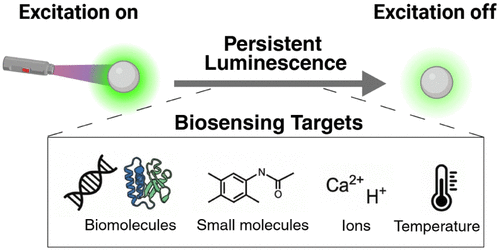
Persistent luminescence nanoparticles (PLNPs) are unique optical nanomaterials that emit a long-lasting afterglow in the absence of real-time excitation, enabling biosensing with near-zero background interference. This review summarizes recent advances in PLNP-based biosensing, highlighting how persistent luminescence improves analytical sensitivity, specificity, and operational simplicity in biological environments. We first outline foundational principles for constructing PLNP biosensors, including signal transduction via (1) analyte-regulated luminescence resonance energy transfer, (2) capture and enrichment of PLNPs for time-gated readout, and (3) ratiometric persistent luminescence. We then comprehensively discuss sensing strategies across major analyte classes, including biomolecules, small molecules, ions, and physiological parameters, such as local temperature. Finally, we examine current challenges in PLNP synthesis, surface engineering, multiplexing, and biosafety, and outline future directions toward next-generation persistent luminescence biosensors with enhanced brightness, programmability, and translational potential. Together, these developments position PLNPs as powerful and increasingly versatile platforms for high-performance biosensing and bioanalysis.
Cited By
This article has not yet been cited by other publications.

Article Views
Altmetric
Citations
Article Views are the COUNTER-compliant sum of full text article downloads since November 2008 (both PDF and HTML) across all institutions and individuals. These metrics are regularly updated to reflect usage leading up to the last few days.
Citations are the number of other articles citing this article, calculated by Crossref and updated daily. Find more information about Crossref citation counts.
The Altmetric Attention Score is a quantitative measure of the attention that a research article has received online. Clicking on the donut icon will load a page at altmetric.com with additional details about the score and the social media presence for the given article. Find more information on the Altmetric Attention Score and how the score is calculated.