


Molecular Simulation of Hydrate-Bearing Sediments: Comprehensive Review with Focus on Molecular Force FieldClick to copy article linkArticle link copied!
- Qiannan YuQiannan YuCollege of Energy and Power Engineering, Guangdong University of Petrochemical Technology, Maoming 525000, ChinaComputational Engineering Design Group, University of Southampton, Southampton SO17 1BF, U.K.More by Qiannan Yu
- Lei YeLei YeCollege of Energy and Power Engineering, Guangdong University of Petrochemical Technology, Maoming 525000, ChinaMore by Lei Ye
- Shuai Tan
- Huimin Tang*Huimin Tang*Email: [email protected]Hainan Branch CNOOC (China) Co., Ltd., Haikou 570311, ChinaMore by Huimin Tang
- Yang Yu*Yang Yu*Email: [email protected]College of Mechanical and Electrical Engineering, Guangdong University of Petrochemical Technology, Maoming 525000, ChinaMore by Yang Yu

Abstract
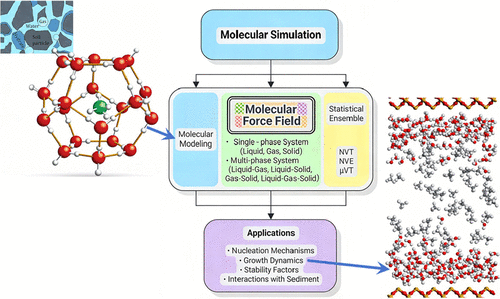
This review provides a comprehensive assessment of recent advancements in molecular simulation methodologies for hydrate-bearing sediments with a focus on innovations in molecular force field development and practical implementations. This review critically assesses how concurrent advancements in single-phase force fields, multiphase interfacial parametrization, and machine learning techniques synergistically improve the accuracy and predictive capability of molecular simulations for hydrate systems under varying geological conditions. Current molecular force fields face significant challenges when applied to hydrate-bearing sediments. These challenges include inaccurate phase transition predictions under extreme conditions. Parameter incompatibility between different phases causes errors in interfacial energy calculations. Computational efficiency and accuracy present fundamental trade-offs that limit large-scale applications. Experimental validation data for microscopic processes remain insufficient. Future research priorities encompass three strategic areas. Development of extreme condition-adaptable force fields will integrate quantum mechanical calculations with experimental data to optimize parameters for high-pressure, low-temperature environments. Machine learning techniques will enable multiphysics-coupled models that balance computational accuracy and efficiency for large-scale multiphase simulations. Collaborative experimental-simulation frameworks will establish high-resolution validation benchmarks across molecular to reservoir scales. These integrated approaches bridge nanoscale molecular phenomena with macroscale engineering applications, enabling effective natural gas hydrate exploitation and utilization.
Cited By
This article has not yet been cited by other publications.

Article Views
Altmetric
Citations
Article Views are the COUNTER-compliant sum of full text article downloads since November 2008 (both PDF and HTML) across all institutions and individuals. These metrics are regularly updated to reflect usage leading up to the last few days.
Citations are the number of other articles citing this article, calculated by Crossref and updated daily. Find more information about Crossref citation counts.
The Altmetric Attention Score is a quantitative measure of the attention that a research article has received online. Clicking on the donut icon will load a page at altmetric.com with additional details about the score and the social media presence for the given article. Find more information on the Altmetric Attention Score and how the score is calculated.