


API Salt Solubility: Unresolved Problems and Innovative Solutions Beyond Conventional ApproachesClick to copy article linkArticle link copied!
- Aakash VermaAakash VermaDepartment of Pharmaceutical Engineering & Technology, Indian Institute of Technology, Banaras Hindu University, Varanasi 221005, Uttar Pradesh IndiaMore by Aakash Verma
- Rohit PatilRohit PatilDepartment of Pharmaceutical Engineering & Technology, Indian Institute of Technology, Banaras Hindu University, Varanasi 221005, Uttar Pradesh IndiaMore by Rohit Patil
- Dinesh KumarDinesh KumarDepartment of Pharmaceutical Engineering & Technology, Indian Institute of Technology, Banaras Hindu University, Varanasi 221005, Uttar Pradesh IndiaMore by Dinesh Kumar
- Ashish Kumar Agrawal*Ashish Kumar Agrawal*Email: [email protected]. Contact: +91-6376983676.Department of Pharmaceutical Engineering & Technology, Indian Institute of Technology, Banaras Hindu University, Varanasi 221005, Uttar Pradesh IndiaMore by Ashish Kumar Agrawal

Abstract
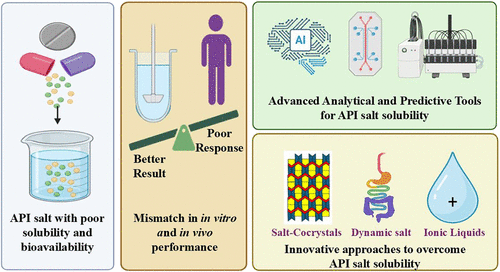
Solubility is one of the most important factors that influences the bioavailability and therapeutic effectiveness of active pharmaceutical ingredients (APIs). Salt formation remains one of the most widely applied strategies to enhance the solubility and dissolution rates. However, many pharmaceutical salts still face persistent solubility challenges, which compromise clinical bioavailability and delay drug development timelines. These challenges are further complicated by the influence of excipients and the frequent discrepancies between in vitro dissolution data and in vivo performance. This review highlights the limitations of API salt forms with poor solubility and emphasizes the growing importance of advanced analytical and predictive tools. Modern approaches such as artificial intelligence (AI) and machine learning (ML) algorithms, along with high-throughput microfluidic screening methods, are increasingly being adopted to better understand and predict the solubility behavior of designed salts. In addition, the review explores innovative strategies to overcome solubility barriers, including the development of dynamic salt forms responsive to physiological conditions, hybrid solid forms such as salt–cocrystals, and counterion engineering with designer ions and ionic liquids. Promising formulation and processing innovations─such as additive manufacturing, microenvironmental pH modulation, and coprocessing with solubility-enhancing polymers─are also discussed as means to further improve solubility. Finally, to foster continued advancement in this field, this review underscores the need for integrated computational–experimental methodologies and cross-disciplinary collaboration. It also addresses regulatory and commercialization challenges associated with these emerging salt approaches while presenting future perspectives.
Cited By
This article has not yet been cited by other publications.

Article Views
Altmetric
Citations
Article Views are the COUNTER-compliant sum of full text article downloads since November 2008 (both PDF and HTML) across all institutions and individuals. These metrics are regularly updated to reflect usage leading up to the last few days.
Citations are the number of other articles citing this article, calculated by Crossref and updated daily. Find more information about Crossref citation counts.
The Altmetric Attention Score is a quantitative measure of the attention that a research article has received online. Clicking on the donut icon will load a page at altmetric.com with additional details about the score and the social media presence for the given article. Find more information on the Altmetric Attention Score and how the score is calculated.