


Acoustic Stimulation for Enhanced Oil Recovery: A Review and Future DirectionsClick to copy article linkArticle link copied!
- Jiale ShiJiale ShiUniversity of Chinese Academy of Sciences, Beijing 100049, ChinaInstitute of Porous Flow and Fluid Mechanics, Chinese Academy of Sciences, Langfang, Hebei 065007, ChinaResearch Institute of Petroleum Exploration and Development, PetroChina, Beijing 100083, ChinaMore by Jiale Shi
- Qingjie Liu*Qingjie Liu*Email: [email protected]Institute of Porous Flow and Fluid Mechanics, Chinese Academy of Sciences, Langfang, Hebei 065007, ChinaResearch Institute of Petroleum Exploration and Development, PetroChina, Beijing 100083, ChinaMore by Qingjie Liu
- Tong WuTong WuUniversity of Chinese Academy of Sciences, Beijing 100049, ChinaInstitute of Porous Flow and Fluid Mechanics, Chinese Academy of Sciences, Langfang, Hebei 065007, ChinaResearch Institute of Petroleum Exploration and Development, PetroChina, Beijing 100083, ChinaMore by Tong Wu
- Ze’an NingZe’an NingUniversity of Chinese Academy of Sciences, Beijing 100049, ChinaInstitute of Porous Flow and Fluid Mechanics, Chinese Academy of Sciences, Langfang, Hebei 065007, ChinaResearch Institute of Petroleum Exploration and Development, PetroChina, Beijing 100083, ChinaMore by Ze’an Ning
- Dongyue ZhangDongyue ZhangUniversity of Chinese Academy of Sciences, Beijing 100049, ChinaInstitute of Porous Flow and Fluid Mechanics, Chinese Academy of Sciences, Langfang, Hebei 065007, ChinaResearch Institute of Petroleum Exploration and Development, PetroChina, Beijing 100083, ChinaMore by Dongyue Zhang
- Shu TangShu TangUniversity of Chinese Academy of Sciences, Beijing 100049, ChinaInstitute of Porous Flow and Fluid Mechanics, Chinese Academy of Sciences, Langfang, Hebei 065007, ChinaResearch Institute of Petroleum Exploration and Development, PetroChina, Beijing 100083, ChinaMore by Shu Tang
- Kesheng TanKesheng TanUniversity of Chinese Academy of Sciences, Beijing 100049, ChinaInstitute of Porous Flow and Fluid Mechanics, Chinese Academy of Sciences, Langfang, Hebei 065007, ChinaResearch Institute of Petroleum Exploration and Development, PetroChina, Beijing 100083, ChinaMore by Kesheng Tan

Abstract
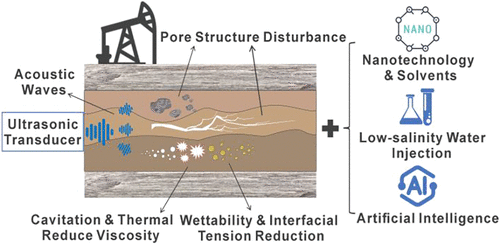
Constrained by the exhausted conventional oil and gas reservoirs and increasing world demand for energy, enhanced oil recovery (EOR) plays an important role in increasing hydrocarbon recovery from wells in maturing fields. As a physical enhanced oil recovery technology, acoustic stimulation-enhanced oil recovery is a new enhanced oil recovery technology that provides a nonthermal and light-chemical way to improve oil recovery. The advances of in situ acoustic stimulation of EOR, including the main types of recovery mechanisms, laboratory tests, numerical simulation, and field applications, have been summarized in this review. It is recognized that the improved recovery might be related to the viscosity reduction, wettability modification, interfacial tension between oil and water reduction, permeability enhancement, and mobilization of oil droplets by emulsification. Laboratory experiments shows that alone, the ultrasonic crude oil viscosity reduction rate could reach 20%–86%, while combined with chemical viscosity reducers, the viscosity reducer rate can reach 96.9%; ultrasound could reduce rock-fluid contact angle 64.73% increasing the wettability of rock and restore the permeability of low-permeability core and reached 80%–100%; field applications show that the increases of oil production rate were 50%–112% and the reduction of water cut was 4%–20%. Although laboratory research shows strong recovery potential, field applications are hindered by wellbore uncertainties, energy decay (high-frequency waves can only reach near the wellbore, and low-frequency waves cannot concentrate enough energy in the same place), reservoir complexity resulting in inefficient targeting of energy, and economics. Furthermore, the absence of a consistent quantitative relationship connecting the pore-scale to reservoir-scale performance further complicates its parameter optimization. The waveform optimization, advanced downhole tools, intelligent monitoring, and multiscale modeling with artificial intelligence are the future research directions that would lead to an accurate and efficient deployment. This summary demonstrated the great scope of acoustic stimulation EOR as a sustainable and noninvasive EOR technology, which was very informative for its large-scale expansion in complex reservoirs.
Cited By
This article has not yet been cited by other publications.

Article Views
Altmetric
Citations
Article Views are the COUNTER-compliant sum of full text article downloads since November 2008 (both PDF and HTML) across all institutions and individuals. These metrics are regularly updated to reflect usage leading up to the last few days.
Citations are the number of other articles citing this article, calculated by Crossref and updated daily. Find more information about Crossref citation counts.
The Altmetric Attention Score is a quantitative measure of the attention that a research article has received online. Clicking on the donut icon will load a page at altmetric.com with additional details about the score and the social media presence for the given article. Find more information on the Altmetric Attention Score and how the score is calculated.