


Hydrogen Production from Pyrolysis-Based Thermochemical Processes of Plastic and Composite Wastes: A ReviewClick to copy article linkArticle link copied!
- Cheryl SalamehCheryl SalamehUniversity of Reims Champagne-Ardenne, Institute of Thermal Sciences, Mechanics, Materials, (ITheMM), UR 7548, Campus Moulin de la Housse, 51687 Reims Cedex 2, FranceMore by Cheryl Salameh
- Mira Abou RjeilyMira Abou RjeilyUniversity of Reims Champagne-Ardenne, Institute of Thermal Sciences, Mechanics, Materials, (ITheMM), UR 7548, Campus Moulin de la Housse, 51687 Reims Cedex 2, FranceMore by Mira Abou Rjeily
- Carmen CiotoneaCarmen CiotoneaUniversity of the Littoral Opal Coast, Environmental Chemistry and Life Interactions Unit, (UCEIV), UR 4492, 145 Avenue Maurice Schumann, 59140 Dunkerque, FranceMore by Carmen Ciotonea
- Cédric GennequinCédric GennequinUniversity of the Littoral Opal Coast, Environmental Chemistry and Life Interactions Unit, (UCEIV), UR 4492, 145 Avenue Maurice Schumann, 59140 Dunkerque, FranceMore by Cédric Gennequin
- Jaona Harifidy Randrianalisoa*Jaona Harifidy Randrianalisoa*Email: [email protected]University of Reims Champagne-Ardenne, Institute of Thermal Sciences, Mechanics, Materials, (ITheMM), UR 7548, Campus Moulin de la Housse, 51687 Reims Cedex 2, FranceMore by Jaona Harifidy Randrianalisoa

Abstract
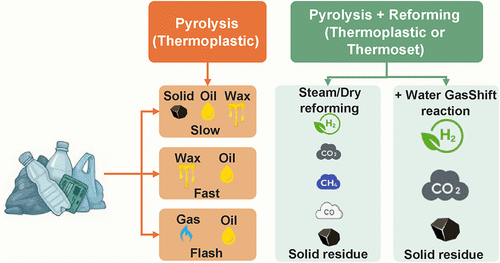
Hydrogen production from plastic waste via pyrolysis-based thermochemical processes is gaining attention as a promising approach to managing plastic waste while generating multiple energy sources. Pyrolysis and catalytic pyrolysis, often combined with catalytic reforming and, in some cases, hydrogen enhancement methods, are considered effective ways to increase the hydrogen yield from plastic-derived gases. This review focuses on hydrogen production from plastic- and polymer-based composite waste through thermochemical processes, especially pyrolysis coupled with catalytic reforming. Thermal degradation of conventional plastics, including thermoplastics and thermosets, is first detailed to describe the main reaction pathways, the different products formed and the resulting gas yields under distinct operating conditions. Polymer-based composites are then analyzed to highlight how the presence of fibers, fillers, and additives influences the pyrolysis behavior, gas composition, and hydrogen production when followed by catalytic reforming. Hydrogen production from pyrolysis coupled with catalytic reforming, including dry and steam reforming, is compared across studies for thermoplastics, thermosets, and composites, with detailed analyses of the effects of the feedstock type, catalyst type, and process conditions (temperature and pressure) on hydrogen yields. Reported hydrogen yields range from 1.2 to 37 wt % depending on the feedstock and the process configuration. The highest hydrogen production is generally achieved with pyrolysis coupled to steam reforming operated at pyrolysis temperatures between 400 and 650 °C and reforming temperatures ranging from 650 to 900 °C, over Ni-based catalysts. In addition, a techno-economic analysis is realized, and some existing industrial plants for the process are reviewed to evaluate the practical potential and scalability of these processes. Finally, the review identifies the current challenges, limitations, and research gaps in hydrogen production from plastic and composite wastes, advising future studies on more efficient solutions.
Cited By
This article has not yet been cited by other publications.

Article Views
Altmetric
Citations
Article Views are the COUNTER-compliant sum of full text article downloads since November 2008 (both PDF and HTML) across all institutions and individuals. These metrics are regularly updated to reflect usage leading up to the last few days.
Citations are the number of other articles citing this article, calculated by Crossref and updated daily. Find more information about Crossref citation counts.
The Altmetric Attention Score is a quantitative measure of the attention that a research article has received online. Clicking on the donut icon will load a page at altmetric.com with additional details about the score and the social media presence for the given article. Find more information on the Altmetric Attention Score and how the score is calculated.