


Metal–Organic Frameworks and Their Derived Materials for Energy Storage and Harvesting: Recent Advances and Future PerspectivesClick to copy article linkArticle link copied!
- Praneet Kumar PathakPraneet Kumar PathakDepartment of Chemistry, Birla Institute of Technology Mesra, Ranchi 835215, IndiaMore by Praneet Kumar Pathak
- Anupam GhoshAnupam GhoshDepartment of Management, Birla Institute of Technology Mesra, Ranchi 835215, IndiaMore by Anupam Ghosh
- Barnali Dasgupta Ghosh*Barnali Dasgupta Ghosh*E-mail: [email protected], [email protected]Department of Chemistry, Birla Institute of Technology Mesra, Ranchi 835215, IndiaMore by Barnali Dasgupta Ghosh

Abstract
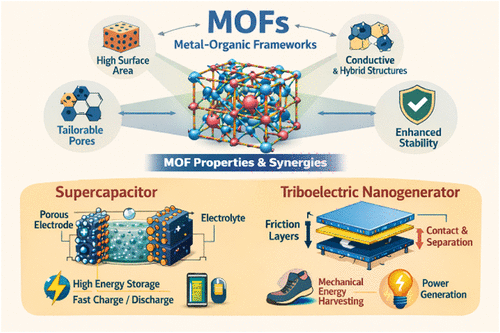
Metal–organic frameworks (MOFs) are crystalline porous materials created by attaching metal ions or clusters to organic ligands. These materials have attracted significant interest due to their structural flexibility, large surface area, and tunable porosity. Metal organic frameworks (MOFs) offer unique features that make them viable candidates for new energy harvesting and storage technologies. Focusing on their applications in triboelectric nanogenerators (TENGs) and supercapacitors, this study examines the design, synthesis, and functionalization of MOFs. Metal–organic frameworks are used as electrode materials or templates in supercapacitors. These frameworks enhance electrochemical performance by enabling the synthesis of derived porous carbons and metal oxides and delivering high capacitance, fast ion transport, and outstanding cycling stability. Modular design enables fine control over redox activity and electrical conductivity, two critical characteristics for pseudocapacitive operation. MOFs have considerable potential in TENGs because they can improve energy conversion efficiency by altering surface charge density, dielectric properties, and mechanical flexibility. Combining MOFs with polymers and nanostructured materials offers new opportunities to improve triboelectric performance and environmental resilience. Improving energy output, charge storage, and material stability are the key areas of research for this method, which emphasizes the linkages between MOFs’ structures and characteristics. It considers multimetallic MOFs, market and industry challenges, and management and commercial strategies. This discovery extends to our understanding of MOFs and provides vital insights for how to develop sustainable energy devices of the future, including triboelectric nanogenerators and supercapacitors.
Cited By
This article has not yet been cited by other publications.

Article Views
Altmetric
Citations
Article Views are the COUNTER-compliant sum of full text article downloads since November 2008 (both PDF and HTML) across all institutions and individuals. These metrics are regularly updated to reflect usage leading up to the last few days.
Citations are the number of other articles citing this article, calculated by Crossref and updated daily. Find more information about Crossref citation counts.
The Altmetric Attention Score is a quantitative measure of the attention that a research article has received online. Clicking on the donut icon will load a page at altmetric.com with additional details about the score and the social media presence for the given article. Find more information on the Altmetric Attention Score and how the score is calculated.