


Biomass-Derived Carbon Materials for Direct Air Capture: A Review and PerspectiveClick to copy article linkArticle link copied!
- Sijin DongSijin DongKey Laboratory of Ocean Energy Utilization and Energy Conservation of Ministry of Education, School of Energy & Power Engineering, Dalian University of Technology, Dalian 116024, ChinaMore by Sijin Dong
- Jie WangJie WangKey Laboratory of Ocean Energy Utilization and Energy Conservation of Ministry of Education, School of Energy & Power Engineering, Dalian University of Technology, Dalian 116024, ChinaMore by Jie Wang
- Shuai WangShuai WangKey Laboratory of Ocean Energy Utilization and Energy Conservation of Ministry of Education, School of Energy & Power Engineering, Dalian University of Technology, Dalian 116024, ChinaMore by Shuai Wang
- Jinjie LiangJinjie LiangKey Laboratory of Ocean Energy Utilization and Energy Conservation of Ministry of Education, School of Energy & Power Engineering, Dalian University of Technology, Dalian 116024, ChinaMore by Jinjie Liang
- Yongchen Song*Yongchen Song*Email: [email protected]Key Laboratory of Ocean Energy Utilization and Energy Conservation of Ministry of Education, School of Energy & Power Engineering, Dalian University of Technology, Dalian 116024, ChinaNingbo Institute of Dalian University of Technology, Ningbo, 315016, ChinaMore by Yongchen Song
- Lanlan JiangLanlan JiangKey Laboratory of Ocean Energy Utilization and Energy Conservation of Ministry of Education, School of Energy & Power Engineering, Dalian University of Technology, Dalian 116024, ChinaNingbo Institute of Dalian University of Technology, Ningbo, 315016, ChinaMore by Lanlan Jiang
- Yu LiuYu LiuKey Laboratory of Ocean Energy Utilization and Energy Conservation of Ministry of Education, School of Energy & Power Engineering, Dalian University of Technology, Dalian 116024, ChinaNingbo Institute of Dalian University of Technology, Ningbo, 315016, ChinaMore by Yu Liu
- Yi ZhangYi ZhangKey Laboratory of Ocean Energy Utilization and Energy Conservation of Ministry of Education, School of Energy & Power Engineering, Dalian University of Technology, Dalian 116024, ChinaNingbo Institute of Dalian University of Technology, Ningbo, 315016, ChinaMore by Yi Zhang
- Lunxiang Zhang*Lunxiang Zhang*Email: [email protected]Key Laboratory of Ocean Energy Utilization and Energy Conservation of Ministry of Education, School of Energy & Power Engineering, Dalian University of Technology, Dalian 116024, ChinaNingbo Institute of Dalian University of Technology, Ningbo, 315016, ChinaMore by Lunxiang Zhang
- Zheng Ling*Zheng Ling*Email: [email protected]Key Laboratory of Ocean Energy Utilization and Energy Conservation of Ministry of Education, School of Energy & Power Engineering, Dalian University of Technology, Dalian 116024, ChinaNingbo Institute of Dalian University of Technology, Ningbo, 315016, ChinaMore by Zheng Ling

Abstract
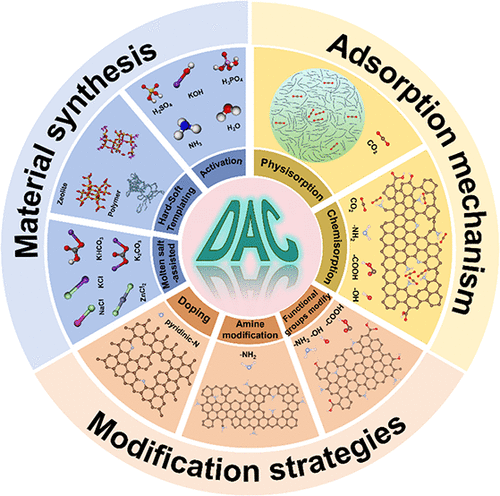
Global atmospheric CO2 concentrations have risen persistently to record highs, making the deployment of negative-emission technologies critical for meeting global climate goals. Among carbon management strategies, direct air capture (DAC) is a prominent negative-emission technology for removing CO2 directly from the atmosphere, but its development is limited by the need for adsorbents that have high CO2 capture efficiency, excellent selectivity, and low energy requirements for regeneration. Biomass-derived carbon materials have emerged as ideal candidates for DAC adsorbents due to their renewable feedstocks, low cost, adjustable structures, and natural carbon-negative potential. This review systematically outlines the core performance metrics of DAC adsorbents, covering the preparation of biomass-derived carbon, key factors influencing CO2 capture performance, and related tuning strategies. While biomass-derived carbon materials show promising prospects for DAC, practical applications still face challenges related to precise structural control and high energy consumption during regeneration. Future research should focus on developing green synthesis methods powered by renewable energy and achieving low-energy regeneration by utilizing the inherent photothermal and electrothermal properties of materials.
Cited By
This article has not yet been cited by other publications.

Article Views
Altmetric
Citations
Article Views are the COUNTER-compliant sum of full text article downloads since November 2008 (both PDF and HTML) across all institutions and individuals. These metrics are regularly updated to reflect usage leading up to the last few days.
Citations are the number of other articles citing this article, calculated by Crossref and updated daily. Find more information about Crossref citation counts.
The Altmetric Attention Score is a quantitative measure of the attention that a research article has received online. Clicking on the donut icon will load a page at altmetric.com with additional details about the score and the social media presence for the given article. Find more information on the Altmetric Attention Score and how the score is calculated.