


Contextual Factors That Impact the Performance of Portable Air Cleaners: A Critical ReviewClick to copy article linkArticle link copied!
- Alexander Y. MendellAlexander Y. MendellDalla Lana School of Public Health, University of Toronto, Toronto, Ontario M5T 1R4, CanadaMore by Alexander Y. Mendell
- Seungjae LeeSeungjae LeeDepartment of Civil and Mineral Engineering, University of Toronto, Toronto, Ontario M5S 1A4, CanadaDepartment of Mechanical and Industrial Engineering, University of Toronto, Toronto, Ontario M5S 3G8, CanadaMore by Seungjae Lee
- Jeffrey A. Siegel*Jeffrey A. Siegel*Email: [email protected]Dalla Lana School of Public Health, University of Toronto, Toronto, Ontario M5T 1R4, CanadaDepartment of Civil and Mineral Engineering, University of Toronto, Toronto, Ontario M5S 1A4, CanadaMore by Jeffrey A. Siegel

Abstract
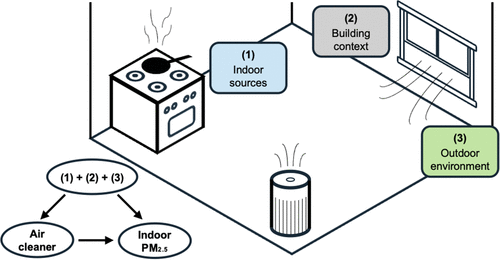
Portable air cleaners (PACs) can reduce indoor concentrations of fine particulate matter (PM2.5), although their impact can vary substantially. This review explores how PAC performance measured during an intervention can be affected by the indoor and outdoor environment, device operation, and study methodology. A literature search identified 41 randomized interventions conducted in homes (64 articles) satisfying the inclusion criteria. Reporting of key contextual factors was inconsistent between investigations, and many factors were frequently absent from discussion. Average reductions in indoor PM2.5 concentration ranged from 6.3–82.7% (effectiveness) and 1.2–54.9 μg·m–3 (absolute reduction). Neither measure was positively associated with PAC cleaning power (clean air delivery rate, CADR, or volume-normalized CADR, CADR/V). Concentration reductions were frequently lower than expected based on nominal CADR/V, suggesting that PACs operated at lower speeds than reported and/or that room dimensions underestimate the mixing volume of a space. Effectiveness was greater when windows were closed and when testing was conducted in bedrooms compared with living rooms. Absolute reductions were greater, with larger variance, as ambient PM2.5 concentrations increased. Accounting for these factors may strengthen assessments of past and future interventions and guide the implementation of PACs to reduce indoor PM2.5 concentrations and improve associated health outcomes.
Cited By
This article has not yet been cited by other publications.
Article Views
Altmetric
Citations
Article Views are the COUNTER-compliant sum of full text article downloads since November 2008 (both PDF and HTML) across all institutions and individuals. These metrics are regularly updated to reflect usage leading up to the last few days.
Citations are the number of other articles citing this article, calculated by Crossref and updated daily. Find more information about Crossref citation counts.
The Altmetric Attention Score is a quantitative measure of the attention that a research article has received online. Clicking on the donut icon will load a page at altmetric.com with additional details about the score and the social media presence for the given article. Find more information on the Altmetric Attention Score and how the score is calculated.