


Fate of Organic Carbon Shaped by Iron Minerals in Coastal Wetlands: Mechanisms and ImplicationsClick to copy article linkArticle link copied!
- Yanran ShaoYanran ShaoChina-UK Low Carbon College, Shanghai Jiao Tong University, Shanghai 201306, ChinaMore by Yanran Shao
- Shanshan SunShanshan SunSchool of Environmental Science and Engineering, Shanghai Jiao Tong University, Shanghai 200240, ChinaMore by Shanshan Sun
- Shaoxuan DingShaoxuan DingSchool of Environmental Science and Engineering, Shanghai Jiao Tong University, Shanghai 200240, ChinaMore by Shaoxuan Ding
- Yuanjun PengYuanjun PengSchool of Environmental Science and Engineering, Shanghai Jiao Tong University, Shanghai 200240, ChinaMore by Yuanjun Peng
- Xushun GuXushun GuSchool of Environmental Science and Engineering, Shanghai Jiao Tong University, Shanghai 200240, ChinaMore by Xushun Gu
- Keiichi MochidaKeiichi MochidaRIKEN Center for Sustainable Resource Science, Yokohama 230-0045, JapanSchool of Information and Data Sciences, Nagasaki University, Nagasaki 852-8521, JapanKihara Institute for Biological Research, Yokohama City University, Yokohama 244-0813, JapanMore by Keiichi Mochida
- Shengbing He*Shengbing He*Email: [email protected]School of Environmental Science and Engineering, Shanghai Jiao Tong University, Shanghai 200240, ChinaMore by Shengbing He

Abstract
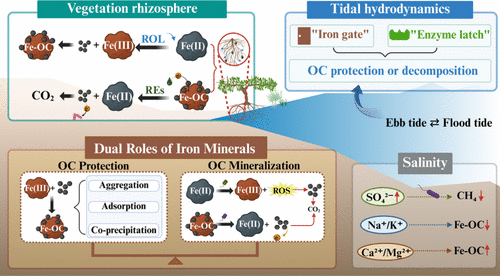
Coastal wetlands are premier blue carbon sinks, yet the stability and fate of their organic carbon (OC) are profoundly shaped by complex biogeochemical interactions with iron minerals. This review provided a systematic analysis of iron-mediated OC dynamics by resolving the “coastal syndrome”─the synergistic regulation of Fe-OC interactions by salinity fluctuations, tidal hydrodynamics, and halophytic vegetation. We elucidated how iron minerals govern OC fate through multipathway stabilization (adsorption, coprecipitation, and aggregation) and simultaneous mineralization driven by redox transitions, including Fe(III) reduction and Fe(II)-catalyzed reactive oxygen species (ROS) production. Crucially, we emphasize the active role of OC as a redox mediator─acting as electron shuttles and complexing agents─that regulates iron transformation and bioavailability. Also, we synthesized microscale mechanisms and responses to environmental drivers, emphasizing dynamic regulation of interactions between iron minerals and OC by salinity fluctuations, tidal hydrodynamics, vegetation rhizospheres, and their joint effects. Integrating these mechanistic insights, we proposed a transition toward a unified, multifactor coupling framework to better predict and manage the carbon sink functionality of coastal wetlands. This review offered a mechanistic basis for linking saltwater intrusion, iron redox dynamics, and microbial metabolism to carbon sequestration in coastal blue carbon ecosystems.
Cited By
This article has not yet been cited by other publications.
Article Views
Altmetric
Citations
Article Views are the COUNTER-compliant sum of full text article downloads since November 2008 (both PDF and HTML) across all institutions and individuals. These metrics are regularly updated to reflect usage leading up to the last few days.
Citations are the number of other articles citing this article, calculated by Crossref and updated daily. Find more information about Crossref citation counts.
The Altmetric Attention Score is a quantitative measure of the attention that a research article has received online. Clicking on the donut icon will load a page at altmetric.com with additional details about the score and the social media presence for the given article. Find more information on the Altmetric Attention Score and how the score is calculated.