


From Paradox to Practice: A Review on Production Strategies, Stability Mechanisms, and Theoretical Insights of Bulk NanobubblesClick to copy article linkArticle link copied!
- Ananda J. Jadhav*Ananda J. Jadhav*Email: [email protected], [email protected]; Tel: +91-22-33612316, +91-8928530865; Fax: +91-22-33611020.Department of Biological Sciences and Biotechnology, Institute of Chemical Technology, Matunga, Mumbai 400019, IndiaMore by Ananda J. Jadhav
- Aniruddha Bhalchandra Pandit*Aniruddha Bhalchandra Pandit*Email: [email protected], [email protected]; Tel: +91-22-33611001; Fax: +91-22-33611002.Department of Chemical Engineering, Institute of Chemical Technology, Mumbai 400019, IndiaMore by Aniruddha Bhalchandra Pandit

Abstract
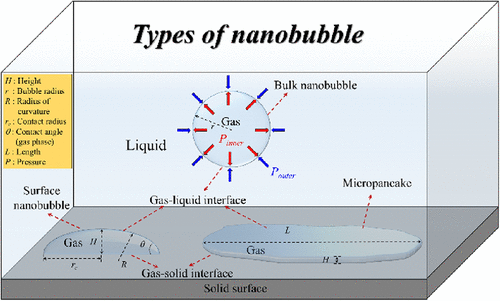
Bulk nanobubbles (BNBs), or ultrafine bubbles, have attracted significant attention due to their unexpected long-term stability and unusual physicochemical behavior. Classical models, including the Epstein–Plesset framework, predict rapid dissolution of nanoscale bubbles; however, numerous studies now confirm that BNBs persist for weeks to months, challenging established theories and stimulating renewed interest in their mechanistic origins. This review provides a comprehensive synthesis of current understanding, beginning with the historical evolution of BNB research and the primary pathways proposed for their formation, including nucleation-driven processes and microbubble shrinkage. Major generation strategies such as cavitation, electrolysis, pressurization–decompression, membrane permeation, and microfluidics are critically evaluated with respect to scalability, efficiency, and gas selectivity. The physicochemical attributes of BNBs, encompassing interfacial charge stabilization, enhanced gas solubility, radical generation, and mass-transfer effects, are discussed alongside recent advances in theoretical, atomistic, and continuum-level modeling that seek to reconcile their anomalous stability. Progress in characterization techniques, from light scattering and acoustic detection to nanopore- and fluorescence-based methods, is also assessed.
Cited By
This article has not yet been cited by other publications.

Article Views
Altmetric
Citations
Article Views are the COUNTER-compliant sum of full text article downloads since November 2008 (both PDF and HTML) across all institutions and individuals. These metrics are regularly updated to reflect usage leading up to the last few days.
Citations are the number of other articles citing this article, calculated by Crossref and updated daily. Find more information about Crossref citation counts.
The Altmetric Attention Score is a quantitative measure of the attention that a research article has received online. Clicking on the donut icon will load a page at altmetric.com with additional details about the score and the social media presence for the given article. Find more information on the Altmetric Attention Score and how the score is calculated.