• Editors Choice
Omics Technologies Applied to Agriculture and Food

Field Asymmetric Ion Mobility Spectrometry for Early Detection of Aphanomyces Root Rot in Peas Using Volatile Biomarkers
Click to copy article linkArticle link copied!

  • Milton Valencia-Ortiz
    Milton Valencia-Ortiz
    Department of Biological System Engineering, Washington State University, Pullman, Washington 99164, United States
  • Rebecca J. McGee
    Rebecca J. McGee
    Department of Crop and Soil Sciences, Washington State University, Pullman, Washington 99164, United States
  • Sindhuja Sankaran*
    Sindhuja Sankaran
    Department of Biological System Engineering, Washington State University, Pullman, Washington 99164, United States
    *Email: [email protected]. Phone: (1)-509-335-8828.
Other Access OptionsSupporting Information (1)

Journal of Agricultural and Food Chemistry

Cite this: J. Agric. Food Chem. 2025, 73, 19, 12083–12092
Click to copy citationCitation copied!
https://doi.org/10.1021/acs.jafc.4c12571
Published April 30, 2025
Copyright © 2025 American Chemical Society

Abstract

Click to copy section linkSection link copied!
Abstract Image

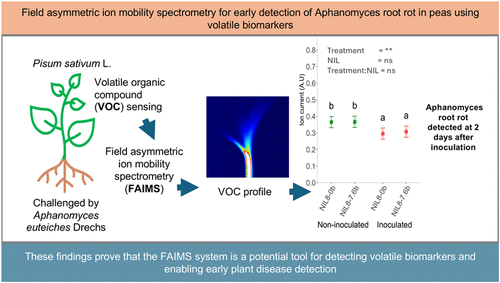
Volatile organic compounds (VOCs) produced by plants during plant–pathogen interactions can be highly informative for early disease detection. The real-time capability of field asymmetric ion mobility spectrometry (FAIMS) offers a valuable opportunity to monitor plant VOCs nondestructively and dynamically. This study evaluated the FAIMS system reliability in measuring VOC profiles for an early diagnosis of Aphanomyces root rot (ARR) in pea (Pisum sativum L.). This evaluation utilized pea lines with a major quantitative trait locus (QTL Ae-Ps7.6) and lines without QTL, identified to provide partial resistance against ARR. For the first time, a VOC biomarker associated with ARR was detected as early as 2 days after inoculation (DAI). Furthermore, at 7 DAI, one of the biomarkers showed significant differences between lines with and without QTL Ae-Ps7.6 in the noninoculated samples. These findings demonstrate the potential applicability of the FAIMS system as a valuable tool for detecting volatile biomarkers for early plant disease detection.

Copyright © 2025 American Chemical Society

Read this article

To access this article, please review the available access options below.

Get instant access

Purchase Access

Read this article for 48 hours. Check out below using your ACS ID or as a guest.

Recommended

Access through Your Institution

You may have access to this article through your institution.

Your institution does not have access to this content. Add or change your institution or let them know you’d like them to include access.

Supporting Information

Click to copy section linkSection link copied!

The Supporting Information is available free of charge at https://pubs.acs.org/doi/10.1021/acs.jafc.4c12571.

  • Figure S1. Hydroponic system schematics utilized to evaluate the effect of A. euteiches on pea; Figure S2. Pearson’s correlation analysis across treatments (noninoculated and inoculated), NILs, and the ion current peaks at 7 DAI showing the relationship between the root rot index and CO2 assimilation and the relationship between the root rot index and the ion current intensity at 2 and 4 DAI; Figure S3. FAIMS ion current profiles of whole pea plants across inoculation treatments (nondestructive sampling) for NIL5-0b, NIL5-7.6b, NIL8-0b, and NIL8-7.6 at 2 and 4 DAI; Figure S4. Agglomerative hierarchical clustering using the ion current profiles for NIL5-0b, NIL5-7.6b, NIL8-0b, and NIL8-7.6b at 2 and 4 DAI; Figure S5. Ion current quantile data across treatments and NILs; Figure S6. FAIMS ion current profiles of pea roots across inoculation treatments at 7 DAI (destructive sampling) for NIL5-0b, NIL5-7.6b, NIL8-0b, and NIL8-7.6; Figure S7. Agglomerative hierarchical clustering from root samples at 7 DAI for NIL5-0b, NIL5-7.6b, NIL8-0b, and NIL8-7.6b; Figure S8. Comparative agglomerative hierarchical clustering analysis using NIL5-0b and NIL5-7.6b from root samples at 7 DAI showing clustering analysis using 21 and 42 metrics (mean, minimum, and maximum metrics) from ion current and curvature quantiles across treatments, NILs, and replications (PDF)

Terms & Conditions

Most electronic Supporting Information files are available without a subscription to ACS Web Editions. Such files may be downloaded by article for research use (if there is a public use license linked to the relevant article, that license may permit other uses). Permission may be obtained from ACS for other uses through requests via the RightsLink permission system: http://pubs.acs.org/page/copyright/permissions.html.

Cited By

Click to copy section linkSection link copied!

This article is cited by 1 publications.

  1. Milton Valencia-Ortiz, Rebecca J. McGee, Sindhuja Sankaran. Early detection of Aphanomyces root rot in pea plants using hyperspectral imaging. Physiological and Molecular Plant Pathology 2025, 140 , 102862. https://doi.org/10.1016/j.pmpp.2025.102862
Journal of Agricultural and Food Chemistry

Cite this: J. Agric. Food Chem. 2025, 73, 19, 12083–12092
Click to copy citationCitation copied!
https://doi.org/10.1021/acs.jafc.4c12571
Published April 30, 2025
Copyright © 2025 American Chemical Society

Article Views

1167

Altmetric

-

Citations

Learn about these metrics

Article Views are the COUNTER-compliant sum of full text article downloads since November 2008 (both PDF and HTML) across all institutions and individuals. These metrics are regularly updated to reflect usage leading up to the last few days.

Citations are the number of other articles citing this article, calculated by Crossref and updated daily. Find more information about Crossref citation counts.

The Altmetric Attention Score is a quantitative measure of the attention that a research article has received online. Clicking on the donut icon will load a page at altmetric.com with additional details about the score and the social media presence for the given article. Find more information on the Altmetric Attention Score and how the score is calculated.