


Deep Eutectic Solvents as Sustainable Media in Maleic Anhydride Esterification: Potential and Application AnalysisClick to copy article linkArticle link copied!
- Yaosen WangYaosen WangSchool of Chemical Engineering and Technology, National Engineering Research Center of Distillation Technology, Collaborative Innovation Center of Chemical Science and Engineering (Tianjin), Tianjin University, Tianjin 300072, ChinaMore by Yaosen Wang
- Qiuyan Ding*Qiuyan Ding*Email: [email protected]School of Chemical Engineering and Technology, National Engineering Research Center of Distillation Technology, Collaborative Innovation Center of Chemical Science and Engineering (Tianjin), Tianjin University, Tianjin 300072, ChinaMore by Qiuyan Ding
- Shun LiuShun LiuSchool of Chemical Engineering and Technology, National Engineering Research Center of Distillation Technology, Collaborative Innovation Center of Chemical Science and Engineering (Tianjin), Tianjin University, Tianjin 300072, ChinaMore by Shun Liu
- Hong Li*Hong Li*Email: [email protected]School of Chemical Engineering and Technology, National Engineering Research Center of Distillation Technology, Collaborative Innovation Center of Chemical Science and Engineering (Tianjin), Tianjin University, Tianjin 300072, ChinaMore by Hong Li
- Xin Gao*Xin Gao*Email: [email protected]School of Chemical Engineering and Technology, National Engineering Research Center of Distillation Technology, Collaborative Innovation Center of Chemical Science and Engineering (Tianjin), Tianjin University, Tianjin 300072, ChinaHaihe Laboratory of Sustainable Chemical Transformations, Tianjin 300192, ChinaMore by Xin Gao

Abstract
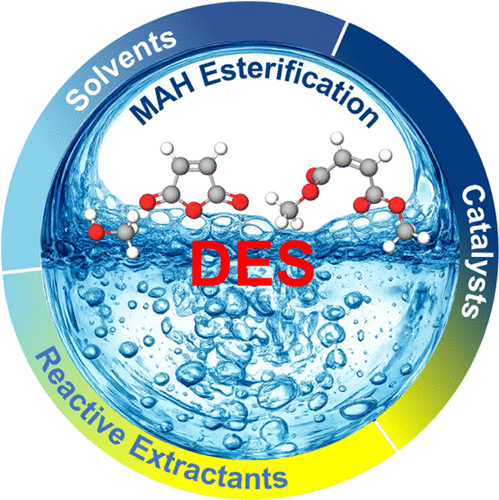
Maleate esters, particularly dimethyl maleate (DMM), are pivotal platform chemicals and key intermediates in the synthesis of polymers, plasticizers, and fine chemicals. However, the conventional production via maleic anhydride (MAH) esterification is often constrained by equilibrium limitations and the use of harsh, nonrecyclable acid catalysts. In this context, deep eutectic solvents (DESs) have recently emerged as sustainable and versatile alternatives in esterification reaction, owing to tunable acidity, negligible volatility, and outstanding environmental compatibility. We systematically summarize the three synergistic roles of DESs: (i) as solvents, enhancing reactant miscibility; (ii) as catalysts, providing tunable acidity for efficient carbonyl activation; and (iii) as reactive extractants, separating byproduct water in situ to drive reactions. This intrinsic multifunctionality enables significant process intensification by coupling reaction and separation into a single unit. Based on the current research status of DMM production, the feasibility, advantages, and potential process strategies for applying DESs to DMM synthesis are thoroughly discussed. Finally, this review concludes by outlining current challenges and future research directions for MAH esterification, emphasizing the need for rational design of DESs. The findings collectively underscore the potential of DESs to revolutionize the sustainable production of maleate esters.
Cited By
This article has not yet been cited by other publications.
Article Views
Altmetric
Citations
Article Views are the COUNTER-compliant sum of full text article downloads since November 2008 (both PDF and HTML) across all institutions and individuals. These metrics are regularly updated to reflect usage leading up to the last few days.
Citations are the number of other articles citing this article, calculated by Crossref and updated daily. Find more information about Crossref citation counts.
The Altmetric Attention Score is a quantitative measure of the attention that a research article has received online. Clicking on the donut icon will load a page at altmetric.com with additional details about the score and the social media presence for the given article. Find more information on the Altmetric Attention Score and how the score is calculated.