


Research on Deep Eutectic Solvents for Fuel Desulfurization: Methods, Mechanisms, and Emerging TrendsClick to copy article linkArticle link copied!
- Siqi ZhuSiqi ZhuInstitute of Bismuth and Rhenium Science, School of Materials and Chemistry, University of Shanghai for Science and Technology, Shanghai 200093, ChinaMore by Siqi Zhu
- Sitong JinSitong JinInstitute of Bismuth and Rhenium Science, School of Materials and Chemistry, University of Shanghai for Science and Technology, Shanghai 200093, ChinaMore by Sitong Jin
- Congfei Yao*Congfei Yao*Email: [email protected]Institute of Bismuth and Rhenium Science, School of Materials and Chemistry, University of Shanghai for Science and Technology, Shanghai 200093, ChinaGSK Carbon Neutral Laboratory, School of Chemistry, University of Nottingham, Nottingham NG7 2RD, U.K.More by Congfei Yao
- Jitong XueJitong XueInstitute of Bismuth and Rhenium Science, School of Materials and Chemistry, University of Shanghai for Science and Technology, Shanghai 200093, ChinaMore by Jitong Xue
- Qiuyu ChenQiuyu ChenInstitute of Bismuth and Rhenium Science, School of Materials and Chemistry, University of Shanghai for Science and Technology, Shanghai 200093, ChinaMore by Qiuyu Chen
- Zheng LiuZheng LiuInstitute of Bismuth and Rhenium Science, School of Materials and Chemistry, University of Shanghai for Science and Technology, Shanghai 200093, ChinaMore by Zheng Liu

Abstract
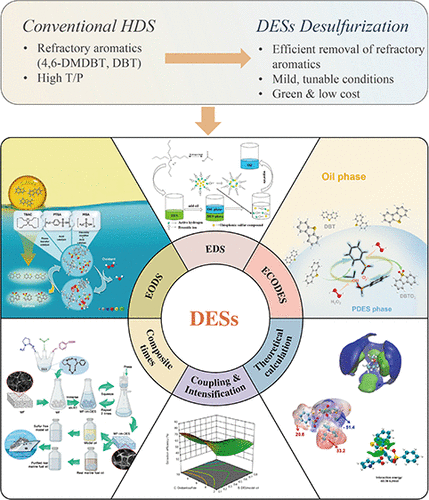
With increasing environmental concerns and stricter sulfur-emission regulations, efficient removal of sulfur-containing compounds from fuels has become a critical issue. Traditional hydrodesulfurization (HDS) faces challenges, including high energy consumption, limited efficiency for refractory sulfur compounds, and the need for severe operating conditions. Therefore, alternative desulfurization methods using novel solvents and green materials have gained interest. Among these, deep eutectic solvents (DESs) are particularly promising due to their tunable physicochemical properties, low toxicity, biodegradability, and excellent extraction capabilities. Unlike previous reviews that primarily emphasize experimental performance comparisons of DESs, this review provides a mechanism- and computation-driven perspective on DES-based fuel desulfurization, with particular emphasis on mechanistic elucidation through the integration of experimental investigations and multiscale computational approaches across different desulfurization technologies. It first introduces the definition, classification, and key physicochemical properties of DESs and their influence on desulfurization performance. Experimental and computational approaches were used to elucidate desulfurization mechanisms, including multiscale simulations and advanced characterization techniques. Finally, emerging research trends in DESs research, such as the design of composite systems, multifunctional development, and strategies for green and sustainable applications, are discussed.
Cited By
This article has not yet been cited by other publications.

Article Views
Altmetric
Citations
Article Views are the COUNTER-compliant sum of full text article downloads since November 2008 (both PDF and HTML) across all institutions and individuals. These metrics are regularly updated to reflect usage leading up to the last few days.
Citations are the number of other articles citing this article, calculated by Crossref and updated daily. Find more information about Crossref citation counts.
The Altmetric Attention Score is a quantitative measure of the attention that a research article has received online. Clicking on the donut icon will load a page at altmetric.com with additional details about the score and the social media presence for the given article. Find more information on the Altmetric Attention Score and how the score is calculated.