


Transforming MOF Modeling with Machine-Learned Potentials: Progress and PerspectivesClick to copy article linkArticle link copied!
- Omer Tayfuroglu*Omer Tayfuroglu*Email: [email protected], Tel.: +90 (212) 338-1362.Department of Chemical and Biological Engineering, Koc University, Rumelifeneri Yolu, Sariyer, Istanbul 34450, TurkeyMore by Omer Tayfuroglu
- Seda Keskin*Seda Keskin*Email: [email protected], Tel.: +90(212) 338-1362.Department of Chemical and Biological Engineering, Koc University, Rumelifeneri Yolu, Sariyer, Istanbul 34450, TurkeyMore by Seda Keskin

Abstract
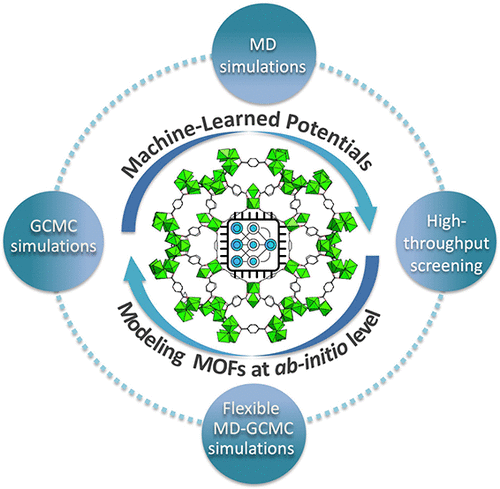
Machine-learned potentials (MLPs) have emerged as transformative tools for modeling metal–organic frameworks (MOFs), bridging the accuracy of quantum mechanics with the efficiency required for large-scale molecular simulations. By learning the potential energy surface directly from quantum-mechanical reference data, MLPs enable a unified description of the complex nature of MOFs and their interactions with guest molecules across multiple length and time scales. Recent developments have demonstrated the capability of MLPs to model intrinsic MOF properties such as lattice dynamics, thermal expansion, and mechanical response, as well as to describe adsorption thermodynamics, diffusion, and cooperative host–guest behavior in flexible frameworks. Developing reliable and transferable MLPs for MOFs remains a significant challenge due to the vast chemical and structural diversity of MOFs and the complexity of sampling guest-framework configurations. The lack of openly shared, standardized, and user-friendly MLP implementations also limits their broader adoption. This review focuses on the current progress in MLP-based modeling of MOFs, highlighting methodological advances, data-generation strategies, and active-learning protocols, while outlining the key challenges and future directions for developing transferable, accessible, and universal MLPs for the predictive design and discovery of MOFs.
Cited By
This article has not yet been cited by other publications.

Article Views
Altmetric
Citations
Article Views are the COUNTER-compliant sum of full text article downloads since November 2008 (both PDF and HTML) across all institutions and individuals. These metrics are regularly updated to reflect usage leading up to the last few days.
Citations are the number of other articles citing this article, calculated by Crossref and updated daily. Find more information about Crossref citation counts.
The Altmetric Attention Score is a quantitative measure of the attention that a research article has received online. Clicking on the donut icon will load a page at altmetric.com with additional details about the score and the social media presence for the given article. Find more information on the Altmetric Attention Score and how the score is calculated.