


The Time-Dependent Density Matrix Renormalization Group Method for Nonadiabatic Dynamics and Electronic DynamicsClick to copy article linkArticle link copied!
- Xiaoyu Xie*Xiaoyu Xie*E-mail: [email protected]Key Laboratory of Collid and Interface Chemistry, Ministry of Education, School of Chemistry and Chemical Engineering, Shandong University, Qingdao 266237, ChinaMore by Xiaoyu Xie
- Yihe XuYihe XuDepartment of Physics, City University of Hong Kong, Kowloon, Hong Kong SAR 999077, ChinaMore by Yihe Xu
- Ulrich SchollwöckUlrich SchollwöckDepartment of Physics and Arnold Sommerfeld Center for Theoretical Physics (ASC), Ludwig-Maximilians-Universität München, Theresienstr. 37, München D-80333, GermanyMunich Center for Quantum Science and Technology (MCQST), Schellingstr. 4, Munich D-80799, GermanyMore by Ulrich Schollwöck
- Haibo Ma*Haibo Ma*E-mail: [email protected]Key Laboratory of Collid and Interface Chemistry, Ministry of Education, School of Chemistry and Chemical Engineering, Shandong University, Qingdao 266237, ChinaMore by Haibo Ma

Abstract
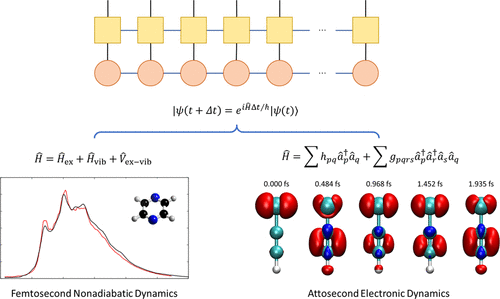
Recent advances in experimental techniques have enabled precise characterization of fundamental nonadiabatic and even electronic dynamics in molecules, on ultrafast time scales reaching femtosecond to attosecond resolution. However, accurate theoretical simulation of these ultrafast chemical dynamics processes in large systems remains challenging, largely due to the overwhelming number of degrees of freedom (DoFs) and the pronounced many-body correlations. In recent years, by leveraging efficient decomposition schemes for high-dimensional wave function and operator tensors, the time-dependent density matrix renormalization group (TD-DMRG) has emerged as a powerful and accurate quantum dynamics method for simulating nonadiabatic and electron dynamics in large chemical systems, in conjunction with realistic electron/exciton-vibration/phonon models or ab initio quantum chemistry many-electron Hamiltonians. This review outlines the fundamentals of TD-DMRG for chemical dynamics, covering matrix product state/operator (MPS/MPO) frameworks and algorithms from ground-state calculations to time evolution. We discuss thermal/environmental effects and compare TD-DMRG with other tensor network methods such as multiconfiguration time-dependent Hartree (MCTDH) and multilayer MCTDH (ML-MCTDH). Demonstrated applications include simulations of pyrazine absorption, singlet fission in rubrene crystal, and charge migration in chloroacetylene cation. These show TD-DMRG’s capability for modeling complex ultrafast processes from femtoseconds to attoseconds with controlled accuracy.
Cited By
This article has not yet been cited by other publications.

Article Views
Altmetric
Citations
Article Views are the COUNTER-compliant sum of full text article downloads since November 2008 (both PDF and HTML) across all institutions and individuals. These metrics are regularly updated to reflect usage leading up to the last few days.
Citations are the number of other articles citing this article, calculated by Crossref and updated daily. Find more information about Crossref citation counts.
The Altmetric Attention Score is a quantitative measure of the attention that a research article has received online. Clicking on the donut icon will load a page at altmetric.com with additional details about the score and the social media presence for the given article. Find more information on the Altmetric Attention Score and how the score is calculated.