


Ising Density Functional Theory for Inhomogeneous Weak PolyelectrolytesClick to copy article linkArticle link copied!
- Alejandro Gallegos*Alejandro Gallegos*Email: [email protected]Department of Chemical and Materials Engineering, New Mexico State University, Las Cruces, New Mexico 88001, United StatesMore by Alejandro Gallegos
- Raju LunkadRaju LunkadInstitut für Theoretische Physik, Georg-August-Universität, 37077 Göttingen, GermanyMore by Raju Lunkad
- Marcus MüllerMarcus MüllerInstitut für Theoretische Physik, Georg-August-Universität, 37077 Göttingen, GermanyMore by Marcus Müller
- Jianzhong Wu*Jianzhong Wu*Email: [email protected]Department of Chemical and Environmental Engineering, University of California, Riverside, California 92521, United StatesMore by Jianzhong Wu

Abstract
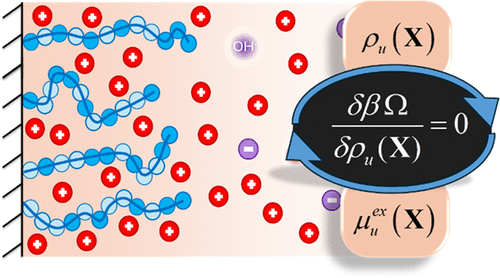
Weak polyelectrolytes are polymers bearing ionizable groups, whose charge states depend sensitively on the local chemical environment. Their ability to respond to variations in pH, ionic strength, and surface chemistry underpins a wide range of applications, from underwater adhesion and biomolecular complexation to responsive coatings and drug delivery systems. Despite this technological relevance, the theoretical description of weak polyelectrolytes remains challenging due to the strong coupling among monomer-ionization equilibria, polymer conformations, and inter- and intramolecular electrostatic interactions. Correlation effects become particularly pronounced in the presence of spatially varying fields, such as near interfaces or under external potentials, where segment densities and ionization profiles adjust self-consistently under global thermodynamic equilibrium. In such settings, polymer conformations and local charge regulation are intimately coupled through the self-consistent fields that determine equilibrium density profiles. In this topical review, we present Ising density functional theory (iDFT) as a unified theoretical framework that integrates statistical–mechanical descriptions of internal-state transitions, modeled in Ising-like variables, with polymer-density functional theory. iDFT enables a self-consistent treatment of chemically responsive polymers in inhomogeneous settings, in which monomer ionization and chain conformations coevolve in response to external stimuli. We outline the conceptual foundations of iDFT, describe its practical implementation using self-consistent field algorithms and Anderson mixing, and illustrate its ability to capture charge regulation and conformational changes in response to solution conditions. Current limitations of iDFT, including the treatment of long-range intrachain correlations, are also discussed along with paths forward through single-chain simulations and analytical developments. By providing a coherent platform for modeling weak polyelectrolytes in complex environments, iDFT provides new opportunities to elucidate their equilibrium structures and thermodynamic behaviors, thereby advancing the predictive design of responsive soft materials.
Cited By
This article has not yet been cited by other publications.

Article Views
Altmetric
Citations
Article Views are the COUNTER-compliant sum of full text article downloads since November 2008 (both PDF and HTML) across all institutions and individuals. These metrics are regularly updated to reflect usage leading up to the last few days.
Citations are the number of other articles citing this article, calculated by Crossref and updated daily. Find more information about Crossref citation counts.
The Altmetric Attention Score is a quantitative measure of the attention that a research article has received online. Clicking on the donut icon will load a page at altmetric.com with additional details about the score and the social media presence for the given article. Find more information on the Altmetric Attention Score and how the score is calculated.