


Mechanistic Insights and Catalyst Exploration for Photothermal Catalytic Ammonia SynthesisClick to copy article linkArticle link copied!
- Zijing ZhangZijing ZhangSchool of Chemistry and Chemical Engineering, Nanjing University of Science and Technology, Nanjing, Jiangsu 210094, ChinaMore by Zijing Zhang
- Shuai YinShuai YinSchool of Chemistry and Chemical Engineering, Nanjing University of Science and Technology, Nanjing, Jiangsu 210094, ChinaMore by Shuai Yin
- Yuqiao LiYuqiao LiSchool of Chemistry and Chemical Engineering, Nanjing University of Science and Technology, Nanjing, Jiangsu 210094, ChinaMore by Yuqiao Li
- Jingran MaoJingran MaoSchool of Chemistry and Chemical Engineering, Nanjing University of Science and Technology, Nanjing, Jiangsu 210094, ChinaMore by Jingran Mao
- Suwei WangSuwei WangSchool of Chemistry and Chemical Engineering, Nanjing University of Science and Technology, Nanjing, Jiangsu 210094, ChinaMore by Suwei Wang
- Hao Zhou*Hao Zhou*Email: [email protected]School of Chemistry and Chemical Engineering, Nanjing University of Science and Technology, Nanjing, Jiangsu 210094, ChinaMore by Hao Zhou
- Guodong DengGuodong DengSchool of Chemistry and Chemical Engineering, Nanjing University of Science and Technology, Nanjing, Jiangsu 210094, ChinaMore by Guodong Deng
- Wei JiangWei JiangSchool of Chemistry and Chemical Engineering, Nanjing University of Science and Technology, Nanjing, Jiangsu 210094, ChinaMore by Wei Jiang
- Guigao Liu*Guigao Liu*Email: [email protected]School of Chemistry and Chemical Engineering, Nanjing University of Science and Technology, Nanjing, Jiangsu 210094, ChinaMore by Guigao Liu

Abstract
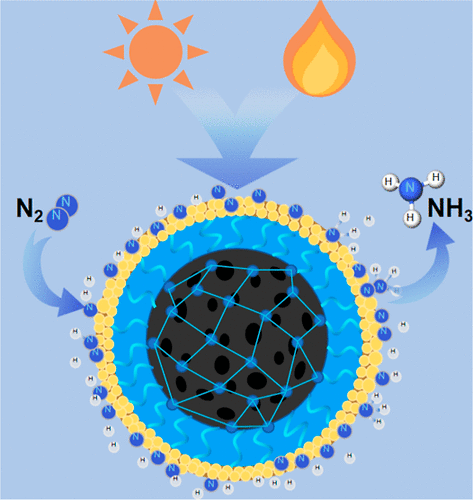
Ammonia (NH3) serves as a key component in the majority of fertilizers, chemicals, and pharmaceuticals. The conventional Haber-Bosch process is highly energy-intensive, accounting for 2% of global energy consumption annually and contributing significantly to greenhouse gas emissions. In recent years, photothermal catalysis, driven by light energy, has emerged as a highly promising approach to synthesizing ammonia under green and mild conditions. By leveraging the synergy between the photochemical and thermochemical effects of sunlight, this method drives chemical reactions efficiently, which offers significant potential to enhance reaction rates and tune selectivity. This review begins with a brief introduction to the principles and limitations of conventional thermal catalysis, highlighting the advantages and mechanisms of photothermal ammonia synthesis. It then categorizes different types of photothermal ammonia synthesis based on their primary reaction pathways. Furthermore, design strategies for photothermal catalysts and methods to improve catalytic activity are discussed. Finally, perspectives and forward-looking suggestions are provided for the future development of photothermal ammonia synthesis.
Cited By
This article has not yet been cited by other publications.

Article Views
Altmetric
Citations
Article Views are the COUNTER-compliant sum of full text article downloads since November 2008 (both PDF and HTML) across all institutions and individuals. These metrics are regularly updated to reflect usage leading up to the last few days.
Citations are the number of other articles citing this article, calculated by Crossref and updated daily. Find more information about Crossref citation counts.
The Altmetric Attention Score is a quantitative measure of the attention that a research article has received online. Clicking on the donut icon will load a page at altmetric.com with additional details about the score and the social media presence for the given article. Find more information on the Altmetric Attention Score and how the score is calculated.