


Recent Developments in Antimicrobial Hydrogel for Wound HealingClick to copy article linkArticle link copied!
- Shuyue WangShuyue WangInstitute of Physical Chemistry, Georg-August-Universität Göttingen, Göttingen 37077, GermanyMore by Shuyue Wang
- Lu MaLu MaInstitute of Physical Chemistry, Georg-August-Universität Göttingen, Göttingen 37077, GermanyMore by Lu Ma
- Qiannian YangQiannian YangSchool of Biomedical Sciences and Engineering, South China University of Technology, Guangzhou 510006, P.R. ChinaMore by Qiannian Yang
- Yan Liu*Yan Liu*Email: [email protected]School of Biomedical Sciences and Engineering, South China University of Technology, Guangzhou 510006, P.R. ChinaMore by Yan Liu

Abstract
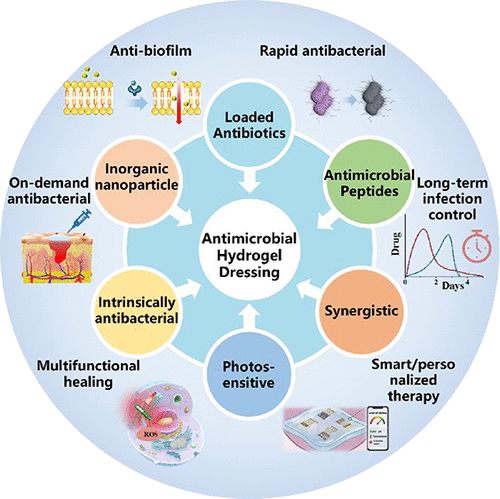
Damage to the skin barrier renders wounds susceptible to bacterial invasion, resulting in a heightened risk of infection and delayed tissue repair. With advances in materials science and biomedical engineering, antimicrobial hydrogels have emerged as promising dressing candidates for the management of both acute and chronic wounds. Owing to their high water content, excellent biocompatibility, and tunable mechanical and chemical properties, these hydrogels create a moist wound environment, facilitate cell migration, and enable localized antimicrobial regulation. In recent years, the antimicrobial efficacy, tissue-repair capacity, and multifunctionality of hydrogels have been substantially enhanced through the incorporation of inorganic nano-antimicrobial agents, the loading of therapeutic drugs or antimicrobial peptides, and the design of polymer networks with intrinsic bactericidal activity. This review systematically summarizes the main categories, construction strategies, and bactericidal mechanisms of antimicrobial hydrogels, with particular emphasis on their key performance features and advantages in wound healing, as well as an analysis of current challenges in their development. Finally, we provide an outlook on future research directions, including intelligent responsiveness, long-term antimicrobial functionality, personalized therapeutic strategies, and clinical translation. Overall, this review aims to offer insight and guidance for the advancement of efficient and safe antimicrobial hydrogel dressings.
Cited By
This article has not yet been cited by other publications.
Article Views
Altmetric
Citations
Article Views are the COUNTER-compliant sum of full text article downloads since November 2008 (both PDF and HTML) across all institutions and individuals. These metrics are regularly updated to reflect usage leading up to the last few days.
Citations are the number of other articles citing this article, calculated by Crossref and updated daily. Find more information about Crossref citation counts.
The Altmetric Attention Score is a quantitative measure of the attention that a research article has received online. Clicking on the donut icon will load a page at altmetric.com with additional details about the score and the social media presence for the given article. Find more information on the Altmetric Attention Score and how the score is calculated.