


Bioinspired Strain-Engineered Perovskite–Organic Tandem Solar Cells: Advances in Organic Semiconductors for Wearable PhotovoltaicsClick to copy article linkArticle link copied!
- Fatemeh ShiravaniFatemeh ShiravaniDepartment of Chemistry, Faculty of Sciences, Shiraz University, Shiraz 71454, IranMore by Fatemeh Shiravani
- Javad Tashkhourian*Javad Tashkhourian*Email: [email protected]. Tel: +98 71 3613 7141. Fax: +98 71 3646 0788.Department of Chemistry, Faculty of Sciences, Shiraz University, Shiraz 71454, IranMore by Javad Tashkhourian
- Glen P. MillerGlen P. MillerDepartment of Chemistry, University of New Hampshire, Durham, New Hampshire 03824-3598, United StatesMore by Glen P. Miller

Abstract
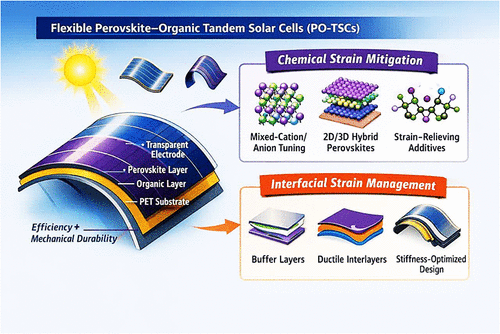
Wearable and biointegrated electronics require lightweight, flexible, and highly efficient power sources capable of adapting to dynamic human motion. Perovskite–organic tandem solar cells (P-O TSCs) have recently emerged as a promising candidate for photovoltaic applications due to their tunable bandgaps, mechanical compliance, and high transparency. In addition to the conventional optimization of devices, the bioinspired strain-engineering paradigm offers a transformative pathway to enhance both efficiency and mechanical durability. The impetus for this research derives from natural architectures, including hierarchical tissues, nacre-like layered composites, and stretchable cellular frameworks. The integration of strain-adapted perovskite and organic semiconductor layers has been demonstrated to mitigate fracture, suppress ion migration, and stabilize interfacial energetics. This review synthesizes progress from 2001 to 2026, highlighting advances in lead-free and hybrid 2D/3D perovskites, narrow-bandgap organic absorbers, next-generation organic semiconductors, and flexible transparent electrodes. Particular emphasis is placed on bioinspired strain-engineering strategies such as hierarchical interlayers, island-bridge architectures, and serpentine interconnects, decoupling global deformation from local stress and preserving electronic functionality under repeated bending. The integration of these chemical, interfacial, and structural approaches enables PO-TSCs to achieve high efficiency alongside mechanical resilience. The final barriers to commercialization are outlined and include scalability, long-term stability under multistress environments, and eco-compatibility. The integration of biomimetic design principles with materials science and device engineering offers a framework for the development of sustainable, adaptive, and industrially viable tandem photovoltaics for the next generation of wearable and transparent energy-harvesting systems.
Cited By
This article has not yet been cited by other publications.
Article Views
Altmetric
Citations
Article Views are the COUNTER-compliant sum of full text article downloads since November 2008 (both PDF and HTML) across all institutions and individuals. These metrics are regularly updated to reflect usage leading up to the last few days.
Citations are the number of other articles citing this article, calculated by Crossref and updated daily. Find more information about Crossref citation counts.
The Altmetric Attention Score is a quantitative measure of the attention that a research article has received online. Clicking on the donut icon will load a page at altmetric.com with additional details about the score and the social media presence for the given article. Find more information on the Altmetric Attention Score and how the score is calculated.