


Unconventional Materials-Based Flexible Synaptic Transistors for Sustainable Neuromorphic Systems: Advancements, Challenges, and Future TrendsClick to copy article linkArticle link copied!
- Somnath BhattacharjeeSomnath BhattacharjeeFlexible Large Area Microelectronics (FLAME) Research Group, Department of Electrical Engineering, Indian Institute of Technology Jodhpur, Jodhpur, Rajasthan 342037, IndiaMore by Somnath Bhattacharjee
- Shree Prakash Tiwari*Shree Prakash Tiwari*Email: [email protected]Flexible Large Area Microelectronics (FLAME) Research Group, Department of Electrical Engineering, Indian Institute of Technology Jodhpur, Jodhpur, Rajasthan 342037, IndiaMore by Shree Prakash Tiwari

Abstract
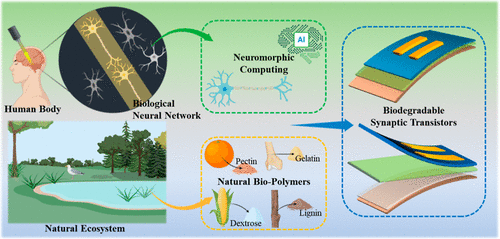
Synaptic transistors have lately emerged as a viable method for the implementation of hardware-based neuromorphic systems, emulating a biological synapse, the junction between two adjacent neurons. These artificial synaptic devices operate on minimal power (in the femtojoule range) while possessing the capability for parallel computation, hence offering the possibility to surmount the von Neumann bottleneck. The research articles published in the past decade have mostly focused on conventional transistors to emulate artificial synaptic function, which are neither sustainable nor flexible. The need for a sustainable environment has necessitated the adoption of benign and eco-friendly materials. Unconventional materials, including natural polymers, biodegradable substances, and waste-derived materials, have lately garnered attention for the fabrication of these devices. The primary objective is to attain neuromorphic functions with particular emphasis on device designs. This review mainly examines sustainable materials, including gelatin, chitosan, and cellulose-based polymers and biodegradable substrate-based devices, which have recently been reported to emulate synaptic behavior and attain neuromorphic functionalities. Moreover, this review briefly addresses details of synaptic activities such as short-term plasticity, long-term plasticity, and pulse paired facilitation, among others. Advanced AI applications, including pattern recognition and on-device learning, have been examined alongside circuit-level applications, such as various logic gates. The environmental impact of these synaptic transistors has also been discussed at the end of their lifespan. Through a detailed discussion of these topics, a comprehensive perspective has been provided to researchers across several domains, and a future pathway toward development of flexible and low-cost neuromorphic systems has been addressed.
Cited By
This article has not yet been cited by other publications.
Article Views
Altmetric
Citations
Article Views are the COUNTER-compliant sum of full text article downloads since November 2008 (both PDF and HTML) across all institutions and individuals. These metrics are regularly updated to reflect usage leading up to the last few days.
Citations are the number of other articles citing this article, calculated by Crossref and updated daily. Find more information about Crossref citation counts.
The Altmetric Attention Score is a quantitative measure of the attention that a research article has received online. Clicking on the donut icon will load a page at altmetric.com with additional details about the score and the social media presence for the given article. Find more information on the Altmetric Attention Score and how the score is calculated.