


Solar Generated Hydrogen: 2D Heterostructures for PhotocatalystsClick to copy article linkArticle link copied!
- Saba ShoaibSaba ShoaibEnergy & Catalysis Center, Department of Materials Physics and Chemistry, School of Materials Science and Engineering, Beijing Institute of Technology, Beijing 100081, P. R. ChinaMore by Saba Shoaib
- Faiza ArshadFaiza ArshadSchool of Science, Harbin Institute of Technology (Shenzhen), Shenzhen 518055, P. R. ChinaMore by Faiza Arshad
- Zhiyi SunZhiyi SunEnergy & Catalysis Center, Department of Materials Physics and Chemistry, School of Materials Science and Engineering, Beijing Institute of Technology, Beijing 100081, P. R. ChinaMore by Zhiyi Sun
- Zilong Wu*Zilong Wu*Email: [email protected]China Academy of Information and Communications Technology, Beijing 100190, P. R. ChinaMore by Zilong Wu
- Zebiao LiZebiao LiPetroChina Shenzhen New Energy Research Institute Co., Ltd., Nanshan District, Shenzhen 518052, P. R. ChinaMore by Zebiao Li
- Xinxin LuXinxin LuPetroChina Shenzhen New Energy Research Institute Co., Ltd., Nanshan District, Shenzhen 518052, P. R. ChinaMore by Xinxin Lu
- Wei GuoWei GuoCentre for Quantum Physics, Key Laboratory of Advanced Optoelectronic Quantum Architecture and Measurement (MOE), School of Physics, Beijing Institute of Technology, Beijing 100081, P. R. ChinaMore by Wei Guo
- Zhuo Chen*Zhuo Chen*Email: [email protected]Energy & Catalysis Center, Department of Materials Physics and Chemistry, School of Materials Science and Engineering, Beijing Institute of Technology, Beijing 100081, P. R. ChinaMore by Zhuo Chen

Abstract
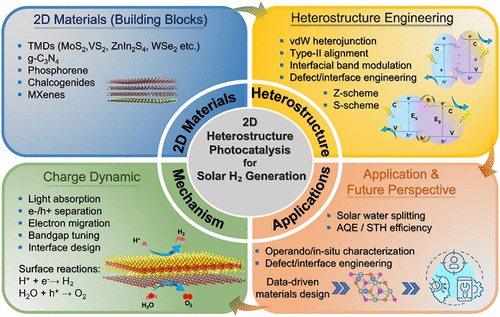
Photocatalytic water splitting offers a promising approach for sustainable hydrogen production; however, its practical application is limited by the inherent limitations of traditional bulk semiconductors, such as restricted visible-light absorption, rapid charge-carrier recombination, and insufficient operational stability. In recent years, atomically thin two-dimensional (2D) materials and their heterostructures have emerged as a highly advanced nanoscale framework for photocatalysis, attributed to their large surface-to-volume ratios, configurable electronic structures, and charge-transfer characteristics, which are dominated by interfaces. This review provides a mechanistic and materials-oriented perspective on solar-driven hydrogen generation using 2D heterostructured photocatalysts, highlighting the influence of nanoscale dimensionality and interfacial engineering on the structure-performance-property relationship and their implication for rational photocatalyst design. Initially, the review summarizes the fundamental principles of water-splitting photocatalysis and the essential requirements for enhanced efficiency, which highlights the important categories of 2D materials, including transition metal dichalcogenides, graphitic carbon nitride, phosphorene, and MXenes, and their suitability for heterostructure construction and outlines their optoelectronic advantages. Specific attention is placed on interface-engineering approaches, including van der Waals heterojunctions, type-II band alignment, Z-scheme and S-scheme designs, and interface-induced bandgap modulation, which offer effective charge stabilization while maintaining significant redox capability. The role of solar-to-hydrogen (STH) efficiency as a performance metric at the system level is conducted with a critical focus on heterostructure design. Additionally, the emerging computational and data-driven approaches, including density functional theory, high-throughput screening, and machine learning-assisted materials discovery, are also considered as effective tools for accelerating the rational design and optimization of high-performance 2D photocatalysis. The review concludes with significant challenges such as scalable production, photocorrosion resistance, and inadequate mechanistic insights while highlighting future opportunities in device integration, in situ characterization, and solar-to-fuel conversion. Collectively, this review highlights the essential role of nanoscale interface engineering in 2D heterostructured photocatalysts for enabling effective, stable, and scalable solar-driven hydrogen production, highlighting their potential for sustainable hydrogen production technologies.
Cited By
This article has not yet been cited by other publications.
Article Views
Altmetric
Citations
Article Views are the COUNTER-compliant sum of full text article downloads since November 2008 (both PDF and HTML) across all institutions and individuals. These metrics are regularly updated to reflect usage leading up to the last few days.
Citations are the number of other articles citing this article, calculated by Crossref and updated daily. Find more information about Crossref citation counts.
The Altmetric Attention Score is a quantitative measure of the attention that a research article has received online. Clicking on the donut icon will load a page at altmetric.com with additional details about the score and the social media presence for the given article. Find more information on the Altmetric Attention Score and how the score is calculated.