


This publication is Open Access under the license indicated. Learn More
Machine Learning in Heat Exchangers: State-of-the-Art ReviewClick to copy article linkArticle link copied!
- Asad AyubAsad AyubSchool of Chemical and Materials Engineering, National University of Sciences and Technology, Islamabad 44000, PakistanMore by Asad Ayub
- Iftikhar Ahmad*Iftikhar Ahmad*Email: [email protected]School of Chemical and Materials Engineering, National University of Sciences and Technology, Islamabad 44000, PakistanMore by Iftikhar Ahmad
- Ahmed QaziAhmed QaziDepartment of Chemical and Petroleum Engineering, College of Engineering, United Arab Emirates University, Al Ain 1555, United Arab EmiratesMore by Ahmed Qazi
- Hamza SethiHamza SethiSchool of Chemical and Materials Engineering, National University of Sciences and Technology, Islamabad 44000, PakistanMore by Hamza Sethi
- Muhammad Zulkefal*Muhammad Zulkefal*Email: [email protected]Department of Energy and Process Engineering, Norwegian University of Science and Technology, Trondheim 7034, NorwayMore by Muhammad Zulkefal
- Aleena ZulfiqarAleena ZulfiqarSchool of Chemical and Materials Engineering, National University of Sciences and Technology, Islamabad 44000, PakistanMore by Aleena Zulfiqar
- Wejdan DeebaniWejdan DeebaniDepartment of Mathematics, College of Science and Arts, King Abdul Aziz University, Rabigh 21911, Saudi ArabiaMore by Wejdan Deebani
ACS Engineering Au
© 2026 The Authors. Published by American Chemical Society. This publication is licensed under
License Summary*
You are free to share (copy and redistribute) this article in any medium or format and to adapt (remix, transform, and build upon) the material for any purpose, even commercially within the parameters below:

Creative Commons (CC): This is a Creative Commons license.

Attribution (BY): Credit must be given to the creator.
*Disclaimer
This summary highlights only some of the key features and terms of the actual license. It is not a license and has no legal value. Carefully review the actual license before using these materials.
Abstract
Heat exchangers play a key role in energy-efficient and sustainable industrial operations. However, process uncertainties are making realization of efficient and stable heat exchanger operation a challenge. Computational methods have been helpful in designing, operation, and control of heat exchanger. Recently, machine learning (ML) has emerged as a very effective tool in heat exchanger offline design as well as online operation and control. This review focuses on the ML methods reported in the literature on parameter estimation, such as fouling factor and heat transfer coefficient, thermal performance, control strategies, and offline and online optimization of heat exchangers. The more frequently used and effective ML methods are identified, and the gaps in research and the demands of practical implementation are elaborated. This study will provide the state of the art in ML applications in heat exchangers and will help in further studies in realizing the scaled-up digital twin realization for the Industry 4.0 mode of heat exchanger design and operation.
This publication is licensed under
License Summary*
You are free to share(copy and redistribute) this article in any medium or format and to adapt(remix, transform, and build upon) the material for any purpose, even commercially within the parameters below:
Creative Commons (CC): This is a Creative Commons license.
Attribution (BY): Credit must be given to the creator.
*Disclaimer
This summary highlights only some of the key features and terms of the actual license. It is not a license and has no legal value. Carefully review the actual license before using these materials.
License Summary*
You are free to share(copy and redistribute) this article in any medium or format and to adapt(remix, transform, and build upon) the material for any purpose, even commercially within the parameters below:
Creative Commons (CC): This is a Creative Commons license.
Attribution (BY): Credit must be given to the creator.
*Disclaimer
This summary highlights only some of the key features and terms of the actual license. It is not a license and has no legal value. Carefully review the actual license before using these materials.
License Summary*
You are free to share(copy and redistribute) this article in any medium or format and to adapt(remix, transform, and build upon) the material for any purpose, even commercially within the parameters below:
Creative Commons (CC): This is a Creative Commons license.
Attribution (BY): Credit must be given to the creator.
*Disclaimer
This summary highlights only some of the key features and terms of the actual license. It is not a license and has no legal value. Carefully review the actual license before using these materials.
Special Issue
Published as part of ACS Engineering Au special issue “AI and Machine Learning in Chemical Engineering: Breakthroughs and Applications”.
Introduction
ML Techniques
Figure 1
Figure 1. Types of ML models. (28)
Figure 2
Figure 2. ML models development steps.
Application of ML Models in Heat Exchangers
Figure 3
Figure 3. ML model applications in heat exchangers.
Estimation of Heat Exchangers Parameters
Fouling Estimation of Heat Exchangers
| heat exchanger type | ML type | model structure | input variable | output variable | model evaluation | references |
|---|---|---|---|---|---|---|
| cross flow | MLFFNN | 6-X-1 | he considered input variables were elapsed time, acid stream temperatures at the inlet and outlet, steam temperature, acid density, and the volumetric flow rate of the acid | fouling resistance | MSE = 1.811 × 10⁻¹¹ and R2 = 0.995 | Jaradi et al. (39) |
| cross flow | DLFFNN | 6-2-1 | fluid’s inlet temperature, the flow-rate ratio under fouled and clean conditions, and the outlet temperature of the fluid | fouling resistance | R2 = 0.99% | Sundar et al. (42) |
| MLFFNN | 6-1-1 | elapsed time, volumetric concentration, heat flux rate, mass flow rate, inlet temperature, and thermal conductivity as input parameters | fouling resistance | MSE = 3.9629 × 10⁻⁴ and R2 = 0.99835 | Benyekhlef et al. (41) | |
| shell and tube | MLFFNN with NARX | 6-13-3 | flow rates and temperatures of the heat exchanger streams, as well as the physical properties of the product and the crude blend | fouling resistance, product and crude outlet temperature | RMSE = 8.19 × 10⁻⁷ | Biyanto (44) |
| cross flow | MLFFNN | 5-5-1 | cold fluid’s inlet and outlet temperatures, the hot fluid inlet temperature, and the mass flow rates of both the hot and cold fluids | fouling factor | NA | Lalot and Pálsson (46) |
| single tube | MLFFNN | 7-10-1 | fluid density, wall temperature, bulk fluid temperature, flow passage diameter, fluid velocity, dissolved oxygen concentration, and elapsed time | fouling factor | MSE = 0.0013 and R2 = 0.977819 | Davoudi and Vaferi (43) |
| double tube | WNN | 4-X-1 | working fluid’s inlet and outlet temperatures, its flow velocity, and three temperature measurements taken along the heat exchanger tube wall | heat exchanger fouling | NA | Sun et al. (47) |
| heat exchanger type | ML type | model structure | input variable | output variable | model evaluation | references |
|---|---|---|---|---|---|---|
| cross flow | Gaussian process regression (GPR), decision trees, bagged trees, support vector regression (SVR), and linear regression | NA | fluid velocity, operation time, its temperature and density, the surface temperature, equivalent diameter, and the oxygen level present | fouling factor | MSE = 7.02 × 10⁻⁴ and R2 = 0.98999 | Hosseini et al. (40) |
| pre-heat exchangers | MLFFNN | 3-5-6-1 | surface temperature, Reynolds and Prandtl numbers | fouling factor | MRE = 0.2623 | Aminian and Shahhosseini (48) |
| pre-heat exchangers | MLFFNN | 3–8–1 | diameter of the tube, crude velocity, and the temperature at the tube surface | fouling rate | MRE = 15.83% | Aminian and Shahhosseini (49) |
Estimation of HTC of Heat Exchangers
| heat exchanger type | ML type | model structure | input variable | output variable | model evaluation | references |
|---|---|---|---|---|---|---|
| shell and helically coiled tube | MLFFNN | 3-8-2-2 | tube inner diameter, coil diameter and mass flow rate | HTC and pressure drop | MSE = 3.94 × 10⁻⁴ and R = 0.99673 | Colak et al. (53) |
| shell and helically coiled tube | MLFFNN | 4-9-1-1 | Reynolds and Dean numbers, coil diameter and curvature ratio | Nusselt number and performance evaluation criteria values | MSE = 2.79 × 10⁻⁷ and R = 0.99999 | Colak et al. (53) |
| ribbed triple tube | MLFFNN with BBO | 3-3-1 | nanoparticle concentration, rib pitch and rib height | overall HTC | R2 = 0.998 and RMSE = 0.030 | Bahiraei et al. (54) |
| finned-tube heat exchanger | ANFIS-CSA | 3-4-2-2-1 | frequency of the oscillations and the mean pressure | oscillatory HTC | MSE = 4.25 × 10⁻⁵ and R2 = 0.9835 | Abd Elaziz et al. (56) |
| double pipe | MLFFNN | 10-15-4-4 | density, number of parallel tubes, thermal conductivity of tube side, Reynolds number of tube side, inside friction factor, Reynolds number of annulus side, outside friction factor, series pipe number, tube side pumping power and annulus side pumping power | overall HTC | MSE = 2.19 × 10⁻³ and R = 0.98197 | Colak et al. (57) |
| tube sides pressure drop | MSE = 9.14 × 10⁻³ | |||||
| annulus sides pressure drop | MSE = 2.54 × 10⁻⁴ | |||||
| overall cost | MSE = 1.93 × 10⁻⁴ | |||||
| double pipe | MLFFNN | 8-15-4-4 | density, number of parallel tubes, thermal conductivity of tube side, Reynolds number of tube side, inside friction factor, Reynolds number of annulus side, outside friction factor and series pipe number | overall HTC | MSE = 1.11 × 10⁻⁴ and R = 0.98453 | Colak et al. (57) |
| tube sides pressure drop | MSE = 1.90 × 10⁻⁴ | |||||
| annulus sides pressure drop | MSE = 6.44 × 10⁻² | |||||
| overall cost | MSE = 5.59 × 10⁻² |
| heat exchanger type | ML type | model structure | input variable | output variable | model evaluation | references |
|---|---|---|---|---|---|---|
| finned-tube heat exchanger | MLFFNN | 2-10-1 | oscillating frequency and mean pressure | oscillatory HTC | R = 0.94696 | Rahman and Zhang (59) |
| helical heat exchanger | MLFFNN | 4-4-1 | Prandtl number, Rayleigh number, helical diameter and number of coils turn | Nusselt number | R = 0.98 | Colorado et al. (60) |
| helicoidal double pipe | ANFIS | inner and annular dean number, inner and annular Prandtl number and pitch of the coil | overall HTC | RMSE = 13.61% and R2 = 0.994 | Mehrabi et al. (61) | |
| inner pressure drop | RMSE = 5.08% and R2 = 0.995 | |||||
| annular pressure drop | RMSE = 13.81% and R2 = 0.951 |
Performance Prediction of Heat Exchangers
| heat exchanger type | ML type | model structure | input variable | output variable | model evaluation | references |
|---|---|---|---|---|---|---|
| nonadiabatic capillary tube suction line heat exchanger | MLFFNN | 7-7-2 | suction line inlet temperature, internal diameter of a capillary tube and suction line, length of the capillary tube, subcooling and heat exchanger and adiabatic inlet length | suction line outlet temperature | MRE = 1.94 × 10⁻² | lslamoglu et al. (65) |
| mass flow rate | MRE = 2.26 × 10⁻² | |||||
| performance prediction of heat exchangers Compact heat exchanger | SVR | NA | fin height, fin pitch, fin thickness, fin length and Reynolds number at the air side | Colburn factor and friction factor | MSE = 2.645 × 10⁻⁴ and MSE = 1.231 × 10⁻³ | Peng and Ling (68) |
| compact heat exchanger | BPNN | 5-6-4-2 | fin height, fin pitch, fin thickness, fin length and Reynolds number at the air side | Colburn factor and friction factor | MSE = 7.471 × 10⁻⁴ and MSE = 2.591 × 10⁻³ | Peng and Ling (68) |
| finned oval-tube | MLFFNN | 10-8-5-2 and 10-8-5-1 | air inlet angles, Reynolds number of the air side and water side, temperature of inlet air and inlet water, number of tube rows and tube-passes, outer length of major axis and minor axis, and fin collar outside diameter | Nusselt number and friction factor | Du et al. (69) | |
| shell and tube | RVFL, SMO, SVM and KNN | NA | cold fluid temperature and injected air volume flow rates | outlet temperature of hot and cold fluids and pressure drop | RMSE = 0.719167, 2.477069, 1.741808, and 1.855635 | El-Said et al. (70) |
| helically coiled tube heat exchanger | LSSVM, ANFIS, and MLP-ANN | Prandtl number, volumetric concentration and helical number | Nusselt number | MRE = 0.11, 5.94, and 5.17% | Baghban et al. (72) |
Control of Heat Exchanger
| heat exchanger type | ML type | model structure | input variable | output variable | model evaluation | references |
|---|---|---|---|---|---|---|
| double tube | ICANNI | 4-1-2 | input temperature of cold, and hot water, and cold and hot water flow | output temperature of hot and cold water | RMSE = 0.2025 | García-Morales et al. (73) |
| water-to-air fin-tube | MLFFNN | 4-5-5-1 | air and water mass flow rate, and air and water inlet temperatures | heat transfer rate | NA | Díaz et al. (81) |
| fin tube heat exchanger | MLFFNN | 5-3-1 | the predictive framework is based on dynamic inputs consisting of temperature and voltage from the last two time steps, in addition to the instantaneous voltage at the current step | present temperature | NA | Varshney et al. (78) |
| HVAC heat exchangers | MLFFNN | 5-10-1 | inlet and outlet chill water temperature, inlet temperature of hot air and chilled water and air mass flow rate | heat transfer rate | MRE = 1.38 × 10⁻² | Hu et al. (79) |
Application of Optimization Techniques in Heat Exchangers
Design Optimization of STHEs
| heat exchanger type | design variables | objective function(s) | optimization technique(s) | key findings | references |
|---|---|---|---|---|---|
| STHX | tube outside diameter, shell inside diameter and baffle spacing | total cost and overall HTC | NSGA-II-PSO | good convergence and strong exploitation to escape from local optima were two advantages of NSGA II-PSO; it was used in two cases and had a total cost that was 4.85% lower in case 1 and 1.51% lower in case 2 | Sai and Rao (82) |
| STHX with helical baffle heat exchanger | number, outer diameter and length of tube, helix angle and axial overlapped ratio | total cost and entropy generation number | MOGA | helix angle and axial overlapped ratio will decrease thermal enhancement and axial velocity, and multiobjective optimization is a better approach than single-objective optimization | Cao et al. (83) |
| STHX | shell inner and tube outer diameter, baffle cut, baffle spacing and baffle orientation angle | heat transfer rate and Pressure drop | NSGA-II and staggered baffles perform significantly better than segmented or helical baffles; heat transmission improves and pressure drop decreases with a lower baffle cut; the maximum heat transfer rate is 154,555 W, and the minimum pressure drop is 88,083.86 Pa | Saijal and Danish (84) | |
| STHX | tube layout, tube outside diameter, number of tubes, tube passes, shell diameter, baffle cut and baffle spacing | total cost | GA | the heat exchanger’s operating costs will rise as the mass flow rate and baffle count increase due to the exponential growth in pressure drops; however, by optimizing the heat transfer area with GA, the capital, operating, and total costs are reduced by 26.4, 20, 50, and 22%, respectively | Jamil et al. (85) |
| STHEs | tube outside diameter, shell inside diameter, baffle spacing and number of tube passes | total cost | ARGA | three cases associated with design were solved and compared with existing methodologies, total cost is reduced by 34.99, 28.95, and 52.71% in Case 1, Case 2 and Case 3 respectively | Iyer et al. (86) |
| heat exchanger type | design variables | objective function(s) | optimization technique(s) | key findings | references |
|---|---|---|---|---|---|
| STHX with SG, CH, and ST baffles | baffle cut, staggered angle and number of baffles | heat transfer rate and pressure drop | MOGA | STHX-ST performed better than STHX-SG and STHX-CH. If you want to improve heat transfer, a special STHX-ST at a staggered angle = 180° is not necessarily the greatest option. The ideal STHX-ST configuration is baffle cut = 0.45, staggered angle = 79°, and number of bags = 11 | Wang et al. (87) |
| STHX | helix angle, overlapped degree and inlet flow rate | overall HTC and shell-side pressure drop | MOGA | using MOGA, three configurations were optimized to decrease shell-side pressure drop and increase the overall heat transfer coefficient; the optimized configuration showed a 19.37% reduction in pressure drop and a 28.3% gain in overall HTC relative to the original design | Wen et al. (88) |
| STHX | helical angle and overlapped degree | heat transfer coefficient, pressure drop on the shell side, HTC per pressure drop and maximum shear stress | MOGA | the HTC per unit pressure drop of STHE-HB initially increases and then falls as the helical angle increases, and decreases with greater baffle overlap; flow and heat transfer respond more strongly to changes in helical angle than in baffle overlap; following optimization, the HTC per unit pressure drop improved by 14.1%, and the maximum shear stress was reduced by 4.1% | Wang et al. (89) |
| STHX | baffle cuts, baffle spacing, tube pitch, tube length and tube layout pattern | total cost and effectiveness | GA + BA | the most efficient of the 30° and 90° tube layouts is the 45° tube architecture, which also has the lowest overall cost. GA is not as efficient as BA; by increasing baffle spacing, baffle cut, and pitch, BA can reduce expenses by up to 13.7% and boost efficacy by up to 3% | Tharakeshwar et al. (90) |
| heat exchanger type | design variables | objective function(s) | optimization technique(s) | key findings | references |
|---|---|---|---|---|---|
| STHX | shell diameter, outer diameter of tube and tube bundle, tube pitch and layout angle, number of tube passes, percentage baffle cut, baffle spacing at inlet and outlet, baffle spacing at center and diametrical clearance of shell-to-baffle and tube-to-baffle | total annual cost | JA, GA, PSO and CSO | comparison of JA with GA, PSO, and CSO across two case studies indicates that JA is more suitable for handling complex constrained and unconstrained problems; in case 1, JA improved total annual cost reduction by 10.59, 2.5, and 1.24% relative to GA, PSO, and CSO; in case 2, the improvements were 16.89, 13.83, and 13.40%, respectively | Rao and Saroj (91) |
| STHX with helical baffles | helical angles, baffle overlap proportion, and inlet volume flow rate | total cost and heat transfer rate | MOGA with Kriging response surface | by employing the Kriging metamodel, the number of design points is minimized, and the optimization process is expedited; a helical angle of 15° combined with a baffle overlap fraction under 0.3 allows for a favorable balance between heat transfer rate and total cost | Wen et al. (92) |
| STHX | tube layout, pitch ratio, tube dimensions (diameter and length), number of tubes, baffle spacing ratio, and baffle cut ratio | maximize thermal efficiency | GA, FA and CS | while design factors identified by FA and CS always result in maximum STHX efficiency, GA is typically unable to identify acceptable and ideal solutions; after optimization, the maximum efficiency that can be attained using many design configurations is 83.8% | Khosravi et al. (93) |
Design Optimization of Other Types of Heat Exchangers
| heat exchanger type | design variables | objective function(s) | optimization technique(s) | key findings | references |
|---|---|---|---|---|---|
| plate fin compact heat exchanger | heat transfer rate, height of fins, number of fin layers at cold stream, transverse length of fins and spacing of fins | heat exchanger volume, pressure drop for hot side and cold side and effectiveness | NSGA-III | for experimental validation, the shear stress transport turbulence model was employed, yielding errors of 4.36% in pressure drop and 3.27% in heat transfer coefficient; following optimization, the pressure drops on the hot and cold sides decreased by approximately 55.4% and 72.3%, respectively, compared with values reported in the literature | do Nascimento et al. (96) |
| shell and helically coiled tube heat exchanger | coiled pitch and diameter, tube diameter and inlet flow rates on the tube side and shell side | heat transfer rate | GA | variations in coil pitch and tube diameter significantly influence the heat transfer rate; with constant inlet flow rates and no pressure drop constraint, the optimal structure enhanced heat flux by 110%; when the pressure drop constraint was applied, the improvement in heat flux was 3.6% | Wang et al. (97) |
| flat plate heat exchanger | fin gradient, height and thickness of fin, fin curvature length, linear cold and warm flow length, nonflow length and plate thickness. | thermal efficiency and manufacturing cost | MOEA | the MOEA-based optimization yielded a 19.962% enhancement in efficiency along with a 9.533% decrease in cost | Jilak et al. (98) |
| plate fin heat exchanger | fin height, fin width, fin length, fin offset, and fin corrugation angle | heat transfer rate and pressure drop | MOGA | optimization led to a 6.2% improvement in heat transfer rate, a 40% reduction in total pressure drop, and a 2.7% decrease in volume relative to the original design | Du et al. (99) |
| shell and double concentric tube heat exchanger | shell internal diameter, outside diameter of the outer tubes, outside diameter of the internal tubes and distance between baffles | total cost | GA | using GA, the total cost of the heat exchanger decreased by approximately 13.16%, while the heat transfer area per unit volume increased from 133.8 to 473.8 m2/m3 | Baadache and Bougriou (100) |
| heat exchanger type | design variables | objective function(s) | optimization technique(s) | key findings | references |
|---|---|---|---|---|---|
| rolling fin and tube heat exchanger | tube bundle length, number of tube rows, core width of heat exchanger, fin pitch | volume, weight and pressure drop | PSO and GA | relative to GA, PSO optimization yielded improvements, lowering the minimum volume by 3.34%, the weight by 4.31%, and the pressure drop by 14.04% | Han et al. (103) |
| tube fin heat exchanger | Reynolds number and tube ellipticity | HTC and pressure drop | NSGA-II | different Reynolds numbers and tube ellipticities were analyzed through CFD simulations; these data were applied to train and validate an ANN model for predicting HTC and pressure drop; optimization was performed using the NSGA-II algorithm; under conditions of Re = 541 and ellipticity = 0.34, the TFHE pressure drop decreased by 20% | Zeng et al. (104) |
Summary and Discussion
Conclusions
Author Information
- Iftikhar Ahmad - School of Chemical and Materials Engineering, National University of Sciences and Technology, Islamabad 44000, Pakistan;
 https://orcid.org/0000-0003-0997-2175;
- Ahmed Qazi - Department of Chemical and Petroleum Engineering, College of Engineering, United Arab Emirates University, Al Ain 1555, United Arab Emirates;https://orcid.org/0009-0002-1467-2935
Acknowledgments
This project was funded by the Deanship of Scientific Research (DSR) at King Abdulaziz University, Jeddah, under grant no. (GPIP: 2019-665-2024). The authors, therefore, acknowledge with thanks DSR for technical and financial support.
References
This article references 104 other publications.
- 1Shah, R. K.; Sekulic, D. P. Fundamentals of heat exchanger design; John Wiley & Sons: 2003.Google ScholarThere is no corresponding record for this reference.
- 2Aquaro, D.; Pieve, M. High temperature heat exchangers for power plants: Performance of advanced metallic recuperators. Applied Thermal Engineering 2007, 27, 389– 400, DOI: 10.1016/j.applthermaleng.2006.07.030Google ScholarThere is no corresponding record for this reference.
- 3Bergles, A. The implications and challenges of enhanced heat transfer for the chemical process industries. Chem. Eng. Res. Des. 2001, 79, 437– 444, DOI: 10.1205/026387601750282562Google ScholarThere is no corresponding record for this reference.
- 4Arsenyeva, O. P.; Tovazhnyanskyy, L. L.; Kapustenko, P. O.; Khavin, G. L.; Yuzbashyan, A. P.; Arsenyev, P. Y. Two types of welded plate heat exchangers for efficient heat recovery in industry. Applied Thermal Engineering 2016, 105, 763– 773, DOI: 10.1016/j.applthermaleng.2016.03.064Google ScholarThere is no corresponding record for this reference.
- 5Fryer, P. J.; Robbins, P. T. Heat transfer in food processing: ensuring product quality and safety. Applied Thermal Engineering 2005, 25, 2499– 2510, DOI: 10.1016/j.applthermaleng.2004.11.021Google ScholarThere is no corresponding record for this reference.
- 6Yan, S.-R.; Moria, H.; Pourhedayat, S.; Hashemian, M.; Asaadi, S.; Dizaji, H. S.; Jermsittiparsert, K. A critique of effectiveness concept for heat exchangers; theoretical-experimental study. Int. J. Heat Mass Transfer 2020, 159, 120160 DOI: 10.1016/j.ijheatmasstransfer.2020.120160Google ScholarThere is no corresponding record for this reference.
- 7Ghalandari, M.; Irandoost Shahrestani, M.; Maleki, A.; Safdari Shadloo, M.; El Haj Assad, M. Applications of intelligent methods in various types of heat exchangers: a review. J. Therm. Anal. Calorim. 2021, 145, 1837, DOI: 10.1007/s10973-020-10425-3Google ScholarThere is no corresponding record for this reference.
- 8Javadi, H.; Ajarostaghi, S. S. M.; Rosen, M. A.; Pourfallah, M. Performance of ground heat exchangers: A comprehensive review of recent advances. Energy 2019, 178, 207– 233, DOI: 10.1016/j.energy.2019.04.094Google ScholarThere is no corresponding record for this reference.
- 9Omidi, M.; Farhadi, M.; Jafari, M. A comprehensive review on double pipe heat exchangers. Applied Thermal Engineering 2017, 110, 1075– 1090, DOI: 10.1016/j.applthermaleng.2016.09.027Google ScholarThere is no corresponding record for this reference.
- 10Cornelissen, R.; Hirs, G. Thermodynamic optimization of a heat exchanger. International journal of heat and mass transfer 1999, 42, 951– 960, DOI: 10.1016/S0017-9310(98)00118-5Google ScholarThere is no corresponding record for this reference.
- 11Clayton, A. D.; Schweidtmann, A. M.; Clemens, G.; Manson, J. A.; Taylor, C. J.; Niño, C. G.; Chamberlain, T. W.; Kapur, N.; Blacker, A. J.; Lapkin, A. A. Automated self-optimization of multi-step reaction and separation processes using machine learning. Chemical Engineering Journal 2020, 384, 123340 DOI: 10.1016/j.cej.2019.123340Google ScholarThere is no corresponding record for this reference.
- 12Keliris, A.; Salehghaffari, H.; Cairl, B.; Krishnamurthy, P.; Maniatakos, M.; Khorrami, F. Machine learning-based defense against process-aware attacks on industrial control systems. In 2016 IEEE International Test Conference (ITC); IEEE: 2016; pp 1– 10.Google ScholarThere is no corresponding record for this reference.
- 13Dalzochio, J.; Kunst, R.; Pignaton, E.; Binotto, A.; Sanyal, S.; Favilla, J.; Barbosa, J. Machine learning and reasoning for predictive maintenance in Industry 4.0: Current status and challenges. Computers in Industry 2020, 123, 103298 DOI: 10.1016/j.compind.2020.103298Google ScholarThere is no corresponding record for this reference.
- 14Zhang, Z.; Wu, Z.; Rincon, D.; Christofides, P. D. Real-time optimization and control of nonlinear processes using machine learning. Mathematics 2019, 7, 890, DOI: 10.3390/math7100890Google ScholarThere is no corresponding record for this reference.
- 15Amruthnath, N.; Gupta, T. A research study on unsupervised machine learning algorithms for early fault detection in predictive maintenance. In 2018 5th international conference on industrial engineering and applications (ICIEA); IEEE: 2018; pp 355– 361.Google ScholarThere is no corresponding record for this reference.
- 16Ge, Z.; Song, Z.; Ding, S. X.; Huang, B. Data mining and analytics in the process industry: The role of machine learning. Ieee Access 2017, 5, 20590– 20616, DOI: 10.1109/ACCESS.2017.2756872Google ScholarThere is no corresponding record for this reference.
- 17Ghazanfari, V.; Imani, M.; Shadman, M. M.; Amini, Y.; Zahakifar, F. Numerical study on the thermal performance of the shell and tube heat exchanger using twisted tubes and Al2O3 nanoparticles. Progress in Nuclear Energy 2023, 155, 104526 DOI: 10.1016/j.pnucene.2022.104526Google ScholarThere is no corresponding record for this reference.
- 18Ramezanizadeh, M.; Ahmadi, M. H.; Nazari, M. A.; Sadeghzadeh, M.; Chen, L. A review on the utilized machine learning approaches for modeling the dynamic viscosity of nanofluids. Renewable and Sustainable Energy Reviews 2019, 114, 109345 DOI: 10.1016/j.rser.2019.109345Google ScholarThere is no corresponding record for this reference.
- 19Ahmadi, M. H.; Kumar, R.; Assad, M. E. H.; Ngo, P. T. T. Applications of machine learning methods in modeling various types of heat pipes: a review. J. Therm. Anal. Calorim. 2021, 146, 2333– 2341, DOI: 10.1007/s10973-021-10603-xGoogle ScholarThere is no corresponding record for this reference.
- 20Krzywanski, J.; Wesolowska, M.; Blaszczuk, A.; Majchrzak, A.; Komorowski, M.; Nowak, W. The non-iterative estimation of bed-to-wall heat transfer coefficient in a CFBC by fuzzy logic methods. Procedia Engineering 2016, 157, 66– 71, DOI: 10.1016/j.proeng.2016.08.339Google ScholarThere is no corresponding record for this reference.
- 21Radomska, E.; Mika, L.; Sztekler, K.; Lis, L. The impact of heat exchangers’ constructions on the melting and solidification time of phase change materials. Energies 2020, 13, 4840, DOI: 10.3390/en13184840Google ScholarThere is no corresponding record for this reference.
- 22Indumathy, M.; Sobana, S.; Panda, B.; Panda, R. C. Modelling and control of plate heat exchanger with continuous high-temperature short time milk pasteurization process–A review. Chemical Engineering Journal. Advances 2022, 11, 100305 DOI: 10.1016/j.ceja.2022.100305Google ScholarThere is no corresponding record for this reference.
- 23Bhutta, M. M. A.; Hayat, N.; Bashir, M. H.; Khan, A. R.; Ahmad, K. N.; Khan, S. CFD applications in various heat exchangers design: A review. Appl. Therm. Eng. 2012, 32, 1– 12, DOI: 10.1016/j.applthermaleng.2011.09.001Google ScholarThere is no corresponding record for this reference.
- 24Villa, L.; Zanini Brusamarello, C. Application of machine learning in monitoring fouling in heat exchangers in chemical engineering: A systematic review. Canadian Journal of Chemical Engineering 2025, 103, 1786– 1801, DOI: 10.1002/cjce.25480Google ScholarThere is no corresponding record for this reference.
- 25Zou, J.; Hirokawa, T.; An, J.; Huang, L.; Camm, J. Recent advances in the applications of machine learning methods for heat exchanger modeling─a review. Front. Energy Res. 2023, 11, 1294531 DOI: 10.3389/fenrg.2023.1294531Google ScholarThere is no corresponding record for this reference.
- 26Chu, H.; Ji, T.; Yu, X.; Liu, Z.; Rui, Z.; Xu, N. Advances in the application of machine learning to boiling heat transfer: A review. International Journal of Heat and Fluid Flow 2024, 108, 109477 DOI: 10.1016/j.ijheatfluidflow.2024.109477Google ScholarThere is no corresponding record for this reference.
- 27Sarker, I. H. Machine learning: Algorithms, real-world applications and research directions. SN Comput. Sci. 2021, 2, 160, DOI: 10.1007/s42979-021-00592-xGoogle ScholarThere is no corresponding record for this reference.
- 28Li, M.; Dai, L.; Hu, Y. Machine learning for harnessing thermal energy: From materials discovery to system optimization. ACS energy letters 2022, 7, 3204– 3226, DOI: 10.1021/acsenergylett.2c01836Google ScholarThere is no corresponding record for this reference.
- 29Jiang, T.; Gradus, J. L.; Rosellini, A. J. Supervised machine learning: a brief primer. Behavior Therapy 2020, 51, 675– 687, DOI: 10.1016/j.beth.2020.05.002Google ScholarThere is no corresponding record for this reference.
- 30Alloghani, M.; Al-Jumeily, D.; Mustafina, J.; Hussain, A.; Aljaaf, A. J. A systematic review on supervised and unsupervised machine learning algorithms for data science. Supervised and unsupervised learning for data science 2020, 3– 21, DOI: 10.1007/978-3-030-22475-2_1Google ScholarThere is no corresponding record for this reference.
- 31Ezugwu, A. E.; Ikotun, A. M.; Oyelade, O. O.; Abualigah, L.; Agushaka, J. O.; Eke, C. I.; Akinyelu, A. A. A comprehensive survey of clustering algorithms: State-of-the-art machine learning applications, taxonomy, challenges, and future research prospects. Engineering Applications of Artificial Intelligence 2022, 110, 104743 DOI: 10.1016/j.engappai.2022.104743Google ScholarThere is no corresponding record for this reference.
- 32Laskin, M.; Lee, K.; Stooke, A.; Pinto, L.; Abbeel, P.; Srinivas, A. Reinforcement learning with augmented data. In Advances in neural information processing systems; Curran Associates Inc.: 2020; Vol. 33, pp 19884– 19895.Google ScholarThere is no corresponding record for this reference.
- 33Uchendu, I.; Xiao, T.; Lu, Y.; Zhu, B.; Yan, M.; Simon, J.; Bennice, M.; Fu, C.; Ma, C.; Jiao, J. Jump-start reinforcement learning. In International Conference on Machine Learning; PMLR: 2023; pp 34556– 34583.Google ScholarThere is no corresponding record for this reference.
- 34Xu, Z.; Han, G.; Liu, L.; Zhu, H.; Peng, J. A lightweight specific emitter identification model for IIoT devices based on adaptive broad learning. IEEE Transactions on Industrial Informatics 2023, 19 (5), 7066– 7075, DOI: 10.1109/TII.2022.3206309Google ScholarThere is no corresponding record for this reference.
- 35Janiesch, C.; Zschech, P.; Heinrich, K. Machine learning and deep learning. Electronic Markets 2021, 31, 685– 695, DOI: 10.1007/s12525-021-00475-2Google ScholarThere is no corresponding record for this reference.
- 36Müller-Steinhagen, H. Advances in heat transfer. Elsevier 1999, 33, 415– 496, DOI: 10.1016/S0065-2717(08)70307-1Google ScholarThere is no corresponding record for this reference.
- 37Jradi, R.; Fguiri, A.; Marvillet, C.; Jeday, M. R. Inverse Heat Conduction and Heat Exchangers; IntechOpen: 2019.Google ScholarThere is no corresponding record for this reference.
- 38Kazi, S. N. Fouling and fouling mitigation of calcium compounds on heat exchangers by novel colloids and surface modifications. Reviews in Chemical Engineering 2020, 36, 653– 685, DOI: 10.1515/revce-2017-0076Google ScholarThere is no corresponding record for this reference.
- 39Jradi, R.; Marvillet, C.; Jeday, M. R. Analysis and estimation of cross-flow heat exchanger fouling in phosphoric acid concentration plant using response surface methodology (RSM) and artificial neural network (ANN). Sci. Rep. 2022, 12, 20437, DOI: 10.1038/s41598-022-24689-2Google ScholarThere is no corresponding record for this reference.
- 40Hosseini, S.; Khandakar, A.; Chowdhury, M. E.; Ayari, M. A.; Rahman, T.; Chowdhury, M. H.; Vaferi, B. Novel and robust machine learning approach for estimating the fouling factor in heat exchangers. Energy Reports 2022, 8, 8767– 8776, DOI: 10.1016/j.egyr.2022.06.123Google ScholarThere is no corresponding record for this reference.
- 41Benyekhlef, A.; Mohammedi, B.; Hassani, D.; Hanini, S. Application of artificial neural network (ANN-MLP) for the prediction of fouling resistance in heat exchanger to MgO-water and CuO-water nanofluids. Water Sci. Technol. 2021, 84, 538– 551, DOI: 10.2166/wst.2021.253Google ScholarThere is no corresponding record for this reference.
- 42Sundar, S.; Rajagopal, M. C.; Zhao, H.; Kuntumalla, G.; Meng, Y.; Chang, H. C.; Shao, C.; Ferreira, P.; Miljkovic, N.; Sinha, S. Fouling modeling and prediction approach for heat exchangers using deep learning. Int. J. Heat Mass Transfer 2020, 159, 120112 DOI: 10.1016/j.ijheatmasstransfer.2020.120112Google ScholarThere is no corresponding record for this reference.
- 43Davoudi, E.; Vaferi, B. Applying artificial neural networks for systematic estimation of degree of fouling in heat exchangers. Chem. Eng. Res. Des. 2018, 130, 138– 153, DOI: 10.1016/j.cherd.2017.12.017Google ScholarThere is no corresponding record for this reference.
- 44Biyanto, T. R. Fouling resistance prediction using artificial neural network nonlinear auto-regressive with exogenous input model based on operating conditions and fluid properties correlations. AIP Conf. Proc. 2016, 1737, 050001 DOI: 10.1063/1.4949304Google ScholarThere is no corresponding record for this reference.
- 45Garcia, R. F. Improving heat exchanger supervision using neural networks and rule based techniques. Expert Systems with Applications 2012, 39, 3012– 3021, DOI: 10.1016/j.eswa.2011.08.163Google ScholarThere is no corresponding record for this reference.
- 46Lalot, S.; Pálsson, H. Detection of fouling in a cross-flow heat exchanger using a neural network based technique. International Journal of Thermal Sciences 2010, 49, 675– 679, DOI: 10.1016/j.ijthermalsci.2009.10.011Google ScholarThere is no corresponding record for this reference.
- 47Sun, L.; Cai, H.; Zhang, Y.; Yang, S.; Qin, Y. Research on the fouling prediction of heat exchanger based on wavelet neural network. In 2008 IEEE Conference on Cybernetics and Intelligent Systems; IEEE: 2008; pp 961– 964.Google ScholarThere is no corresponding record for this reference.
- 48Aminian, J.; Shahhosseini, S. Evaluation of ANN modeling for prediction of crude oil fouling behavior. Applied thermal engineering 2008, 28, 668– 674, DOI: 10.1016/j.applthermaleng.2007.06.022Google ScholarThere is no corresponding record for this reference.
- 49Aminian, J.; Shahhosseini, S. Neuro-based formulation to predict fouling threshold in crude preheaters. International Communications in Heat and Mass Transfer 2009, 36, 525– 531, DOI: 10.1016/j.icheatmasstransfer.2009.01.020Google ScholarThere is no corresponding record for this reference.
- 50Mohanty, D. K.; Singru, P. M. Fouling analysis of a shell and tube heat exchanger using local linear wavelet neural network. International journal of heat and mass transfer 2014, 77, 946– 955, DOI: 10.1016/j.ijheatmasstransfer.2014.06.007Google ScholarThere is no corresponding record for this reference.
- 51Radhakrishnan, V.; Ramasamy, M.; Zabiri, H.; Do Thanh, V.; Tahir, N.; Mukhtar, H.; Hamdi, M.; Ramli, N. Heat exchanger fouling model and preventive maintenance scheduling tool. Applied Thermal Engineering 2007, 27, 2791– 2802, DOI: 10.1016/j.applthermaleng.2007.02.009Google ScholarThere is no corresponding record for this reference.
- 52Kashani, M. N.; Aminian, J.; Shahhosseini, S.; Farrokhi, M. Dynamic crude oil fouling prediction in industrial preheaters using optimized ANN based moving window technique. Chem. Eng. Res. Des. 2012, 90, 938– 949, DOI: 10.1016/j.cherd.2011.10.013Google ScholarThere is no corresponding record for this reference.
- 53Colak, A. B.; Akgul, D.; Mercan, H.; Dalkilic, A. S.; Wongwises, S. Estimation of heat transfer parameters of shell and helically coiled tube heat exchangers by machine learning. CASE STUDIES IN THERMAL ENGINEERING 2023, 42, 102713 DOI: 10.1016/j.csite.2023.102713Google ScholarThere is no corresponding record for this reference.
- 54Bahiraei, M.; Foong, L. K.; Hosseini, S.; Mazaheri, N. Neural network combined with nature-inspired algorithms to estimate overall heat transfer coefficient of a ribbed triple-tube heat exchanger operating with a hybrid nanofluid. Measurement 2021, 174, 108967 DOI: 10.1016/j.measurement.2021.108967Google ScholarThere is no corresponding record for this reference.
- 55Zheng, X.; Yang, R.; Wang, Q.; Yan, Y.; Zhang, Y.; Fu, J.; Liu, Z. Comparison of GRNN and RF algorithms for predicting heat transfer coefficient in heat exchange channels with bulges. Applied Thermal Engineering 2022, 217, 119263 DOI: 10.1016/j.applthermaleng.2022.119263Google ScholarThere is no corresponding record for this reference.
- 56Abd Elaziz, M.; Elsheikh, A. H.; Sharshir, S. W. Improved prediction of oscillatory heat transfer coefficient for a thermoacoustic heat exchanger using modified adaptive neuro-fuzzy inference system. Int. J. Refrig. 2019, 102, 47– 54, DOI: 10.1016/j.ijrefrig.2019.03.009Google ScholarThere is no corresponding record for this reference.
- 57Colak, A. B.; Açkgöz, Ö.; Mercan, H.; Dalklç, A. S.; Wongwises, S. Prediction of heat transfer coefficient, pressure drop, and overall cost of double-pipe heat exchangers using the artificial neural network. Case Stud. Therm. Eng. 2022, 39, 102391 DOI: 10.1016/j.csite.2022.102391Google ScholarThere is no corresponding record for this reference.
- 58Dheenamma, M.; Soman, D. P.; Muthamizhi, K.; Kalaichelvi, P. In pursuit of the best artificial neural network configuration for the prediction of output parameters of corrugated plate heat exchanger. Fuel 2019, 239, 461– 470, DOI: 10.1016/j.fuel.2018.11.034Google ScholarThere is no corresponding record for this reference.
- 59Rahman, A. A.; Zhang, X. Prediction of oscillatory heat transfer coefficient for a thermoacoustic heat exchanger through artificial neural network technique. Int. J. Heat Mass Transfer 2018, 124, 1088– 1096, DOI: 10.1016/j.ijheatmasstransfer.2018.04.035Google ScholarThere is no corresponding record for this reference.
- 60Colorado, D.; Ali, M.; García-Valladares, O.; Hernández, J. Heat transfer using a correlation by neural network for natural convection from vertical helical coil in oil and glycerol/water solution. Energy 2011, 36, 854– 863, DOI: 10.1016/j.energy.2010.12.029Google ScholarThere is no corresponding record for this reference.
- 61Mehrabi, M.; Pesteei, S. Modeling of heat transfer and fluid flow characteristics of helicoidal double-pipe heat exchangers using adaptive neuro-fuzzy inference system (ANFIS). International Communications in Heat and Mass Transfer 2011, 38, 525– 532, DOI: 10.1016/j.icheatmasstransfer.2010.12.025Google ScholarThere is no corresponding record for this reference.
- 62Ghasemi, N.; Maddah, H.; Mohebbi, M.; Aghayari, R.; Rohani, S. Proposing a method for combining monitored multilayered perceptron (MLP) and self-organizing map (SOM) neural networks in prediction of heat transfer parameters in a double pipe heat exchanger with nanofluid. Heat and Mass Transfer 2019, 55, 2261– 2276, DOI: 10.1007/s00231-019-02576-3Google ScholarThere is no corresponding record for this reference.
- 63Krzywanski, J.; Wesolowska, M.; Blaszczuk, A.; Majchrzak, A.; Komorowski, M.; Nowak, W. The Non-Iterative Estimation of Bed-to-Wall Heat Transfer Coefficient in a CFBC by Fuzzy Logic Methods. Procedia Engineering 2016, 157, 66– 71, DOI: 10.1016/j.proeng.2016.08.339Google ScholarThere is no corresponding record for this reference.
- 64Krzywanski, J.; Nowak, W.; Skrobek, D.; Zylka, A.; Ashraf, W. M.; Grabowska, K.; Sosnowski, M.; Kulakowska, A.; Czakiert, T.; Gao, Y. Modeling of bed-to-wall heat transfer coefficient in fluidized adsorption bed by gene expression programming approach. Powder Technol. 2025, 449, 120392 DOI: 10.1016/j.powtec.2024.120392Google ScholarThere is no corresponding record for this reference.
- 65Islamoglu, Y.; Kurt, A.; Parmaksizoglu, C. Performance prediction for non-adiabatic capillary tube suction line heat exchanger: an artificial neural network approach. Energy conversion and management 2005, 46, 223– 232, DOI: 10.1016/j.enconman.2004.02.015Google ScholarThere is no corresponding record for this reference.
- 66Ramasamy, M.; Zabiri, H.; Thanh Ha, N.; Ramli, N. Heat exchanger performance prediction modeling using NARX-type neural networks. In Proceedings of the WSEAS Int. Conf. on Waste Management, Water Pollution, Air Pollution, Indoor Climate, Arcachon, France ; 2007.Google ScholarThere is no corresponding record for this reference.
- 67Xie, G.; Sunden, B.; Wang, Q.; Tang, L. Performance predictions of laminar and turbulent heat transfer and fluid flow of heat exchangers having large tube-diameter and large tube-row by artificial neural networks. Int. J. Heat Mass Transfer 2009, 52, 2484– 2497, DOI: 10.1016/j.ijheatmasstransfer.2008.10.036Google ScholarThere is no corresponding record for this reference.
- 68Peng, H.; Ling, X. Predicting thermal–hydraulic performances in compact heat exchangers by support vector regression. Int. J. Heat Mass Transfer 2015, 84, 203– 213, DOI: 10.1016/j.ijheatmasstransfer.2015.01.017Google ScholarThere is no corresponding record for this reference.
- 69Du, X.; Chen, Z.; Meng, Q.; Song, Y. Experimental analysis and ANN prediction on performances of finned oval-tube heat exchanger under different air inlet angles with limited experimental data. Open Physics 2020, 18, 968– 980, DOI: 10.1515/phys-2020-0212Google ScholarThere is no corresponding record for this reference.
- 70El-Said, E. M.; Abd Elaziz, M.; Elsheikh, A. H. Machine learning algorithms for improving the prediction of air injection effect on the thermohydraulic performance of shell and tube heat exchanger. Applied Thermal Engineering 2021, 185, 116471 DOI: 10.1016/j.applthermaleng.2020.116471Google ScholarThere is no corresponding record for this reference.
- 71Gupta, A. K.; Kumar, P.; Sahoo, R. K.; Sahu, A. K.; Sarangi, S. K. Performance measurement of plate fin heat exchanger by exploration: ANN, ANFIS, GA, and SA. Journal of Computational Design and Engineering 2017, 4, 60– 68, DOI: 10.1016/j.jcde.2016.07.002Google ScholarThere is no corresponding record for this reference.
- 72Baghban, A.; Kahani, M.; Nazari, M. A.; Ahmadi, M. H.; Yan, W.-M. Sensitivity analysis and application of machine learning methods to predict the heat transfer performance of CNT/water nanofluid flows through coils. Int. J. Heat Mass Transfer 2019, 128, 825– 835, DOI: 10.1016/j.ijheatmasstransfer.2018.09.041Google ScholarThere is no corresponding record for this reference.
- 73García-Morales, J.; Cervantes-Bobadilla, M.; Hernández-Pérez, J.; Saavedra-Benítez, Y.; Adam-Medina, M.; Guerrero-Ramírez, G. Inverse artificial neural network control design for a double tube heat exchanger. Case Studies in Thermal Engineering 2022, 34, 102075 DOI: 10.1016/j.csite.2022.102075Google ScholarThere is no corresponding record for this reference.
- 74Carvalho, C. B.; Carvalho, E. P.; Ravagnani, M. A. Implementation of a neural network MPC for heat exchanger network temperature control. Brazilian Journal of Chemical Engineering 2020, 37, 729– 744, DOI: 10.1007/s43153-020-00058-2Google ScholarThere is no corresponding record for this reference.
- 75Bakošová, M.; Oravec, J.; Vasičkaninová, A.; Mészáros, A. Neural-network-based and robust model-based predictive control of a tubular heat exchanger. Chem. Eng. Trans. 2017, 61, 301, DOI: 10.3303/CET1761048Google ScholarThere is no corresponding record for this reference.
- 76Vasičkaninová, A.; Bakošová, M. Control of a heat exchanger using neural network predictive controller combined with auxiliary fuzzy controller. Applied Thermal Engineering 2015, 89, 1046– 1053, DOI: 10.1016/j.applthermaleng.2015.02.063Google ScholarThere is no corresponding record for this reference.
- 77Vasičkaninová, A.; Bakošová, M.; Mészáros, A.; Klemeš, J. J. Neural network predictive control of a heat exchanger. Applied Thermal Engineering 2011, 31, 2094– 2100, DOI: 10.1016/j.applthermaleng.2011.01.026Google ScholarThere is no corresponding record for this reference.
- 78Varshney, K.; Panigrahi, P. K. Artificial neural network control of a heat exchanger in a closed flow air circuit. Applied Soft Computing 2005, 5, 441– 465, DOI: 10.1016/j.asoc.2004.10.004Google ScholarThere is no corresponding record for this reference.
- 79Hu, Q.; So, A. T.; Tse, W.; Ren, Q. Development of ANN-based models to predict the static response and dynamic response of a heat exchanger in a real MVAC system. Journal of Physics: Conference Series. 2005, 23, 110, DOI: 10.1088/1742-6596/23/1/013Google ScholarThere is no corresponding record for this reference.
- 80Jahedi, G.; Ardehali, M. Wavelet based artificial neural network applied for energy efficiency enhancement of decoupled HVAC system. Energy Conversion and Management 2012, 54, 47– 56, DOI: 10.1016/j.enconman.2011.10.005Google ScholarThere is no corresponding record for this reference.
- 81Díaz, G.; Sen, M.; Yang, K.; McClain, R. L. Dynamic prediction and control of heat exchangers using artificial neural networks. International journal of heat and mass transfer 2001, 44, 1671– 1679, DOI: 10.1016/S0017-9310(00)00228-3Google ScholarThere is no corresponding record for this reference.
- 82Sai, J. P.; Rao, B. N. Non-dominated Sorting Genetic Algorithm II and Particle Swarm Optimization for design optimization of Shell and Tube Heat Exchanger. International Communications in Heat and Mass Transfer 2022, 132, 105896 DOI: 10.1016/j.icheatmasstransfer.2022.105896Google ScholarThere is no corresponding record for this reference.
- 83Cao, X.; Zhang, R.; Chen, D.; Chen, L.; Du, T.; Yu, H. Performance investigation and multi-objective optimization of helical baffle heat exchangers based on thermodynamic and economic analyses. Int. J. Heat Mass Transfer 2021, 176, 121489 DOI: 10.1016/j.ijheatmasstransfer.2021.121489Google ScholarThere is no corresponding record for this reference.
- 84Saijal, K. K.; Danish, T. Design optimization of a shell and tube heat exchanger with staggered baffles using neural network and genetic algorithm. Proceedings of the Institution of Mechanical Engineers, Part C: Journal of Mechanical Engineering Science 2021, 235, 5931– 5946, DOI: 10.1177/09544062211005797Google ScholarThere is no corresponding record for this reference.
- 85Jamil, M. A.; Goraya, T. S.; Shahzad, M. W.; Zubair, S. M. Exergoeconomic optimization of a shell-and-tube heat exchanger. Energy Conversion and Management 2020, 226, 113462 DOI: 10.1016/j.enconman.2020.113462Google ScholarThere is no corresponding record for this reference.
- 86Iyer, V. H.; Mahesh, S.; Malpani, R.; Sapre, M.; Kulkarni, A. J. Adaptive range genetic algorithm: a hybrid optimization approach and its application in the design and economic optimization of shell-and-tube heat exchanger. Engineering Applications of Artificial Intelligence 2019, 85, 444– 461, DOI: 10.1016/j.engappai.2019.07.001Google ScholarThere is no corresponding record for this reference.
- 87Wang, X.; Zheng, N.; Liu, Z.; Liu, W. Numerical analysis and optimization study on shell-side performances of a shell and tube heat exchanger with staggered baffles. Int. J. Heat Mass Transfer 2018, 124, 247– 259, DOI: 10.1016/j.ijheatmasstransfer.2018.03.081Google ScholarThere is no corresponding record for this reference.
- 88Wen, J.; Gu, X.; Wang, M.; Wang, S.; Tu, J. Numerical investigation on the multi-objective optimization of a shell-and-tube heat exchanger with helical baffles. International Communications in Heat and Mass Transfer 2017, 89, 91– 97, DOI: 10.1016/j.icheatmasstransfer.2017.09.014Google ScholarThere is no corresponding record for this reference.
- 89Wang, S.; Xiao, J.; Wang, J.; Jian, G.; Wen, J.; Zhang, Z. Configuration optimization of shell-and-tube heat exchangers with helical baffles using multi-objective genetic algorithm based on fluid-structure interaction. International Communications in Heat and Mass Transfer 2017, 85, 62– 69, DOI: 10.1016/j.icheatmasstransfer.2017.04.016Google ScholarThere is no corresponding record for this reference.
- 90Tharakeshwar, T.; Seetharamu, K.; Prasad, B. D. Multi-objective optimization using bat algorithm for shell and tube heat exchangers. Appl. Therm. Eng. 2017, 110, 1029– 1038, DOI: 10.1016/j.applthermaleng.2016.09.031Google ScholarThere is no corresponding record for this reference.
- 91Rao, R. V.; Saroj, A. Economic optimization of shell-and-tube heat exchanger using Jaya algorithm with maintenance consideration. Applied Thermal Engineering 2017, 116, 473– 487, DOI: 10.1016/j.applthermaleng.2017.01.071Google ScholarThere is no corresponding record for this reference.
- 92Wen, J.; Yang, H.; Jian, G.; Tong, X.; Li, K.; Wang, S. Energy and cost optimization of shell and tube heat exchanger with helical baffles using Kriging metamodel based on MOGA. International Journal of heat and Mass transfer 2016, 98, 29– 39, DOI: 10.1016/j.ijheatmasstransfer.2016.02.084Google ScholarThere is no corresponding record for this reference.
- 93Khosravi, R.; Khosravi, A.; Nahavandi, S.; Hajabdollahi, H. Effectiveness of evolutionary algorithms for optimization of heat exchangers. Energy conversion and management 2015, 89, 281– 288, DOI: 10.1016/j.enconman.2014.09.039Google ScholarThere is no corresponding record for this reference.
- 94Guo, J.; Cheng, L.; Xu, M. Optimization design of shell-and-tube heat exchanger by entropy generation minimization and genetic algorithm. Applied Thermal Engineering 2009, 29, 2954– 2960, DOI: 10.1016/j.applthermaleng.2009.03.011Google ScholarThere is no corresponding record for this reference.
- 95Radomska, E.; Mika, L.; Sztekler, K.; Lis, L. The Impact of Heat Exchangers’ Constructions on the Melting and Solidification Time of Phase Change Materials. Energies 2020, 13, 4840, DOI: 10.3390/en13184840Google ScholarThere is no corresponding record for this reference.
- 96do Nascimento, C. A. R.; Mariani, V. C.; dos Santos Coelho, L. Integrative numerical modeling and thermodynamic optimal design of counter-flow plate-fin heat exchanger applying neural networks. Int. J. Heat Mass Transfer 2020, 159, 120097 DOI: 10.1016/j.ijheatmasstransfer.2020.120097Google ScholarThere is no corresponding record for this reference.
- 97Wang, C.; Cui, Z.; Yu, H.; Chen, K.; Wang, J. Intelligent optimization design of shell and helically coiled tube heat exchanger based on genetic algorithm. Int. J. Heat Mass Transfer 2020, 159, 120140 DOI: 10.1016/j.ijheatmasstransfer.2020.120140Google ScholarThere is no corresponding record for this reference.
- 98Jilak, A.; Assareh, E.; Nedaei, M. Application of a novel multi-objective optimization method integrated with the artificial neural networks for optimum design of a plate heat exchanger. Australian Journal of Mechanical Engineering 2020, 18 (1), 1– 15, DOI: 10.1080/14484846.2017.1359897Google ScholarThere is no corresponding record for this reference.
- 99Du, J.; Yang, M.-N.; Yang, S.-F. Correlations and optimization of a heat exchanger with offset fins by genetic algorithm combining orthogonal design. Applied Thermal Engineering 2016, 107, 1091– 1103, DOI: 10.1016/j.applthermaleng.2016.04.074Google ScholarThere is no corresponding record for this reference.
- 100Baadache, K.; Bougriou, C. Optimisation of the design of shell and double concentric tubes heat exchanger using the Genetic Algorithm. Heat and Mass Transfer 2015, 51, 1371– 1381, DOI: 10.1007/s00231-015-1501-yGoogle ScholarThere is no corresponding record for this reference.
- 101Najafi, H.; Najafi, B.; Hoseinpoori, P. Energy and cost optimization of a plate and fin heat exchanger using genetic algorithm. Applied thermal engineering 2011, 31, 1839– 1847, DOI: 10.1016/j.applthermaleng.2011.02.031Google ScholarThere is no corresponding record for this reference.
- 102Mishra, M.; Das, P.; Sarangi, S. Second law based optimization of crossflow plate-fin heat exchanger design using genetic algorithm. Applied thermal engineering 2009, 29, 2983– 2989, DOI: 10.1016/j.applthermaleng.2009.03.009Google ScholarThere is no corresponding record for this reference.
- 103Han, W.; Tang, L.; Xie, G.; Wang, Q. Performance comparison of particle swarm optimization and genetic algorithm in rolling fin-tube heat exchanger optimization design. In Heat Transfer Summer Conference; ASME: 2008; pp 5– 10.Google ScholarThere is no corresponding record for this reference.
- 104Zheng, N.; Liu, P.; Shan, F.; Liu, Z.; Liu, W. Sensitivity analysis and multi-objective optimization of a heat exchanger tube with conical strip vortex generators. Applied Thermal Engineering 2017, 122, 642– 652, DOI: 10.1016/j.applthermaleng.2017.05.046Google ScholarThere is no corresponding record for this reference.
Cited By
This article has not yet been cited by other publications.



ACS Engineering Au
© 2026 The Authors. Published by American Chemical Society. This publication is licensed under
License Summary*
You are free to share (copy and redistribute) this article in any medium or format and to adapt (remix, transform, and build upon) the material for any purpose, even commercially within the parameters below:
Creative Commons (CC): This is a Creative Commons license.
Attribution (BY): Credit must be given to the creator.
*Disclaimer
This summary highlights only some of the key features and terms of the actual license. It is not a license and has no legal value. Carefully review the actual license before using these materials.
Article Views
Altmetric
Citations
Article Views are the COUNTER-compliant sum of full text article downloads since November 2008 (both PDF and HTML) across all institutions and individuals. These metrics are regularly updated to reflect usage leading up to the last few days.
Citations are the number of other articles citing this article, calculated by Crossref and updated daily. Find more information about Crossref citation counts.
The Altmetric Attention Score is a quantitative measure of the attention that a research article has received online. Clicking on the donut icon will load a page at altmetric.com with additional details about the score and the social media presence for the given article. Find more information on the Altmetric Attention Score and how the score is calculated.
Recommended Articles
Abstract

Figure 1
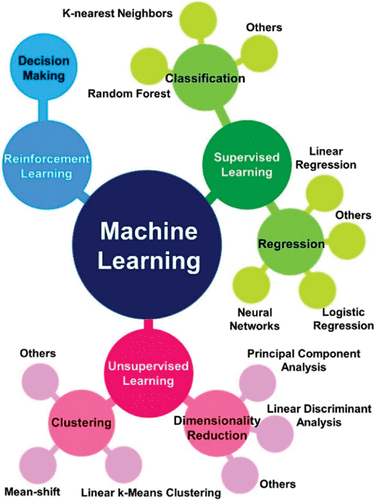
Figure 1. Types of ML models. (28)
Figure 2
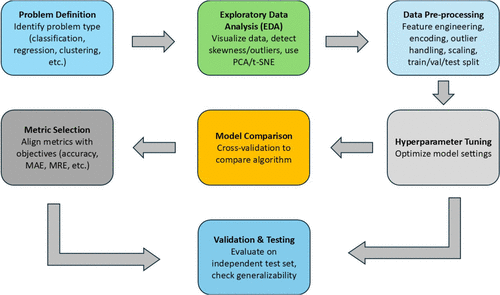
Figure 2. ML models development steps.
Figure 3

Figure 3. ML model applications in heat exchangers.
References
This article references 104 other publications.
- 1Shah, R. K.; Sekulic, D. P. Fundamentals of heat exchanger design; John Wiley & Sons: 2003.There is no corresponding record for this reference.
- 2Aquaro, D.; Pieve, M. High temperature heat exchangers for power plants: Performance of advanced metallic recuperators. Applied Thermal Engineering 2007, 27, 389– 400, DOI: 10.1016/j.applthermaleng.2006.07.030There is no corresponding record for this reference.
- 3Bergles, A. The implications and challenges of enhanced heat transfer for the chemical process industries. Chem. Eng. Res. Des. 2001, 79, 437– 444, DOI: 10.1205/026387601750282562There is no corresponding record for this reference.
- 4Arsenyeva, O. P.; Tovazhnyanskyy, L. L.; Kapustenko, P. O.; Khavin, G. L.; Yuzbashyan, A. P.; Arsenyev, P. Y. Two types of welded plate heat exchangers for efficient heat recovery in industry. Applied Thermal Engineering 2016, 105, 763– 773, DOI: 10.1016/j.applthermaleng.2016.03.064There is no corresponding record for this reference.
- 5Fryer, P. J.; Robbins, P. T. Heat transfer in food processing: ensuring product quality and safety. Applied Thermal Engineering 2005, 25, 2499– 2510, DOI: 10.1016/j.applthermaleng.2004.11.021There is no corresponding record for this reference.
- 6Yan, S.-R.; Moria, H.; Pourhedayat, S.; Hashemian, M.; Asaadi, S.; Dizaji, H. S.; Jermsittiparsert, K. A critique of effectiveness concept for heat exchangers; theoretical-experimental study. Int. J. Heat Mass Transfer 2020, 159, 120160 DOI: 10.1016/j.ijheatmasstransfer.2020.120160There is no corresponding record for this reference.
- 7Ghalandari, M.; Irandoost Shahrestani, M.; Maleki, A.; Safdari Shadloo, M.; El Haj Assad, M. Applications of intelligent methods in various types of heat exchangers: a review. J. Therm. Anal. Calorim. 2021, 145, 1837, DOI: 10.1007/s10973-020-10425-3There is no corresponding record for this reference.
- 8Javadi, H.; Ajarostaghi, S. S. M.; Rosen, M. A.; Pourfallah, M. Performance of ground heat exchangers: A comprehensive review of recent advances. Energy 2019, 178, 207– 233, DOI: 10.1016/j.energy.2019.04.094There is no corresponding record for this reference.
- 9Omidi, M.; Farhadi, M.; Jafari, M. A comprehensive review on double pipe heat exchangers. Applied Thermal Engineering 2017, 110, 1075– 1090, DOI: 10.1016/j.applthermaleng.2016.09.027There is no corresponding record for this reference.
- 10Cornelissen, R.; Hirs, G. Thermodynamic optimization of a heat exchanger. International journal of heat and mass transfer 1999, 42, 951– 960, DOI: 10.1016/S0017-9310(98)00118-5There is no corresponding record for this reference.
- 11Clayton, A. D.; Schweidtmann, A. M.; Clemens, G.; Manson, J. A.; Taylor, C. J.; Niño, C. G.; Chamberlain, T. W.; Kapur, N.; Blacker, A. J.; Lapkin, A. A. Automated self-optimization of multi-step reaction and separation processes using machine learning. Chemical Engineering Journal 2020, 384, 123340 DOI: 10.1016/j.cej.2019.123340There is no corresponding record for this reference.
- 12Keliris, A.; Salehghaffari, H.; Cairl, B.; Krishnamurthy, P.; Maniatakos, M.; Khorrami, F. Machine learning-based defense against process-aware attacks on industrial control systems. In 2016 IEEE International Test Conference (ITC); IEEE: 2016; pp 1– 10.There is no corresponding record for this reference.
- 13Dalzochio, J.; Kunst, R.; Pignaton, E.; Binotto, A.; Sanyal, S.; Favilla, J.; Barbosa, J. Machine learning and reasoning for predictive maintenance in Industry 4.0: Current status and challenges. Computers in Industry 2020, 123, 103298 DOI: 10.1016/j.compind.2020.103298There is no corresponding record for this reference.
- 14Zhang, Z.; Wu, Z.; Rincon, D.; Christofides, P. D. Real-time optimization and control of nonlinear processes using machine learning. Mathematics 2019, 7, 890, DOI: 10.3390/math7100890There is no corresponding record for this reference.
- 15Amruthnath, N.; Gupta, T. A research study on unsupervised machine learning algorithms for early fault detection in predictive maintenance. In 2018 5th international conference on industrial engineering and applications (ICIEA); IEEE: 2018; pp 355– 361.There is no corresponding record for this reference.
- 16Ge, Z.; Song, Z.; Ding, S. X.; Huang, B. Data mining and analytics in the process industry: The role of machine learning. Ieee Access 2017, 5, 20590– 20616, DOI: 10.1109/ACCESS.2017.2756872There is no corresponding record for this reference.
- 17Ghazanfari, V.; Imani, M.; Shadman, M. M.; Amini, Y.; Zahakifar, F. Numerical study on the thermal performance of the shell and tube heat exchanger using twisted tubes and Al2O3 nanoparticles. Progress in Nuclear Energy 2023, 155, 104526 DOI: 10.1016/j.pnucene.2022.104526There is no corresponding record for this reference.
- 18Ramezanizadeh, M.; Ahmadi, M. H.; Nazari, M. A.; Sadeghzadeh, M.; Chen, L. A review on the utilized machine learning approaches for modeling the dynamic viscosity of nanofluids. Renewable and Sustainable Energy Reviews 2019, 114, 109345 DOI: 10.1016/j.rser.2019.109345There is no corresponding record for this reference.
- 19Ahmadi, M. H.; Kumar, R.; Assad, M. E. H.; Ngo, P. T. T. Applications of machine learning methods in modeling various types of heat pipes: a review. J. Therm. Anal. Calorim. 2021, 146, 2333– 2341, DOI: 10.1007/s10973-021-10603-xThere is no corresponding record for this reference.
- 20Krzywanski, J.; Wesolowska, M.; Blaszczuk, A.; Majchrzak, A.; Komorowski, M.; Nowak, W. The non-iterative estimation of bed-to-wall heat transfer coefficient in a CFBC by fuzzy logic methods. Procedia Engineering 2016, 157, 66– 71, DOI: 10.1016/j.proeng.2016.08.339There is no corresponding record for this reference.
- 21Radomska, E.; Mika, L.; Sztekler, K.; Lis, L. The impact of heat exchangers’ constructions on the melting and solidification time of phase change materials. Energies 2020, 13, 4840, DOI: 10.3390/en13184840There is no corresponding record for this reference.
- 22Indumathy, M.; Sobana, S.; Panda, B.; Panda, R. C. Modelling and control of plate heat exchanger with continuous high-temperature short time milk pasteurization process–A review. Chemical Engineering Journal. Advances 2022, 11, 100305 DOI: 10.1016/j.ceja.2022.100305There is no corresponding record for this reference.
- 23Bhutta, M. M. A.; Hayat, N.; Bashir, M. H.; Khan, A. R.; Ahmad, K. N.; Khan, S. CFD applications in various heat exchangers design: A review. Appl. Therm. Eng. 2012, 32, 1– 12, DOI: 10.1016/j.applthermaleng.2011.09.001There is no corresponding record for this reference.
- 24Villa, L.; Zanini Brusamarello, C. Application of machine learning in monitoring fouling in heat exchangers in chemical engineering: A systematic review. Canadian Journal of Chemical Engineering 2025, 103, 1786– 1801, DOI: 10.1002/cjce.25480There is no corresponding record for this reference.
- 25Zou, J.; Hirokawa, T.; An, J.; Huang, L.; Camm, J. Recent advances in the applications of machine learning methods for heat exchanger modeling─a review. Front. Energy Res. 2023, 11, 1294531 DOI: 10.3389/fenrg.2023.1294531There is no corresponding record for this reference.
- 26Chu, H.; Ji, T.; Yu, X.; Liu, Z.; Rui, Z.; Xu, N. Advances in the application of machine learning to boiling heat transfer: A review. International Journal of Heat and Fluid Flow 2024, 108, 109477 DOI: 10.1016/j.ijheatfluidflow.2024.109477There is no corresponding record for this reference.
- 27Sarker, I. H. Machine learning: Algorithms, real-world applications and research directions. SN Comput. Sci. 2021, 2, 160, DOI: 10.1007/s42979-021-00592-xThere is no corresponding record for this reference.
- 28Li, M.; Dai, L.; Hu, Y. Machine learning for harnessing thermal energy: From materials discovery to system optimization. ACS energy letters 2022, 7, 3204– 3226, DOI: 10.1021/acsenergylett.2c01836There is no corresponding record for this reference.
- 29Jiang, T.; Gradus, J. L.; Rosellini, A. J. Supervised machine learning: a brief primer. Behavior Therapy 2020, 51, 675– 687, DOI: 10.1016/j.beth.2020.05.002There is no corresponding record for this reference.
- 30Alloghani, M.; Al-Jumeily, D.; Mustafina, J.; Hussain, A.; Aljaaf, A. J. A systematic review on supervised and unsupervised machine learning algorithms for data science. Supervised and unsupervised learning for data science 2020, 3– 21, DOI: 10.1007/978-3-030-22475-2_1There is no corresponding record for this reference.
- 31Ezugwu, A. E.; Ikotun, A. M.; Oyelade, O. O.; Abualigah, L.; Agushaka, J. O.; Eke, C. I.; Akinyelu, A. A. A comprehensive survey of clustering algorithms: State-of-the-art machine learning applications, taxonomy, challenges, and future research prospects. Engineering Applications of Artificial Intelligence 2022, 110, 104743 DOI: 10.1016/j.engappai.2022.104743There is no corresponding record for this reference.
- 32Laskin, M.; Lee, K.; Stooke, A.; Pinto, L.; Abbeel, P.; Srinivas, A. Reinforcement learning with augmented data. In Advances in neural information processing systems; Curran Associates Inc.: 2020; Vol. 33, pp 19884– 19895.There is no corresponding record for this reference.
- 33Uchendu, I.; Xiao, T.; Lu, Y.; Zhu, B.; Yan, M.; Simon, J.; Bennice, M.; Fu, C.; Ma, C.; Jiao, J. Jump-start reinforcement learning. In International Conference on Machine Learning; PMLR: 2023; pp 34556– 34583.There is no corresponding record for this reference.
- 34Xu, Z.; Han, G.; Liu, L.; Zhu, H.; Peng, J. A lightweight specific emitter identification model for IIoT devices based on adaptive broad learning. IEEE Transactions on Industrial Informatics 2023, 19 (5), 7066– 7075, DOI: 10.1109/TII.2022.3206309There is no corresponding record for this reference.
- 35Janiesch, C.; Zschech, P.; Heinrich, K. Machine learning and deep learning. Electronic Markets 2021, 31, 685– 695, DOI: 10.1007/s12525-021-00475-2There is no corresponding record for this reference.
- 36Müller-Steinhagen, H. Advances in heat transfer. Elsevier 1999, 33, 415– 496, DOI: 10.1016/S0065-2717(08)70307-1There is no corresponding record for this reference.
- 37Jradi, R.; Fguiri, A.; Marvillet, C.; Jeday, M. R. Inverse Heat Conduction and Heat Exchangers; IntechOpen: 2019.There is no corresponding record for this reference.
- 38Kazi, S. N. Fouling and fouling mitigation of calcium compounds on heat exchangers by novel colloids and surface modifications. Reviews in Chemical Engineering 2020, 36, 653– 685, DOI: 10.1515/revce-2017-0076There is no corresponding record for this reference.
- 39Jradi, R.; Marvillet, C.; Jeday, M. R. Analysis and estimation of cross-flow heat exchanger fouling in phosphoric acid concentration plant using response surface methodology (RSM) and artificial neural network (ANN). Sci. Rep. 2022, 12, 20437, DOI: 10.1038/s41598-022-24689-2There is no corresponding record for this reference.
- 40Hosseini, S.; Khandakar, A.; Chowdhury, M. E.; Ayari, M. A.; Rahman, T.; Chowdhury, M. H.; Vaferi, B. Novel and robust machine learning approach for estimating the fouling factor in heat exchangers. Energy Reports 2022, 8, 8767– 8776, DOI: 10.1016/j.egyr.2022.06.123There is no corresponding record for this reference.
- 41Benyekhlef, A.; Mohammedi, B.; Hassani, D.; Hanini, S. Application of artificial neural network (ANN-MLP) for the prediction of fouling resistance in heat exchanger to MgO-water and CuO-water nanofluids. Water Sci. Technol. 2021, 84, 538– 551, DOI: 10.2166/wst.2021.253There is no corresponding record for this reference.
- 42Sundar, S.; Rajagopal, M. C.; Zhao, H.; Kuntumalla, G.; Meng, Y.; Chang, H. C.; Shao, C.; Ferreira, P.; Miljkovic, N.; Sinha, S. Fouling modeling and prediction approach for heat exchangers using deep learning. Int. J. Heat Mass Transfer 2020, 159, 120112 DOI: 10.1016/j.ijheatmasstransfer.2020.120112There is no corresponding record for this reference.
- 43Davoudi, E.; Vaferi, B. Applying artificial neural networks for systematic estimation of degree of fouling in heat exchangers. Chem. Eng. Res. Des. 2018, 130, 138– 153, DOI: 10.1016/j.cherd.2017.12.017There is no corresponding record for this reference.
- 44Biyanto, T. R. Fouling resistance prediction using artificial neural network nonlinear auto-regressive with exogenous input model based on operating conditions and fluid properties correlations. AIP Conf. Proc. 2016, 1737, 050001 DOI: 10.1063/1.4949304There is no corresponding record for this reference.
- 45Garcia, R. F. Improving heat exchanger supervision using neural networks and rule based techniques. Expert Systems with Applications 2012, 39, 3012– 3021, DOI: 10.1016/j.eswa.2011.08.163There is no corresponding record for this reference.
- 46Lalot, S.; Pálsson, H. Detection of fouling in a cross-flow heat exchanger using a neural network based technique. International Journal of Thermal Sciences 2010, 49, 675– 679, DOI: 10.1016/j.ijthermalsci.2009.10.011There is no corresponding record for this reference.
- 47Sun, L.; Cai, H.; Zhang, Y.; Yang, S.; Qin, Y. Research on the fouling prediction of heat exchanger based on wavelet neural network. In 2008 IEEE Conference on Cybernetics and Intelligent Systems; IEEE: 2008; pp 961– 964.There is no corresponding record for this reference.
- 48Aminian, J.; Shahhosseini, S. Evaluation of ANN modeling for prediction of crude oil fouling behavior. Applied thermal engineering 2008, 28, 668– 674, DOI: 10.1016/j.applthermaleng.2007.06.022There is no corresponding record for this reference.
- 49Aminian, J.; Shahhosseini, S. Neuro-based formulation to predict fouling threshold in crude preheaters. International Communications in Heat and Mass Transfer 2009, 36, 525– 531, DOI: 10.1016/j.icheatmasstransfer.2009.01.020There is no corresponding record for this reference.
- 50Mohanty, D. K.; Singru, P. M. Fouling analysis of a shell and tube heat exchanger using local linear wavelet neural network. International journal of heat and mass transfer 2014, 77, 946– 955, DOI: 10.1016/j.ijheatmasstransfer.2014.06.007There is no corresponding record for this reference.
- 51Radhakrishnan, V.; Ramasamy, M.; Zabiri, H.; Do Thanh, V.; Tahir, N.; Mukhtar, H.; Hamdi, M.; Ramli, N. Heat exchanger fouling model and preventive maintenance scheduling tool. Applied Thermal Engineering 2007, 27, 2791– 2802, DOI: 10.1016/j.applthermaleng.2007.02.009There is no corresponding record for this reference.
- 52Kashani, M. N.; Aminian, J.; Shahhosseini, S.; Farrokhi, M. Dynamic crude oil fouling prediction in industrial preheaters using optimized ANN based moving window technique. Chem. Eng. Res. Des. 2012, 90, 938– 949, DOI: 10.1016/j.cherd.2011.10.013There is no corresponding record for this reference.
- 53Colak, A. B.; Akgul, D.; Mercan, H.; Dalkilic, A. S.; Wongwises, S. Estimation of heat transfer parameters of shell and helically coiled tube heat exchangers by machine learning. CASE STUDIES IN THERMAL ENGINEERING 2023, 42, 102713 DOI: 10.1016/j.csite.2023.102713There is no corresponding record for this reference.
- 54Bahiraei, M.; Foong, L. K.; Hosseini, S.; Mazaheri, N. Neural network combined with nature-inspired algorithms to estimate overall heat transfer coefficient of a ribbed triple-tube heat exchanger operating with a hybrid nanofluid. Measurement 2021, 174, 108967 DOI: 10.1016/j.measurement.2021.108967There is no corresponding record for this reference.
- 55Zheng, X.; Yang, R.; Wang, Q.; Yan, Y.; Zhang, Y.; Fu, J.; Liu, Z. Comparison of GRNN and RF algorithms for predicting heat transfer coefficient in heat exchange channels with bulges. Applied Thermal Engineering 2022, 217, 119263 DOI: 10.1016/j.applthermaleng.2022.119263There is no corresponding record for this reference.
- 56Abd Elaziz, M.; Elsheikh, A. H.; Sharshir, S. W. Improved prediction of oscillatory heat transfer coefficient for a thermoacoustic heat exchanger using modified adaptive neuro-fuzzy inference system. Int. J. Refrig. 2019, 102, 47– 54, DOI: 10.1016/j.ijrefrig.2019.03.009There is no corresponding record for this reference.
- 57Colak, A. B.; Açkgöz, Ö.; Mercan, H.; Dalklç, A. S.; Wongwises, S. Prediction of heat transfer coefficient, pressure drop, and overall cost of double-pipe heat exchangers using the artificial neural network. Case Stud. Therm. Eng. 2022, 39, 102391 DOI: 10.1016/j.csite.2022.102391There is no corresponding record for this reference.
- 58Dheenamma, M.; Soman, D. P.; Muthamizhi, K.; Kalaichelvi, P. In pursuit of the best artificial neural network configuration for the prediction of output parameters of corrugated plate heat exchanger. Fuel 2019, 239, 461– 470, DOI: 10.1016/j.fuel.2018.11.034There is no corresponding record for this reference.
- 59Rahman, A. A.; Zhang, X. Prediction of oscillatory heat transfer coefficient for a thermoacoustic heat exchanger through artificial neural network technique. Int. J. Heat Mass Transfer 2018, 124, 1088– 1096, DOI: 10.1016/j.ijheatmasstransfer.2018.04.035There is no corresponding record for this reference.
- 60Colorado, D.; Ali, M.; García-Valladares, O.; Hernández, J. Heat transfer using a correlation by neural network for natural convection from vertical helical coil in oil and glycerol/water solution. Energy 2011, 36, 854– 863, DOI: 10.1016/j.energy.2010.12.029There is no corresponding record for this reference.
- 61Mehrabi, M.; Pesteei, S. Modeling of heat transfer and fluid flow characteristics of helicoidal double-pipe heat exchangers using adaptive neuro-fuzzy inference system (ANFIS). International Communications in Heat and Mass Transfer 2011, 38, 525– 532, DOI: 10.1016/j.icheatmasstransfer.2010.12.025There is no corresponding record for this reference.
- 62Ghasemi, N.; Maddah, H.; Mohebbi, M.; Aghayari, R.; Rohani, S. Proposing a method for combining monitored multilayered perceptron (MLP) and self-organizing map (SOM) neural networks in prediction of heat transfer parameters in a double pipe heat exchanger with nanofluid. Heat and Mass Transfer 2019, 55, 2261– 2276, DOI: 10.1007/s00231-019-02576-3There is no corresponding record for this reference.
- 63Krzywanski, J.; Wesolowska, M.; Blaszczuk, A.; Majchrzak, A.; Komorowski, M.; Nowak, W. The Non-Iterative Estimation of Bed-to-Wall Heat Transfer Coefficient in a CFBC by Fuzzy Logic Methods. Procedia Engineering 2016, 157, 66– 71, DOI: 10.1016/j.proeng.2016.08.339There is no corresponding record for this reference.
- 64Krzywanski, J.; Nowak, W.; Skrobek, D.; Zylka, A.; Ashraf, W. M.; Grabowska, K.; Sosnowski, M.; Kulakowska, A.; Czakiert, T.; Gao, Y. Modeling of bed-to-wall heat transfer coefficient in fluidized adsorption bed by gene expression programming approach. Powder Technol. 2025, 449, 120392 DOI: 10.1016/j.powtec.2024.120392There is no corresponding record for this reference.
- 65Islamoglu, Y.; Kurt, A.; Parmaksizoglu, C. Performance prediction for non-adiabatic capillary tube suction line heat exchanger: an artificial neural network approach. Energy conversion and management 2005, 46, 223– 232, DOI: 10.1016/j.enconman.2004.02.015There is no corresponding record for this reference.
- 66Ramasamy, M.; Zabiri, H.; Thanh Ha, N.; Ramli, N. Heat exchanger performance prediction modeling using NARX-type neural networks. In Proceedings of the WSEAS Int. Conf. on Waste Management, Water Pollution, Air Pollution, Indoor Climate, Arcachon, France ; 2007.There is no corresponding record for this reference.
- 67Xie, G.; Sunden, B.; Wang, Q.; Tang, L. Performance predictions of laminar and turbulent heat transfer and fluid flow of heat exchangers having large tube-diameter and large tube-row by artificial neural networks. Int. J. Heat Mass Transfer 2009, 52, 2484– 2497, DOI: 10.1016/j.ijheatmasstransfer.2008.10.036There is no corresponding record for this reference.
- 68Peng, H.; Ling, X. Predicting thermal–hydraulic performances in compact heat exchangers by support vector regression. Int. J. Heat Mass Transfer 2015, 84, 203– 213, DOI: 10.1016/j.ijheatmasstransfer.2015.01.017There is no corresponding record for this reference.
- 69Du, X.; Chen, Z.; Meng, Q.; Song, Y. Experimental analysis and ANN prediction on performances of finned oval-tube heat exchanger under different air inlet angles with limited experimental data. Open Physics 2020, 18, 968– 980, DOI: 10.1515/phys-2020-0212There is no corresponding record for this reference.
- 70El-Said, E. M.; Abd Elaziz, M.; Elsheikh, A. H. Machine learning algorithms for improving the prediction of air injection effect on the thermohydraulic performance of shell and tube heat exchanger. Applied Thermal Engineering 2021, 185, 116471 DOI: 10.1016/j.applthermaleng.2020.116471There is no corresponding record for this reference.
- 71Gupta, A. K.; Kumar, P.; Sahoo, R. K.; Sahu, A. K.; Sarangi, S. K. Performance measurement of plate fin heat exchanger by exploration: ANN, ANFIS, GA, and SA. Journal of Computational Design and Engineering 2017, 4, 60– 68, DOI: 10.1016/j.jcde.2016.07.002There is no corresponding record for this reference.
- 72Baghban, A.; Kahani, M.; Nazari, M. A.; Ahmadi, M. H.; Yan, W.-M. Sensitivity analysis and application of machine learning methods to predict the heat transfer performance of CNT/water nanofluid flows through coils. Int. J. Heat Mass Transfer 2019, 128, 825– 835, DOI: 10.1016/j.ijheatmasstransfer.2018.09.041There is no corresponding record for this reference.
- 73García-Morales, J.; Cervantes-Bobadilla, M.; Hernández-Pérez, J.; Saavedra-Benítez, Y.; Adam-Medina, M.; Guerrero-Ramírez, G. Inverse artificial neural network control design for a double tube heat exchanger. Case Studies in Thermal Engineering 2022, 34, 102075 DOI: 10.1016/j.csite.2022.102075There is no corresponding record for this reference.
- 74Carvalho, C. B.; Carvalho, E. P.; Ravagnani, M. A. Implementation of a neural network MPC for heat exchanger network temperature control. Brazilian Journal of Chemical Engineering 2020, 37, 729– 744, DOI: 10.1007/s43153-020-00058-2There is no corresponding record for this reference.
- 75Bakošová, M.; Oravec, J.; Vasičkaninová, A.; Mészáros, A. Neural-network-based and robust model-based predictive control of a tubular heat exchanger. Chem. Eng. Trans. 2017, 61, 301, DOI: 10.3303/CET1761048There is no corresponding record for this reference.
- 76Vasičkaninová, A.; Bakošová, M. Control of a heat exchanger using neural network predictive controller combined with auxiliary fuzzy controller. Applied Thermal Engineering 2015, 89, 1046– 1053, DOI: 10.1016/j.applthermaleng.2015.02.063There is no corresponding record for this reference.
- 77Vasičkaninová, A.; Bakošová, M.; Mészáros, A.; Klemeš, J. J. Neural network predictive control of a heat exchanger. Applied Thermal Engineering 2011, 31, 2094– 2100, DOI: 10.1016/j.applthermaleng.2011.01.026There is no corresponding record for this reference.
- 78Varshney, K.; Panigrahi, P. K. Artificial neural network control of a heat exchanger in a closed flow air circuit. Applied Soft Computing 2005, 5, 441– 465, DOI: 10.1016/j.asoc.2004.10.004There is no corresponding record for this reference.
- 79Hu, Q.; So, A. T.; Tse, W.; Ren, Q. Development of ANN-based models to predict the static response and dynamic response of a heat exchanger in a real MVAC system. Journal of Physics: Conference Series. 2005, 23, 110, DOI: 10.1088/1742-6596/23/1/013There is no corresponding record for this reference.
- 80Jahedi, G.; Ardehali, M. Wavelet based artificial neural network applied for energy efficiency enhancement of decoupled HVAC system. Energy Conversion and Management 2012, 54, 47– 56, DOI: 10.1016/j.enconman.2011.10.005There is no corresponding record for this reference.
- 81Díaz, G.; Sen, M.; Yang, K.; McClain, R. L. Dynamic prediction and control of heat exchangers using artificial neural networks. International journal of heat and mass transfer 2001, 44, 1671– 1679, DOI: 10.1016/S0017-9310(00)00228-3There is no corresponding record for this reference.
- 82Sai, J. P.; Rao, B. N. Non-dominated Sorting Genetic Algorithm II and Particle Swarm Optimization for design optimization of Shell and Tube Heat Exchanger. International Communications in Heat and Mass Transfer 2022, 132, 105896 DOI: 10.1016/j.icheatmasstransfer.2022.105896There is no corresponding record for this reference.
- 83Cao, X.; Zhang, R.; Chen, D.; Chen, L.; Du, T.; Yu, H. Performance investigation and multi-objective optimization of helical baffle heat exchangers based on thermodynamic and economic analyses. Int. J. Heat Mass Transfer 2021, 176, 121489 DOI: 10.1016/j.ijheatmasstransfer.2021.121489There is no corresponding record for this reference.
- 84Saijal, K. K.; Danish, T. Design optimization of a shell and tube heat exchanger with staggered baffles using neural network and genetic algorithm. Proceedings of the Institution of Mechanical Engineers, Part C: Journal of Mechanical Engineering Science 2021, 235, 5931– 5946, DOI: 10.1177/09544062211005797There is no corresponding record for this reference.
- 85Jamil, M. A.; Goraya, T. S.; Shahzad, M. W.; Zubair, S. M. Exergoeconomic optimization of a shell-and-tube heat exchanger. Energy Conversion and Management 2020, 226, 113462 DOI: 10.1016/j.enconman.2020.113462There is no corresponding record for this reference.
- 86Iyer, V. H.; Mahesh, S.; Malpani, R.; Sapre, M.; Kulkarni, A. J. Adaptive range genetic algorithm: a hybrid optimization approach and its application in the design and economic optimization of shell-and-tube heat exchanger. Engineering Applications of Artificial Intelligence 2019, 85, 444– 461, DOI: 10.1016/j.engappai.2019.07.001There is no corresponding record for this reference.
- 87Wang, X.; Zheng, N.; Liu, Z.; Liu, W. Numerical analysis and optimization study on shell-side performances of a shell and tube heat exchanger with staggered baffles. Int. J. Heat Mass Transfer 2018, 124, 247– 259, DOI: 10.1016/j.ijheatmasstransfer.2018.03.081There is no corresponding record for this reference.
- 88Wen, J.; Gu, X.; Wang, M.; Wang, S.; Tu, J. Numerical investigation on the multi-objective optimization of a shell-and-tube heat exchanger with helical baffles. International Communications in Heat and Mass Transfer 2017, 89, 91– 97, DOI: 10.1016/j.icheatmasstransfer.2017.09.014There is no corresponding record for this reference.
- 89Wang, S.; Xiao, J.; Wang, J.; Jian, G.; Wen, J.; Zhang, Z. Configuration optimization of shell-and-tube heat exchangers with helical baffles using multi-objective genetic algorithm based on fluid-structure interaction. International Communications in Heat and Mass Transfer 2017, 85, 62– 69, DOI: 10.1016/j.icheatmasstransfer.2017.04.016There is no corresponding record for this reference.
- 90Tharakeshwar, T.; Seetharamu, K.; Prasad, B. D. Multi-objective optimization using bat algorithm for shell and tube heat exchangers. Appl. Therm. Eng. 2017, 110, 1029– 1038, DOI: 10.1016/j.applthermaleng.2016.09.031There is no corresponding record for this reference.
- 91Rao, R. V.; Saroj, A. Economic optimization of shell-and-tube heat exchanger using Jaya algorithm with maintenance consideration. Applied Thermal Engineering 2017, 116, 473– 487, DOI: 10.1016/j.applthermaleng.2017.01.071There is no corresponding record for this reference.
- 92Wen, J.; Yang, H.; Jian, G.; Tong, X.; Li, K.; Wang, S. Energy and cost optimization of shell and tube heat exchanger with helical baffles using Kriging metamodel based on MOGA. International Journal of heat and Mass transfer 2016, 98, 29– 39, DOI: 10.1016/j.ijheatmasstransfer.2016.02.084There is no corresponding record for this reference.
- 93Khosravi, R.; Khosravi, A.; Nahavandi, S.; Hajabdollahi, H. Effectiveness of evolutionary algorithms for optimization of heat exchangers. Energy conversion and management 2015, 89, 281– 288, DOI: 10.1016/j.enconman.2014.09.039There is no corresponding record for this reference.
- 94Guo, J.; Cheng, L.; Xu, M. Optimization design of shell-and-tube heat exchanger by entropy generation minimization and genetic algorithm. Applied Thermal Engineering 2009, 29, 2954– 2960, DOI: 10.1016/j.applthermaleng.2009.03.011There is no corresponding record for this reference.
- 95Radomska, E.; Mika, L.; Sztekler, K.; Lis, L. The Impact of Heat Exchangers’ Constructions on the Melting and Solidification Time of Phase Change Materials. Energies 2020, 13, 4840, DOI: 10.3390/en13184840There is no corresponding record for this reference.
- 96do Nascimento, C. A. R.; Mariani, V. C.; dos Santos Coelho, L. Integrative numerical modeling and thermodynamic optimal design of counter-flow plate-fin heat exchanger applying neural networks. Int. J. Heat Mass Transfer 2020, 159, 120097 DOI: 10.1016/j.ijheatmasstransfer.2020.120097There is no corresponding record for this reference.
- 97Wang, C.; Cui, Z.; Yu, H.; Chen, K.; Wang, J. Intelligent optimization design of shell and helically coiled tube heat exchanger based on genetic algorithm. Int. J. Heat Mass Transfer 2020, 159, 120140 DOI: 10.1016/j.ijheatmasstransfer.2020.120140There is no corresponding record for this reference.
- 98Jilak, A.; Assareh, E.; Nedaei, M. Application of a novel multi-objective optimization method integrated with the artificial neural networks for optimum design of a plate heat exchanger. Australian Journal of Mechanical Engineering 2020, 18 (1), 1– 15, DOI: 10.1080/14484846.2017.1359897There is no corresponding record for this reference.
- 99Du, J.; Yang, M.-N.; Yang, S.-F. Correlations and optimization of a heat exchanger with offset fins by genetic algorithm combining orthogonal design. Applied Thermal Engineering 2016, 107, 1091– 1103, DOI: 10.1016/j.applthermaleng.2016.04.074There is no corresponding record for this reference.
- 100Baadache, K.; Bougriou, C. Optimisation of the design of shell and double concentric tubes heat exchanger using the Genetic Algorithm. Heat and Mass Transfer 2015, 51, 1371– 1381, DOI: 10.1007/s00231-015-1501-yThere is no corresponding record for this reference.
- 101Najafi, H.; Najafi, B.; Hoseinpoori, P. Energy and cost optimization of a plate and fin heat exchanger using genetic algorithm. Applied thermal engineering 2011, 31, 1839– 1847, DOI: 10.1016/j.applthermaleng.2011.02.031There is no corresponding record for this reference.
- 102Mishra, M.; Das, P.; Sarangi, S. Second law based optimization of crossflow plate-fin heat exchanger design using genetic algorithm. Applied thermal engineering 2009, 29, 2983– 2989, DOI: 10.1016/j.applthermaleng.2009.03.009There is no corresponding record for this reference.
- 103Han, W.; Tang, L.; Xie, G.; Wang, Q. Performance comparison of particle swarm optimization and genetic algorithm in rolling fin-tube heat exchanger optimization design. In Heat Transfer Summer Conference; ASME: 2008; pp 5– 10.There is no corresponding record for this reference.
- 104Zheng, N.; Liu, P.; Shan, F.; Liu, Z.; Liu, W. Sensitivity analysis and multi-objective optimization of a heat exchanger tube with conical strip vortex generators. Applied Thermal Engineering 2017, 122, 642– 652, DOI: 10.1016/j.applthermaleng.2017.05.046There is no corresponding record for this reference.