


Nitric Oxide-Releasing Therapeutics for Treating Bacterial Infections: Anatomical Targeting and Therapeutic DesignClick to copy article linkArticle link copied!
- Courtney R. JohnsonCourtney R. JohnsonDepartment of Chemistry, University of North Carolina at Chapel Hill, Chapel Hill, North Carolina 27599, United StatesMore by Courtney R. Johnson
- Tsian D. RamrattanTsian D. RamrattanDepartment of Chemistry, University of North Carolina at Chapel Hill, Chapel Hill, North Carolina 27599, United StatesMore by Tsian D. Ramrattan
- Mikaylin E. NoglerMikaylin E. NoglerDepartment of Chemistry, University of North Carolina at Chapel Hill, Chapel Hill, North Carolina 27599, United StatesMore by Mikaylin E. Nogler
- Kacey N. DurkinKacey N. DurkinDepartment of Chemistry, University of North Carolina at Chapel Hill, Chapel Hill, North Carolina 27599, United StatesMore by Kacey N. Durkin
- Joseph J. MetivaJoseph J. MetivaDepartment of Chemistry, University of North Carolina at Chapel Hill, Chapel Hill, North Carolina 27599, United StatesMore by Joseph J. Metiva
- Sarah G. NagySarah G. NagyDepartment of Chemistry, University of North Carolina at Chapel Hill, Chapel Hill, North Carolina 27599, United StatesMore by Sarah G. Nagy
- Mark H. Schoenfisch*Mark H. Schoenfisch*Email: [email protected]Department of Chemistry, University of North Carolina at Chapel Hill, Chapel Hill, North Carolina 27599, United StatesEshelman School of Pharmacy, University of North Carolina at Chapel Hill, Chapel Hill, North Carolina 27599, United StatesMore by Mark H. Schoenfisch

Abstract
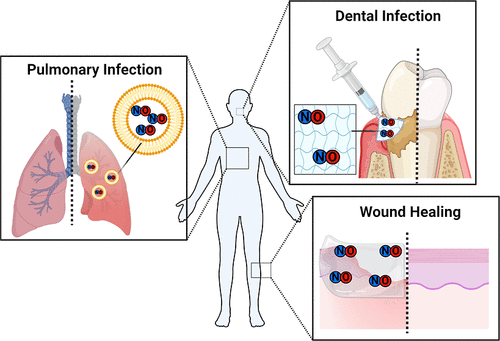
Targeted therapeutic delivery for treating bacterial infections remains underutilized in most pharmaceutical interventions. Existing therapeutics (i.e., antibiotics) are often systematically administered despite the presence of localized infection, leading to both off-target toxicity and suboptimal bacterial clearance with limited efficacy against biofilms. The overuse of antibiotics has resulted in increased antimicrobial resistance, creating a need for alternative interventions that are unlikely to confer resistance. Nitric oxide (NO), an endogenous mediator produced by macrophages and other immune cells in response to infection, elicits broad spectrum antibacterial and antibiofilm activity. The use of exogenous NO donors, alone or as conjugated ligands to macromolecular scaffolds, has proven effective in treating anatomical targets, including dermal wounds, dental infections, and pulmonary conditions, in a localized manner. In this perspective, we provide an overview of the recent advancements in NO-releasing biomaterials, highlighting design strategy and antimicrobial action across diverse anatomical sites.
Cited By
This article has not yet been cited by other publications.

Article Views
Altmetric
Citations
Article Views are the COUNTER-compliant sum of full text article downloads since November 2008 (both PDF and HTML) across all institutions and individuals. These metrics are regularly updated to reflect usage leading up to the last few days.
Citations are the number of other articles citing this article, calculated by Crossref and updated daily. Find more information about Crossref citation counts.
The Altmetric Attention Score is a quantitative measure of the attention that a research article has received online. Clicking on the donut icon will load a page at altmetric.com with additional details about the score and the social media presence for the given article. Find more information on the Altmetric Attention Score and how the score is calculated.