


Ultrasensitive Cascade Enzyme Immunoassay Electrochemical Microfluidic Chip for Early Screening of Prostate CancerClick to copy article linkArticle link copied!
- Jialuo AiJialuo AiSchool of Materials Science and Engineering, South China University of Technology, Guangzhou 510006, P. R. ChinaNational Engineering Research Center for Tissue Restoration and Reconstruction, South China University of Technology, Guangzhou 510006, P. R. ChinaMore by Jialuo Ai
- Ling YanLing YanDepartment of Clinical Laboratory, The Second Affiliated Hospital of Chongqing Medical University, Chongqing 400010, P. R. ChinaMore by Ling Yan
- Feiyu ChenFeiyu ChenSchool of Materials Science and Engineering, South China University of Technology, Guangzhou 510006, P. R. ChinaNational Engineering Research Center for Tissue Restoration and Reconstruction, South China University of Technology, Guangzhou 510006, P. R. ChinaMore by Feiyu Chen
- Hao WangHao WangCollege of Food Science, South China Agricultural University, Guangzhou 510642, P.R. ChinaMore by Hao Wang
- Wuyi ZhouWuyi ZhouResearch Center of Biomass 3D Printing Materials, College of Materials and Energy, South China Agricultural University, Guangzhou 510642, P.R. ChinaMore by Wuyi Zhou
- Yueyao LiuYueyao LiuSchool of Materials Science and Engineering, South China University of Technology, Guangzhou 510006, P. R. ChinaNational Engineering Research Center for Tissue Restoration and Reconstruction, South China University of Technology, Guangzhou 510006, P. R. ChinaMore by Yueyao Liu
- Zhongyi FengZhongyi FengSchool of Materials Science and Engineering, South China University of Technology, Guangzhou 510006, P. R. ChinaNational Engineering Research Center for Tissue Restoration and Reconstruction, South China University of Technology, Guangzhou 510006, P. R. ChinaMore by Zhongyi Feng
- Zigang Ge*Zigang Ge*Email: [email protected]Department of Biomedical Engineering, College of Future Technology, Peking University, Beijing 100871, ChinaMore by Zigang Ge
- Zhuo Jiang*Zhuo Jiang*Email: [email protected]College of Food Science, South China Agricultural University, Guangzhou 510642, P.R. ChinaMore by Zhuo Jiang
- Chengyun Ning*Chengyun Ning*Email: [email protected]School of Materials Science and Engineering, South China University of Technology, Guangzhou 510006, P. R. ChinaNational Engineering Research Center for Tissue Restoration and Reconstruction, South China University of Technology, Guangzhou 510006, P. R. ChinaMore by Chengyun Ning
- Zhengao Wang*Zhengao Wang*Email: [email protected]Research Center of Biomass 3D Printing Materials, College of Materials and Energy, South China Agricultural University, Guangzhou 510642, P.R. ChinaSchool of Materials Science and Engineering, South China University of Technology, Guangzhou 510006, P. R. ChinaMore by Zhengao Wang

Abstract
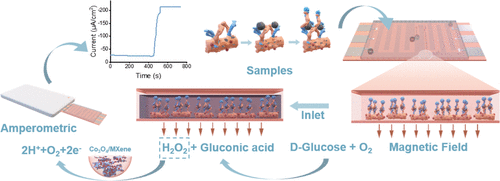
Immunosensors offer great promise for cancer diagnostics owing to their high sensitivity, specificity, and potential for miniaturization. However, conventional electrochemical immunosensors often rely on single-step enzyme reactions and single-biomarker detection, limiting their signal amplification capacity and diagnostic accuracy for complex diseases such as prostate cancer. Here, we presented an ultrasensitive cascade enzyme immunoassay electrochemical microfluidic chip (CEE-CHIP) for the simultaneous detection of multiple prostate cancer biomarkers. The system employed primary antibody-functionalized magnetic metal-organic frameworks (Fe3O4@MOF), followed by target antigens binding specifically and glucose oxidase-labeled secondary antibodies conjugating to form stable sandwich immunocomplexes. The functionalized Fe3O4@MOF were magnetically positioned within a microfluidic channel and a subsequent cascade reaction involving glucose oxidase generates H2O2. H2O2 was detected by a Co3O4/MXene-modified working electrode, resulting in amplified electrochemical signals. This system allowed for the simultaneous detection of multiple tumor markers, including prostate-specific antigen and Engrailed 2, with detection limits as low as 0.154 and 0.146 pg/mL, respectively. With a broad linear range (0.001−100 ng/mL), excellent sensitivity, and minimal sample consumption, the CEE-CHIP represented a promising non-invasive, point-of-care diagnostic platform for early prostate cancer detection and broader clinical applications.
Cited By
This article has not yet been cited by other publications.

Article Views
Altmetric
Citations
Article Views are the COUNTER-compliant sum of full text article downloads since November 2008 (both PDF and HTML) across all institutions and individuals. These metrics are regularly updated to reflect usage leading up to the last few days.
Citations are the number of other articles citing this article, calculated by Crossref and updated daily. Find more information about Crossref citation counts.
The Altmetric Attention Score is a quantitative measure of the attention that a research article has received online. Clicking on the donut icon will load a page at altmetric.com with additional details about the score and the social media presence for the given article. Find more information on the Altmetric Attention Score and how the score is calculated.