


ACS Editors' Choice® is a collection designed to feature scientific articles of broad public interest. Read the latest articles
Using In Vitro and Machine Learning Approaches to Determine Species-Specific Dioxin-like Potency and Congener-Specific Relative Sensitivity among Birds for Brominated Dioxin AnaloguesClick to copy article linkArticle link copied!
- Rui Zhang*Rui Zhang*Email: [email protected]. Phone/Fax: 86-531-82769233.School of Water Conservancy and Environment, University of Jinan, Jinan 250022, ChinaMore by Rui Zhang
- Qiuxuan WuQiuxuan WuSchool of Water Conservancy and Environment, University of Jinan, Jinan 250022, ChinaMore by Qiuxuan Wu
- Xiaoyi QiXiaoyi QiDepartment of Gynecology, Shandong Provincial Hospital, Cheeloo College of Medicine, Shandong University, Jinan 250021, ChinaDepartment of Gynecology, Shandong Provincial Hospital Affiliated to Shandong First Medical University, Jinan 250021, ChinaMore by Xiaoyi Qi
- Xiaoxiang Wang*Xiaoxiang Wang*Email: [email protected]. Phone/Fax: 86-0577-86815708.State Environmental Protection Key Laboratory of Integrated Surface Water-Groundwater Pollution Control, Guangdong Provincial Key Laboratory of Soil and Groundwater Pollution Control, School of Environmental Science and Engineering, Southern University of Science and Technology, Shenzhen 518055, ChinaYuanshang Technology Co., Ltd., Shenzhen 518126, ChinaMore by Xiaoxiang Wang
- Xuesheng Zhang*Xuesheng Zhang*Email: [email protected]School of Resources and Environmental Engineering, Anhui University, Hefei 230601, ChinaMore by Xuesheng Zhang
- Chao SongChao SongFreshwater Fisheries Research Center, Chinese Academy of Fishery Sciences, Wuxi 214081, ChinaLaboratory of Quality & Safety Risk Assessment for Aquatic Products on Environmental Factors (Wuxi), Ministry of Agriculture, Wuxi 214081, ChinaMore by Chao Song
- Ying PengYing PengResearch and Development Center for Watershed Environmental Eco-Engineering, Beijing Normal University, Zhuhai 519087, ChinaMore by Ying Peng
- Doug CrumpDoug CrumpEcotoxicology and Wildlife Health Division, Environment and Climate Change Canada, National Wildlife Research Centre, Carleton University, Ottawa K1A 0H3, CanadaMore by Doug Crump
- Xiaowei ZhangXiaowei ZhangState Key Laboratory of Pollution Control and Resources Reuse, School of the Environment, Nanjing University, Nanjing 210023, ChinaMore by Xiaowei Zhang

Abstract
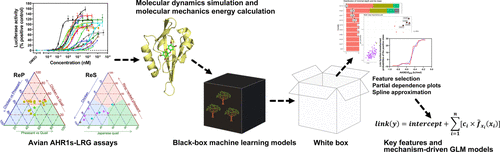
There is a paucity of experimental data regarding dioxin-like toxicity of polybrominated dibenzo-p-dioxins/dibenzofurans (PBDD/Fs) and non-ortho polybrominated biphenyls (PBBs). In this study, avian aryl hydrocarbon receptor 1 (AHR1)-luciferase reporter gene assays were used to determine their species-specific dioxin-like potencies (DLPs) and congener-specific interspecies relative sensitivities in birds. The results suggested that DLPs of the brominated congeners for chicken-like (Ile324_Ser380) species did not always follow World Health Organization toxicity equivalency factors of their chlorinated analogues. For ring-necked pheasant-like (Ile324_Ala380) and Japanese quail-like (Val324_Ala380) species, the difference in DLP for several congeners was 1 or even 2 orders of magnitude. Moreover, molecular docking and molecular dynamics simulation were performed to explore the interactions between the brominated congeners and AHR1-ligand-binding domain (LBD). The molecular mechanics energy (EMM) between each congener and each individual amino acid (AA) residue in AHR1–LBD was calculated. These EMM values could finely characterize the final conformation of species-specific AHR1–LBD for each brominated congener. Based on this, mechanism-driven generalized linear models were successfully built using machine learning algorithms and the spline approximation method, and these models could qualitatively predict the complex relationships between AHR1 conformations and DLPs or avian interspecies relative sensitivity to brominated dioxin-like compounds (DLCs). In addition, several AAs conserved among birds were found to potentially interact with species-specific AAs, thereby inducing species-specific interactions between AHR1 and brominated DLCs. The present study provides a novel strategy to facilitate the development of mechanism-driven computational prediction models for supporting safety assessment of DLCs, as well as a basis for the ecotoxicological risk assessment of brominated congeners in birds.
Cited By
This article is cited by 14 publications.
- Rui Zhang, Jian Zhai, Qiuxuan Wu, Chunlan Wei, Haiyan Zhu, Qiuli Shan, Jian Zhang, Yuwei Xie, Xuesheng Zhang, Ying Peng, Liqun Xing, Xiaowei Zhang, Doug Crump. Aryl Hydrocarbon Receptor Activation Mediates Acute Lethality and Developmental Toxicity of Polychlorinated Diphenyl Ethers in Vertebrates: Mechanistic Insights and Implications for Toxicity Equivalency Factor Frameworks. Environmental Science & Technology 2025, 59
(50)
, 27173-27185. https://doi.org/10.1021/acs.est.5c13745
- Dong-Ying Lan, Pin-Jing He, Ya-Ping Qi, Ting-Wei Wu, Hao-Yang Xian, Rui-Heng Wang, Fan Lü, Hua Zhang. Optimizing the Quality of Machine Learning for Identifying the Share of Biogenic and Fossil Carbon in Solid Waste. Analytical Chemistry 2023, 95
(9)
, 4412-4420. https://doi.org/10.1021/acs.analchem.2c04940
- Koichi Handa, Hideaki Mamada, Shinji Nakayama, Tadahaya Mizuno, Hiroaki Iwata, Tsuyoshi Esaki, Yohei Kosugi. Advances in In silico predictive models for DDI prediction: Implications and practical applications in drug discovery. Drug Metabolism and Pharmacokinetics 2026, 68 , 101532. https://doi.org/10.1016/j.dmpk.2026.101532
- Peng Liao, Zhenzhong Liu, Xianchuan Xie, Zhanli Chen, Hongliang Ji, Xiaofang Xiang, Lili Liao, Weikang Zheng, Zhengguo Fu, Ronglong Chen. QSAR modeling to describe n-octanol-water partition coefficients of perfluorinated/polyfluorinated alkyl compounds. Marine Pollution Bulletin 2025, 212 , 117594. https://doi.org/10.1016/j.marpolbul.2025.117594
- Kumuduni N. Palansooriya, Jie Li, Yanjiang Cai, Yin Wang, Zhengfeng An, Scott X. Chang. Machine learning models predict organic fertilization effects on soil organic carbon stocks in global agroecosystems. Earth Critical Zone 2025, 2 , 100033. https://doi.org/10.1016/j.ecz.2025.100033
- Yifan Pan, Yue Niu, Yongqi Fu, Shuaimeng Wang, Jing Chang, Wentao Liu, Weiyu Hao, Lu Yang, Peng Xu. Central nervous system disturbances by thiamethoxam in Japanese quail (Coturnix japonica): In vivo, ex vivo, and in silico study. Environmental Pollution 2024, 360 , 124768. https://doi.org/10.1016/j.envpol.2024.124768
- Qing Li, Yuhan Cui, Zhonghe Wang, Yu Li, Hao Yang. Toxicity assessment of dioxins and their transformation by-products from inferred degradation pathways. Science of The Total Environment 2024, 937 , 173416. https://doi.org/10.1016/j.scitotenv.2024.173416
- Congcong Zhang, Ziang Bai, Xingshuang Liu, Dan Xia, Xiang Li, Jisheng Long, Zhongtao Sun, Yaojian Li, Yifei Sun. Co-incineration of medical waste in municipal solid waste incineration increased emission of chlorine/brominated organic pollutants. Science of The Total Environment 2024, 937 , 173544. https://doi.org/10.1016/j.scitotenv.2024.173544
- Barnett A. Rattner, Thomas G. Bean, Val R. Beasley, Philippe Berny, Karen M. Eisenreich, John E. Elliott, Margaret L. Eng, Phyllis C. Fuchsman, Mason D. King, Rafael Mateo, Carolyn B. Meyer, Jason M. O'Brien, Christopher J. Salice. Wildlife ecological risk assessment in the 21st century: Promising technologies to assess toxicological effects. Integrated Environmental Assessment and Management 2024, 20
(3)
, 725-748. https://doi.org/10.1002/ieam.4806
- Yuqi Wang, Yunpeng Song, Wanxin Yin, Hewen Li, Jiaqiang Lv, Ai-Jie Wang, Hong-Cheng Wang. Modeling processes and sensitivity analysis of machine learning methods for environmental data. 2024, 511-522. https://doi.org/10.1016/B978-0-443-14170-6.00016-0
- Ying He, Guohong Liu, Song Hu, Xiaohong Wang, Jianbo Jia, Hongyu Zhou, Xiliang Yan. Implementing comprehensive machine learning models of multispecies toxicity assessment to improve regulation of organic compounds. Journal of Hazardous Materials 2023, 458 , 131942. https://doi.org/10.1016/j.jhazmat.2023.131942
- Jie Li, Lanjia Pan, Zhiwei Li, Yin Wang. Unveiling the migration of Cr and Cd to biochar from pyrolysis of manure and sludge using machine learning. Science of The Total Environment 2023, 885 , 163895. https://doi.org/10.1016/j.scitotenv.2023.163895
- Haoyue Tan, Rong Zhang, Qinchang Chen, Chi Zhang, Jing Guo, Xiaowei Zhang, Hongxia Yu, Wei Shi. Computational toxicology studies on the interactions between environmental contaminants and biomacromolecules. Chinese Science Bulletin 2022, 67
(35)
, 4180-4191. https://doi.org/10.1360/TB-2022-0613
- Huifang Zhong, Wencheng Liu, Ningqi Li, Donghui Ma, Chunyan Zhao, Juan Li, Yawei Wang, Guibin Jiang. Assessment of perfluorohexane sulfonic acid (PFHxS)-related compounds degradation potential: Computational and experimental approaches. Journal of Hazardous Materials 2022, 436 , 129240. https://doi.org/10.1016/j.jhazmat.2022.129240

Article Views are the COUNTER-compliant sum of full text article downloads since November 2008 (both PDF and HTML) across all institutions and individuals. These metrics are regularly updated to reflect usage leading up to the last few days.
Citations are the number of other articles citing this article, calculated by Crossref and updated daily. Find more information about Crossref citation counts.
The Altmetric Attention Score is a quantitative measure of the attention that a research article has received online. Clicking on the donut icon will load a page at altmetric.com with additional details about the score and the social media presence for the given article. Find more information on the Altmetric Attention Score and how the score is calculated.