


ACS Editors' Choice® is a collection designed to feature scientific articles of broad public interest. Read the latest articles
N6-Methyladenosine Modification Regulates Prunus Necrotic Ringspot Virus Infection in Cucumis sativusClick to copy article linkArticle link copied!
- Zhenfei DongZhenfei DongDepartment of Fruit Science, College of Horticulture, China Agricultural University, Beijing 100193, ChinaState Key Laboratory for Biology of Plant Diseases and Insect Pests, Institute of Plant Protection, Chinese Academy of Agricultural Sciences, Beijing 100193, ChinaMore by Zhenfei Dong
- Na LiuNa LiuState Key Laboratory for Biology of Plant Diseases and Insect Pests, Institute of Plant Protection, Chinese Academy of Agricultural Sciences, Beijing 100193, ChinaMore by Na Liu
- Zhixiang ZhangZhixiang ZhangState Key Laboratory for Biology of Plant Diseases and Insect Pests, Institute of Plant Protection, Chinese Academy of Agricultural Sciences, Beijing 100193, ChinaMore by Zhixiang Zhang
- Hongqing WangHongqing WangDepartment of Fruit Science, College of Horticulture, China Agricultural University, Beijing 100193, ChinaMore by Hongqing Wang
- Shifang Li*Shifang Li*Email: [email protected]State Key Laboratory for Biology of Plant Diseases and Insect Pests, Institute of Plant Protection, Chinese Academy of Agricultural Sciences, Beijing 100193, ChinaCenter for Biosafety, Chinese Academy of Inspection and Quarantine, Sanya 572024, Hainan, ChinaMore by Shifang Li
- Binhui Zhan*Binhui Zhan*Email: [email protected]State Key Laboratory for Biology of Plant Diseases and Insect Pests, Institute of Plant Protection, Chinese Academy of Agricultural Sciences, Beijing 100193, ChinaMore by Binhui Zhan

Abstract
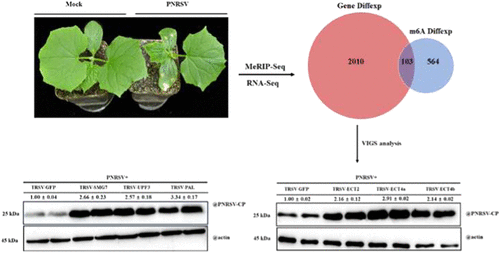
N6-methyladenosine (m6A) is a common epigenetic modification found in eukaryotic RNA. Recent studies have increasingly highlighted the importance of m6A modification in plant defense against viruses. In this investigation, we found that prunus necrotic ringspot virus (PNRSV) infection affected the m6A modification process. Plant transcriptomes and epitranscriptomes were sequenced to coanalyze the dynamic changes of m6A modifications after PNRSV infection. Further studies revealed that the silencing of evolutionarily conserved C-terminal region (ECTs), encoding m6A readers, led to increased PNRSV accumulation, indicating that ECTs confer resistance to PNRSV. Additionally, we demonstrated that UPF3 and SMG7, which are involved in non-sense-mediated mRNA decay pathways, as well as phenylalanine ammonia-lyase (PAL), a well-known key enzyme in plant defense and an identified m6A-modified gene following PNRSV infection, play crucial roles in regulating PNRSV infection. These findings provide new insights into understanding PNRSV infection and further elucidate the role of m6A in modulating viral infection in plants.
Cited By
This article is cited by 1 publications.
- Rakesh Srivastava, Niraj Lodhi. Role of m6A mRNA Methylation in Plant Defense. Epigenomes 2025, 9
(4)
, 42. https://doi.org/10.3390/epigenomes9040042

Article Views are the COUNTER-compliant sum of full text article downloads since November 2008 (both PDF and HTML) across all institutions and individuals. These metrics are regularly updated to reflect usage leading up to the last few days.
Citations are the number of other articles citing this article, calculated by Crossref and updated daily. Find more information about Crossref citation counts.
The Altmetric Attention Score is a quantitative measure of the attention that a research article has received online. Clicking on the donut icon will load a page at altmetric.com with additional details about the score and the social media presence for the given article. Find more information on the Altmetric Attention Score and how the score is calculated.