


This publication is free to access through this site. Learn More

ACS Editors' Choice® is a collection designed to feature scientific articles of broad public interest. Read the latest articles
Routes to the Density Profile and Structural InconsistencyClick to copy article linkArticle link copied!
- S. M. Tschopp*S. M. Tschopp*Email: [email protected]Department of Physics, University of Fribourg, CH-1700 Fribourg, SwitzerlandMore by S. M. Tschopp
- H. Vahid*H. Vahid*Email: [email protected]Leibniz-Institute for Polymer Research, Institute Theory of Polymers, D-01069 Dresden, GermanyMore by H. Vahid
- J. M. Brader*J. M. Brader*Email: [email protected]Department of Physics, University of Fribourg, CH-1700 Fribourg, SwitzerlandMore by J. M. Brader
Abstract
Classical density functional theory (DFT) is the primary method for investigations of inhomogeneous fluids in external fields. It requires the excess Helmholtz free energy functional as input to an Euler–Lagrange equation for the one-body density. A variant of this methodology, the force-DFT, uses instead the Yvon–Born–Green equation to generate density profiles. It is known that the latter are consistent with the virial route to the thermodynamics, while DFT is consistent with the compressibility route. In this work we will show an alternative DFT scheme using the Lovett–Mou–Buff–Wertheim (LMBW) equation to obtain density profiles, that are shown to be also consistent with the compressibility route. However, force-DFT and LMBW DFT can both be implemented using a closure relation on the level of the two-body correlation functions. This is proven to be an advantageous feature, opening the possibility of an optimization scheme in which the structural inconsistency between different routes to the density profile is minimized. (“Structural inconsistency” is a generalization of the notion of thermodynamic inconsistency, familiar from bulk integral equation studies). Numerical results are given for the density profiles of two-dimensional systems of hard-core Yukawa particles with a repulsive or an attractive tail, in planar geometry.
This publication is licensed for personal use by The American Chemical Society.
Special Issue
Published as part of The Journal of Physical Chemistry B special issue “Classical Density Functional Theory in Physical Chemistry”.
1. Introduction
2. Methods
2.1. Bulk Fluids
2.1.1. The Bulk Ornstein–Zernike Equation
2.1.2. Two Routes to Calculate the Pressure
2.1.2.1. The Virial Route
2.1.2.2. The Compressibility Route
2.2. Inhomogeneous Fluids
2.2.1. The Inhomogeneous Ornstein–Zernike Equation
2.2.2. Two Routes to the One-Body Density
2.2.2.1. The Yvon–Born–Green Equation
2.2.2.2. The Lovett–Mou–Buff–Wertheim Equation
2.2.3. Closure Relation Approximations
2.2.4. Wall Contact Theorem
2.3. Numerical Implementation
2.3.1. System of Interest: Specification of the Interparticle and External Potentials
2.3.1.1. Choice of the Interparticle Pair Potential
2.3.1.2. Choice of External Potentials
Figure 1
2.3.2. Obtaining the Inhomogeneous Density Profiles
2.3.2.1. YBG and LMBW DFT in Two-Dimensional Planar Geometry
2.3.2.2. Accounting for Discontinuities
2.3.2.3. The Inhomogeneous OZ Equation in Two-Dimensional Planar Geometry
2.3.3. Generating Simulation Data for Comparison
3. Results
3.1. Contact Theorem
Figure 2
Figure 2. Testing the contact theorem. We consider two types of HCY particles 25, both with α = 2. Column 1, shows results for κ = −1.5 < 0, thus an attractive tail. Column 2, shows results for particles with a repulsive tail, with κ = 10 > 0. In panels A, we show reduced pressure curves calculated using both the virial 3 and compressibility 7 equations of state, given by the solid orange and dashed lime green curves, respectively. The red circles show the results obtained via eq 24, when the input density profile is generated by the YBG eq 17. The green circles show the same, when the input density profile is generated by the LMBW eq 20. In panels B, we show the contact theorem integrand as solid green lines and the density profile generated by the LMBW equation as dashed green lines, to illustrate how we obtain the circles shown in panels A.
3.2. Optimization by Enforcing Structural Consistency
3.2.1. Packed System
Figure 3
Figure 3. Optimization of the density profiles using the Modified Verlet closure. In panels A we show density profiles calculated using the YBG and LMBW equations for various values of the optimization parameter, αV. Since the profiles are symmetric about z = 0 we show both YBG and LMBW profiles on the same plot for ease of comparison. The left column of panels concern results for ⟨N⟩ = 0.4, while the right column is for ⟨N⟩ = 0.8. Panels B show the root-mean-square difference between the profiles obtained using the two different routes as a function of αV. The minimum of both curves is found to be at αV = 1.6. Panels C show the profiles at this optimal value of αV and demonstrate the improved structural consistency compared with the standard Verlet closure. We also show simulation data as dotted black curves for comparison.
3.2.2. Pressure Curves
Figure 4
Figure 4. Bulk pressure optimization using the Modified Verlet closure. In panel A we show the bulk pressure from the virial 3 and compressibility 7 equations as a function of the bulk density. The dashed sea green lines show the results obtained using the standard Verlet closure, as in Figure 2. Increasing the parameter αV from 0.8 (the standard Verlet value) to 1.6 leads to a reduction of thermodynamic inconsistency. Virial pressures are shown as solid lime green lines, while the compressibility pressures are shown in orange. In panel B we show only the pressures for the standard Verlet closure and the Modified Verlet closure with the optimized αV = 1.6. Panels C show zooms of the data from panel B to focus on different density regimes. We added simulation data as dotted black curves to panels B and C for comparison.
3.3. Test on a Different External Potential
Figure 5
Figure 5. Application of the optimized closure to a harmonic trap. We show density profiles in the external field 28. In panels A the average number of particles per unit length is ⟨N⟩ = 0.8, while in panels B its value is ⟨N⟩ = 1.0. The first column (in sea green) shows results using the standard Verlet closure. The second column (in purple) shows results using the Modified Verlet closure for fixed optimized αV = 1.6. The density profiles calculated with the LMBW equation are given by solid green lines and the ones calculated with the YBG equation are in dashed red. The simulation data are given by the dotted black curves. It is clear that in both test-cases the Modified Verlet closure with αV = 1.6 reduces the structural inconsistency in comparison to the results from the standard Verlet closure.
4. Discussion & Conclusions
Author Information
- S. M. Tschopp - Department of Physics, University of Fribourg, CH-1700 Fribourg, Switzerland;
 https://orcid.org/0000-0003-3259-052X;
Appendix A
Detailed Calculations to Account for Discontinuities
Appendix B
Details on the Simulation Data Curves
Packed System
Pressure Curve
Test on a Different External Potential
References
This article references 71 other publications.
- 1Rosenfeld, Y. Free-energy model for the inhomogeneous hard-sphere fluid mixture and density-functional theory of freezing. Phys. Rev. Lett. 1989, 63, 980, DOI: 10.1103/PhysRevLett.63.980Google ScholarThere is no corresponding record for this reference.
- 2Tarazona, P. Density functional for hard sphere crystals: A fundamental measure approach. Phys. Rev. Lett. 2000, 84, 694, DOI: 10.1103/PhysRevLett.84.694Google ScholarThere is no corresponding record for this reference.
- 3Roth, R. Fundamental measure theory for hard-sphere mixtures: a review. J. Phys.:Condens. Matter 2010, 22, 063102, DOI: 10.1088/0953-8984/22/6/063102Google ScholarThere is no corresponding record for this reference.
- 4Wittmann, R.; Marechal, M.; Mecke, K. Fundamental mixed measure theory for non-spherical colloids. Europhys. Lett. 2015, 109, 26003, DOI: 10.1209/0295-5075/109/26003Google ScholarThere is no corresponding record for this reference.
- 5Cuesta, J. A. Fluid mixtures of parallel hard cubes. Phys. Rev. Lett. 1996, 76, 3742, DOI: 10.1103/PhysRevLett.76.3742Google ScholarThere is no corresponding record for this reference.
- 6Roth, R.; Mecke, K.; Oettel, M. Communication: Fundamental measure theory for hard disks: Fluid and solid. J. Chem. Phys. 2012, 136, 081101, DOI: 10.1063/1.3687921Google ScholarThere is no corresponding record for this reference.
- 7Barker, J. A.; Henderson, D. What is liquid? understanding the states of matter. Rev. Mod. Phys. 1976, 48, 587, DOI: 10.1103/RevModPhys.48.587Google ScholarThere is no corresponding record for this reference.
- 8Evans, R. The nature of the liquid-vapour interface and other topics in the statistical mechanics of non-uniform, classical fluids. Adv. Phys. 1979, 28, 143, DOI: 10.1080/00018737900101365Google ScholarThere is no corresponding record for this reference.
- 9Evans, R. In Ch. 3 in Fundamentals of Inhomogeneous Fluids; Henderson, D., Ed.; Marcel Dekker: New York, 1992.Google ScholarThere is no corresponding record for this reference.
- 10Rosenfeld, Y. Free energy model for inhomogeneous fluid mixtures: Yukawa-charged hard spheres, general interactions, and plasmas. J. Chem. Phys. 1993, 98, 8126, DOI: 10.1063/1.464569Google ScholarThere is no corresponding record for this reference.
- 11Oettel, M. Integral equations for simple fluids in a general reference functional approach. J. Phys.:Condens. Matter 2005, 17, 429, DOI: 10.1088/0953-8984/17/3/003Google ScholarThere is no corresponding record for this reference.
- 12Tschopp, S. M.; Vuijk, H. D.; Sharma, A.; Brader, J. M. Mean-field theory of inhomogeneous fluids. Phys. Rev. E 2020, 102, 042140, DOI: 10.1103/PhysRevE.102.042140Google ScholarThere is no corresponding record for this reference.
- 13Dijkman, J.; Dijkstra, M.; van Roij, R.; Welling, M.; van de Meent, J.-W.; Ensing, B. Learning neural free-energy functionals with pair-correlation matching. Phys. Rev. Lett. 2025, 134, 056103, DOI: 10.1103/PhysRevLett.134.056103Google ScholarThere is no corresponding record for this reference.
- 14Sammüller, F.; Hermann, S.; de las Heras, D.; Schmidt, M. Neural functional theory for inhomogeneous fluids: Fundamentals and applications. Proc. Natl. Acad. Sci. U.S.A. 2023, 120, e2312484120 DOI: 10.1073/pnas.2312484120Google ScholarThere is no corresponding record for this reference.
- 15Sammüller, F.; Hermann, S.; Schmidt, M. Why neural functionals suit statistical mechanics. J. Phys.: Condens. Matter 2024, 36, 243002, DOI: 10.1088/1361-648X/ad326fGoogle ScholarThere is no corresponding record for this reference.
- 16ter Rele, T.; Campos-Villalobos, G.; van Roij, R.; Dijkstra, M. Machine learning many-body potentials for charged colloids in primitive 1:1 electrolytes. arXiv 2025, arXiv.2507.12934, DOI: 10.48550/arXiv.2507.12934Google ScholarThere is no corresponding record for this reference.
- 17Simon, A.; Weimar, J.; Martius, G.; Oettel, M. Machine learning of a density functional for anisotropic patchy particles. J. Chem. Theory Comput. 2024, 20, 1062, DOI: 10.1021/acs.jctc.3c01238Google ScholarThere is no corresponding record for this reference.
- 18Simon, A.; Belloni, L.; Borgis, D.; Oettel, M. The orientational structure of a model patchy particle fluid: Simulations, integral equations, density functional theory, and machine learning. J. Chem. Phys. 2025, 162, 034503, DOI: 10.1063/5.0248694Google ScholarThere is no corresponding record for this reference.
- 19Simon, A.; Oettel, M. Machine learning approaches to classical density functional theory. arXiv 2024, arXiv.2406.07345, DOI: 10.48550/arXiv.2406.07345Google ScholarThere is no corresponding record for this reference.
- 20Henderson, D. In Ch. 4 in Fundamentals of Inhomogeneous Fluids; Henderson, D., Ed.; Marcel Dekker: New York, 1992.Google ScholarThere is no corresponding record for this reference.
- 21Tschopp, S. M.; Vahid, H.; Sharma, A.; Brader, J. M. Combining integral equation closures with force density functional theory for the study of inhomogeneous fluids. Soft Matter 2025, 21, 2633, DOI: 10.1039/D4SM01262CGoogle ScholarThere is no corresponding record for this reference.
- 22Hansen, J.-P.; McDonald, I. R. Theory of Simple Liquids; Elsevier Science: Amsterdam, 2006.Google ScholarThere is no corresponding record for this reference.
- 23McQuarrie, D. A. Statistical Mechanics; University Science Books: CA, 2000.Google ScholarThere is no corresponding record for this reference.
- 24Caccamo, C. Integral equation theory description of phase equilibria in classical fluids. Phys. Rep. 1996, 274, 1, DOI: 10.1016/0370-1573(96)00011-7Google ScholarThere is no corresponding record for this reference.
- 25Pihlajamaa, I.; Janssen, L. M. C. Comparison of integral equation theories of the liquid state. Phys. Rev. E 2024, 110, 044608, DOI: 10.1103/PhysRevE.110.044608Google ScholarThere is no corresponding record for this reference.
- 26Bomont, J.-M. Recent advances in the field of integral equation theories: bridge functions and applications to classical fluids. Adv. Chem. Phys. 2008, 139, 1– 84, DOI: 10.1002/9780470259498.ch1Google ScholarThere is no corresponding record for this reference.
- 27Waisman, E. The radial distribution function for a fluid of hard spheres at high densities. Mol. Phys. 1973, 25, 45, DOI: 10.1080/00268977300100061Google ScholarThere is no corresponding record for this reference.
- 28Ho/ye, J. S.; Stell, G. Thermodynamics of the msa for simple fluids. J. Chem. Phys. 1977, 67, 439– 445, DOI: 10.1063/1.434887Google ScholarThere is no corresponding record for this reference.
- 29Rosenfeld, Y.; Ashcroft, N. W. Theory of simple classical fluids: Universality in the short-range structure. Phys. Rev. A 1979, 20, 1208, DOI: 10.1103/PhysRevA.20.1208Google ScholarThere is no corresponding record for this reference.
- 30Verlet, L. Integral equations for classical fluids. Mol. Phys. 1980, 41, 183, DOI: 10.1080/00268978000102671Google ScholarThere is no corresponding record for this reference.
- 31Rogers, F. J.; Young, D. A. New, thermodynamically consistent, integral equation for simple fluids. Phys. Rev. A 1984, 30, 999, DOI: 10.1103/PhysRevA.30.999Google ScholarThere is no corresponding record for this reference.
- 32Zerah, G.; Hansen, J.-P. Self-consistent integral equations for fluid pair distribution functions: Another attempt. J. Chem. Phys. 1986, 84, 2336, DOI: 10.1063/1.450397Google ScholarThere is no corresponding record for this reference.
- 33Ballone, P.; Pastore, G.; Gazzillo, D. Additive and non-additive hard sphere mixtures. Mol. Phys. 1986, 59, 275, DOI: 10.1080/00268978600102071Google ScholarThere is no corresponding record for this reference.
- 34Pini, D.; Stell, G.; Wilding, N. A liquid-state theory that remains successful in the critical region. Mol. Phys. 1998, 95, 483, DOI: 10.1080/00268979809483183Google ScholarThere is no corresponding record for this reference.
- 35Pini, D.; Stell, G.; Høye, J. Self-consistent approximation for fluids and lattice gases. Int. J. Thermophys. 1998, 19, 1029, DOI: 10.1023/A:1022673222199Google ScholarThere is no corresponding record for this reference.
- 36Caccamo, C.; Pellicane, G.; Costa, D.; Pini, D.; Stell, G. Thermodynamically self-consistent theories of fluids interacting through short-range forces. Phys. Rev. E 1999, 60, 5533, DOI: 10.1103/PhysRevE.60.5533Google ScholarThere is no corresponding record for this reference.
- 37Duh, D.; Haymet, A. D. J. Integral equation theory for uncharged liquids: The Lennard-Jones fluid and the bridge function. J. Chem. Phys. 1995, 103, 2625, DOI: 10.1063/1.470724Google ScholarThere is no corresponding record for this reference.
- 38Duh, D.; Henderson, D. Integral equation theory for Lennard-Jones fluids: The bridge function and applications to pure fluids and mixtures. J. Chem. Phys. 1996, 104, 6742, DOI: 10.1063/1.471391Google ScholarThere is no corresponding record for this reference.
- 39Parola, A.; Reatto, L. Liquid state theories and critical phenomena. Adv. Phys. 1995, 44, 211, DOI: 10.1080/00018739500101536Google ScholarThere is no corresponding record for this reference.
- 40Parola, A.; Pini, D.; Reatto, L. The smooth cut-off hierarchical reference theory of fluids. Mol. Phys. 2009, 107, 503, DOI: 10.1080/00268970902873547Google ScholarThere is no corresponding record for this reference.
- 41Caillol, J.-M. Link between the hierarchical reference theory of liquids and a new version of the non-perturbative renormalization group in statistical field theory. Mol. Phys. 2011, 109, 2813, DOI: 10.1080/00268976.2011.621455Google ScholarThere is no corresponding record for this reference.
- 42Parola, A.; Reatto, L. Recent developments of the hierarchical reference theory of fluids and its relation to the renormalization group. Mol. Phys. 2012, 110, 2859, DOI: 10.1080/00268976.2012.666573Google ScholarThere is no corresponding record for this reference.
- 43Lee, L. L. An accurate integral equation theory for hard spheres: Role of the zero-separation theorems in the closure relation. J. Chem. Phys. 1995, 103, 9388, DOI: 10.1063/1.469998Google ScholarThere is no corresponding record for this reference.
- 44Lee, L. L. The potential distribution-based closures to the integral equations for liquid structure: The Lennard-Jones fluid. J. Chem. Phys. 1997, 107, 7360, DOI: 10.1063/1.474974Google ScholarThere is no corresponding record for this reference.
- 45Yuste, S. B.; Santos, A. Radial distribution function for hard spheres. Phys. Rev. A 1991, 43, 5418, DOI: 10.1103/PhysRevA.43.5418Google ScholarThere is no corresponding record for this reference.
- 46Yuste, S. B.; Santos, A.; López de Haro, M. Structure of multi-component hard-sphere mixtures. J. Chem. Phys. 1998, 108, 3683, DOI: 10.1063/1.475762Google ScholarThere is no corresponding record for this reference.
- 47Choudhury, N.; Ghosh, S. K. Integral equation theory of Lennard-Jones fluids: A modified Verlet bridge function approach. J. Chem. Phys. 2002, 116, 8517, DOI: 10.1063/1.1467894Google ScholarThere is no corresponding record for this reference.
- 48Bomont, J. M.; Bretonnet, J. L. A self-consistent integral equation: Bridge function and thermodynamic properties for the Lennard-Jones fluid. J. Chem. Phys. 2003, 119, 2188, DOI: 10.1063/1.1583675Google ScholarThere is no corresponding record for this reference.
- 49Carbajal-Tinoco, M. D. Thermodynamically consistent integral equation for soft repulsive spheres. J. Chem. Phys. 2008, 128, 184507, DOI: 10.1063/1.2918495Google ScholarThere is no corresponding record for this reference.
- 50Rowlinson, J. S.; Widom, B. Molecular Theory of Capillarity; Dover: New York, 2003.Google ScholarThere is no corresponding record for this reference.
- 51Henderson, J. In Ch. 2 in Fundamentals of Inhomogeneous Fluids; Henderson, D., Ed.; Marcel Dekker: New York, 1992.Google ScholarThere is no corresponding record for this reference.
- 52Attard, P. Thermodynamics and Statistical Mechanics; Academic Press: Amsterdam, 2002.Google ScholarThere is no corresponding record for this reference.
- 53Yvon, J. La théorie statistique des fluides et l’équation d’état; Hermann: Paris, 1935.Google ScholarThere is no corresponding record for this reference.
- 54Born, M.; Green, H. S. A general kinetic theory of liquids I. the molecular distribution functions. Proc. R. Soc. A 1946, 188, 10, DOI: 10.1098/rspa.1946.0093Google ScholarThere is no corresponding record for this reference.
- 55Lovett, R. A.; Mou, C. Y.; Buff, F. P. The structure of the liquid–vapor interface. J. Chem. Phys. 1976, 65, 570, DOI: 10.1063/1.433110Google ScholarThere is no corresponding record for this reference.
- 56Wertheim, M. S. Correlations in the liquid–vapor interface. J. Chem. Phys. 1976, 65, 2377, DOI: 10.1063/1.433352Google ScholarThere is no corresponding record for this reference.
- 57Lovett, R. A.; Buff, F. P. Examples of the construction of integral equations in equilibrium statistical mechanics from invariance principles. Phys. A 1991, 172, 147, DOI: 10.1016/0378-4371(91)90317-6Google ScholarThere is no corresponding record for this reference.
- 58Baus, M.; Lovett, R. A. A direct derivation of the profile equations of Buff-Lovett-Mou-Wertheim from the Born-Green-Yvon equations for a non-uniform equilibrium fluid. Phys. A 1992, 181, 329, DOI: 10.1016/0378-4371(92)90092-5Google ScholarThere is no corresponding record for this reference.
- 59Omelyan, I.; Hirata, F.; Kovalenko, A. Criticality of a liquid–vapor interface from an inhomogeneous integral equation theory. Phys. Chem. Chem. Phys. 2005, 7, 4132, DOI: 10.1039/b507761cGoogle ScholarThere is no corresponding record for this reference.
- 60Brader, J. M. Structural precursor to freezing: an integral equation study. J. Chem. Phys. 2008, 128, 104503, DOI: 10.1063/1.2889926Google ScholarThere is no corresponding record for this reference.
- 61Nygård, K.; Sarman, S.; Kjellander, R. Local order variations in confined hard-sphere fluids. J. Chem. Phys. 2013, 139, 164701, DOI: 10.1063/1.4825176Google ScholarThere is no corresponding record for this reference.
- 62Nygård, K.; Sarman, S.; Hyltegren, K.; Chodankar, S.; Perret, E.; Buitenhuis, J.; van der Veen, J. F.; Kjellander, R. Density fluctuations of hard-sphere fluids in narrow confinement. Phys. Rev. X 2016, 6, 011014, DOI: 10.1103/PhysRevX.6.011014Google ScholarThere is no corresponding record for this reference.
- 63Attard, P. Spherically inhomogeneous fluids. i. percus–yevick hard spheres: Osmotic coefficients and triplet correlations. J. Chem. Phys. 1989, 91, 3072, DOI: 10.1063/1.456930Google ScholarThere is no corresponding record for this reference.
- 64Attard, P. Spherically inhomogeneous fluids. ii. hard-sphere solute in a hard-sphere solvent. J. Chem. Phys. 1989, 91, 3083, DOI: 10.1063/1.456931Google ScholarThere is no corresponding record for this reference.
- 65Kjellander, R.; Sarman, S. On the statistical mechanics of inhomogeneous fluids in narrow slits. an application to a hard-sphere fluid between hard walls. Chem. Phys. Lett. 1988, 149, 102, DOI: 10.1016/0009-2614(88)80357-9Google ScholarThere is no corresponding record for this reference.
- 66Tschopp, S. M.; Sammüller, F.; Hermann, S.; Schmidt, M.; Brader, J. M. Force density functional theory in- and out-of-equilibrium. Phys. Rev. E 2022, 106, 014115, DOI: 10.1103/PhysRevE.106.014115Google ScholarThere is no corresponding record for this reference.
- 67Yvon, J. Note sur un calcul de perturbation en mécanique statistique. Il Nuovo Cimento 1958, 9, 144, DOI: 10.1007/BF02824240Google ScholarThere is no corresponding record for this reference.
- 68Evans, R.; Dolny, K. Density Functional Theory for Inhomogeneous Fluids I: Simple Fluids in Equilibrium, Lecture notes in physics; University of Bristol, 2009.Google ScholarThere is no corresponding record for this reference.
- 69Lado, F. Numerical fourier transforms in one, two, and three dimensions for liquid state calculations. J. Comput. Phys. 1971, 8, 417, DOI: 10.1016/0021-9991(71)90021-0Google ScholarThere is no corresponding record for this reference.
- 70Thompson, A. P.; Aktulga, H. M.; Berger, R.; Bolintineanu, D. S.; Brown, W. M.; Crozier, P. S.; in ’t Veld, P. J.; Kohlmeyer, A.; Moore, S. G.; Nguyen, T. D.; Shan, R.; Stevens, M. J.; Tranchida, J.; Trott, C.; Plimpton, S. J. LAMMPS - a flexible simulation tool for particle-based materials modeling at the atomic, meso, and continuum scales. Comput. Phys. Commun. 2022, 271, 108171, DOI: 10.1016/j.cpc.2021.108171Google ScholarThere is no corresponding record for this reference.
- 71Tschopp, S. M.; Brader, J. M. First-principles superadiabatic theory for the dynamics of inhomogeneous fluids. J. Chem. Phys. 2022, 157, 234108, DOI: 10.1063/5.0131441Google ScholarThere is no corresponding record for this reference.
Cited By
This article is cited by 1 publications.
- J. M. Brader, E. Di Bernardo, S. M. Tschopp. Hard Disks Confined within a Narrow Channel. The Journal of Physical Chemistry B 2026, 130
(9)
, 2721-2731. https://doi.org/10.1021/acs.jpcb.6c00488


Article Views are the COUNTER-compliant sum of full text article downloads since November 2008 (both PDF and HTML) across all institutions and individuals. These metrics are regularly updated to reflect usage leading up to the last few days.
Citations are the number of other articles citing this article, calculated by Crossref and updated daily. Find more information about Crossref citation counts.
The Altmetric Attention Score is a quantitative measure of the attention that a research article has received online. Clicking on the donut icon will load a page at altmetric.com with additional details about the score and the social media presence for the given article. Find more information on the Altmetric Attention Score and how the score is calculated.
Recommended Articles
Abstract
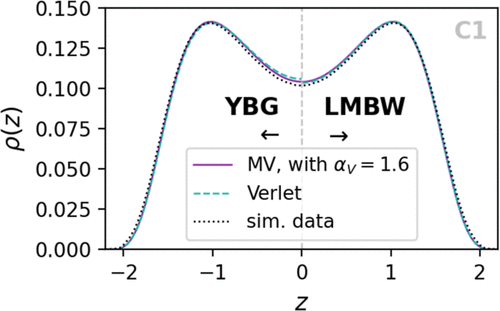
Figure 1

Figure 2
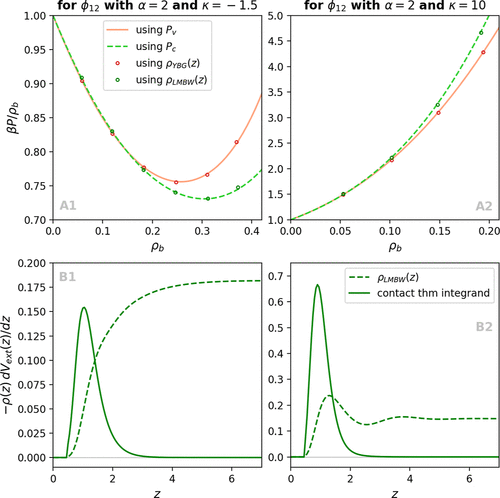
Figure 2. Testing the contact theorem. We consider two types of HCY particles 25, both with α = 2. Column 1, shows results for κ = −1.5 < 0, thus an attractive tail. Column 2, shows results for particles with a repulsive tail, with κ = 10 > 0. In panels A, we show reduced pressure curves calculated using both the virial 3 and compressibility 7 equations of state, given by the solid orange and dashed lime green curves, respectively. The red circles show the results obtained via eq 24, when the input density profile is generated by the YBG eq 17. The green circles show the same, when the input density profile is generated by the LMBW eq 20. In panels B, we show the contact theorem integrand as solid green lines and the density profile generated by the LMBW equation as dashed green lines, to illustrate how we obtain the circles shown in panels A.
Figure 3
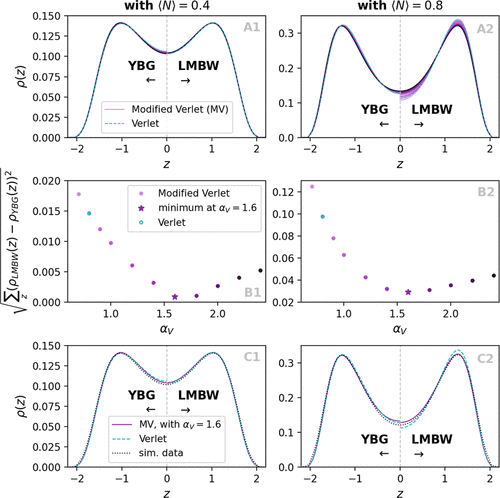
Figure 3. Optimization of the density profiles using the Modified Verlet closure. In panels A we show density profiles calculated using the YBG and LMBW equations for various values of the optimization parameter, αV. Since the profiles are symmetric about z = 0 we show both YBG and LMBW profiles on the same plot for ease of comparison. The left column of panels concern results for ⟨N⟩ = 0.4, while the right column is for ⟨N⟩ = 0.8. Panels B show the root-mean-square difference between the profiles obtained using the two different routes as a function of αV. The minimum of both curves is found to be at αV = 1.6. Panels C show the profiles at this optimal value of αV and demonstrate the improved structural consistency compared with the standard Verlet closure. We also show simulation data as dotted black curves for comparison.
Figure 4

Figure 4. Bulk pressure optimization using the Modified Verlet closure. In panel A we show the bulk pressure from the virial 3 and compressibility 7 equations as a function of the bulk density. The dashed sea green lines show the results obtained using the standard Verlet closure, as in Figure 2. Increasing the parameter αV from 0.8 (the standard Verlet value) to 1.6 leads to a reduction of thermodynamic inconsistency. Virial pressures are shown as solid lime green lines, while the compressibility pressures are shown in orange. In panel B we show only the pressures for the standard Verlet closure and the Modified Verlet closure with the optimized αV = 1.6. Panels C show zooms of the data from panel B to focus on different density regimes. We added simulation data as dotted black curves to panels B and C for comparison.
Figure 5

Figure 5. Application of the optimized closure to a harmonic trap. We show density profiles in the external field 28. In panels A the average number of particles per unit length is ⟨N⟩ = 0.8, while in panels B its value is ⟨N⟩ = 1.0. The first column (in sea green) shows results using the standard Verlet closure. The second column (in purple) shows results using the Modified Verlet closure for fixed optimized αV = 1.6. The density profiles calculated with the LMBW equation are given by solid green lines and the ones calculated with the YBG equation are in dashed red. The simulation data are given by the dotted black curves. It is clear that in both test-cases the Modified Verlet closure with αV = 1.6 reduces the structural inconsistency in comparison to the results from the standard Verlet closure.
References
This article references 71 other publications.
- 1Rosenfeld, Y. Free-energy model for the inhomogeneous hard-sphere fluid mixture and density-functional theory of freezing. Phys. Rev. Lett. 1989, 63, 980, DOI: 10.1103/PhysRevLett.63.980There is no corresponding record for this reference.
- 2Tarazona, P. Density functional for hard sphere crystals: A fundamental measure approach. Phys. Rev. Lett. 2000, 84, 694, DOI: 10.1103/PhysRevLett.84.694There is no corresponding record for this reference.
- 3Roth, R. Fundamental measure theory for hard-sphere mixtures: a review. J. Phys.:Condens. Matter 2010, 22, 063102, DOI: 10.1088/0953-8984/22/6/063102There is no corresponding record for this reference.
- 4Wittmann, R.; Marechal, M.; Mecke, K. Fundamental mixed measure theory for non-spherical colloids. Europhys. Lett. 2015, 109, 26003, DOI: 10.1209/0295-5075/109/26003There is no corresponding record for this reference.
- 5Cuesta, J. A. Fluid mixtures of parallel hard cubes. Phys. Rev. Lett. 1996, 76, 3742, DOI: 10.1103/PhysRevLett.76.3742There is no corresponding record for this reference.
- 6Roth, R.; Mecke, K.; Oettel, M. Communication: Fundamental measure theory for hard disks: Fluid and solid. J. Chem. Phys. 2012, 136, 081101, DOI: 10.1063/1.3687921There is no corresponding record for this reference.
- 7Barker, J. A.; Henderson, D. What is liquid? understanding the states of matter. Rev. Mod. Phys. 1976, 48, 587, DOI: 10.1103/RevModPhys.48.587There is no corresponding record for this reference.
- 8Evans, R. The nature of the liquid-vapour interface and other topics in the statistical mechanics of non-uniform, classical fluids. Adv. Phys. 1979, 28, 143, DOI: 10.1080/00018737900101365There is no corresponding record for this reference.
- 9Evans, R. In Ch. 3 in Fundamentals of Inhomogeneous Fluids; Henderson, D., Ed.; Marcel Dekker: New York, 1992.There is no corresponding record for this reference.
- 10Rosenfeld, Y. Free energy model for inhomogeneous fluid mixtures: Yukawa-charged hard spheres, general interactions, and plasmas. J. Chem. Phys. 1993, 98, 8126, DOI: 10.1063/1.464569There is no corresponding record for this reference.
- 11Oettel, M. Integral equations for simple fluids in a general reference functional approach. J. Phys.:Condens. Matter 2005, 17, 429, DOI: 10.1088/0953-8984/17/3/003There is no corresponding record for this reference.
- 12Tschopp, S. M.; Vuijk, H. D.; Sharma, A.; Brader, J. M. Mean-field theory of inhomogeneous fluids. Phys. Rev. E 2020, 102, 042140, DOI: 10.1103/PhysRevE.102.042140There is no corresponding record for this reference.
- 13Dijkman, J.; Dijkstra, M.; van Roij, R.; Welling, M.; van de Meent, J.-W.; Ensing, B. Learning neural free-energy functionals with pair-correlation matching. Phys. Rev. Lett. 2025, 134, 056103, DOI: 10.1103/PhysRevLett.134.056103There is no corresponding record for this reference.
- 14Sammüller, F.; Hermann, S.; de las Heras, D.; Schmidt, M. Neural functional theory for inhomogeneous fluids: Fundamentals and applications. Proc. Natl. Acad. Sci. U.S.A. 2023, 120, e2312484120 DOI: 10.1073/pnas.2312484120There is no corresponding record for this reference.
- 15Sammüller, F.; Hermann, S.; Schmidt, M. Why neural functionals suit statistical mechanics. J. Phys.: Condens. Matter 2024, 36, 243002, DOI: 10.1088/1361-648X/ad326fThere is no corresponding record for this reference.
- 16ter Rele, T.; Campos-Villalobos, G.; van Roij, R.; Dijkstra, M. Machine learning many-body potentials for charged colloids in primitive 1:1 electrolytes. arXiv 2025, arXiv.2507.12934, DOI: 10.48550/arXiv.2507.12934There is no corresponding record for this reference.
- 17Simon, A.; Weimar, J.; Martius, G.; Oettel, M. Machine learning of a density functional for anisotropic patchy particles. J. Chem. Theory Comput. 2024, 20, 1062, DOI: 10.1021/acs.jctc.3c01238There is no corresponding record for this reference.
- 18Simon, A.; Belloni, L.; Borgis, D.; Oettel, M. The orientational structure of a model patchy particle fluid: Simulations, integral equations, density functional theory, and machine learning. J. Chem. Phys. 2025, 162, 034503, DOI: 10.1063/5.0248694There is no corresponding record for this reference.
- 19Simon, A.; Oettel, M. Machine learning approaches to classical density functional theory. arXiv 2024, arXiv.2406.07345, DOI: 10.48550/arXiv.2406.07345There is no corresponding record for this reference.
- 20Henderson, D. In Ch. 4 in Fundamentals of Inhomogeneous Fluids; Henderson, D., Ed.; Marcel Dekker: New York, 1992.There is no corresponding record for this reference.
- 21Tschopp, S. M.; Vahid, H.; Sharma, A.; Brader, J. M. Combining integral equation closures with force density functional theory for the study of inhomogeneous fluids. Soft Matter 2025, 21, 2633, DOI: 10.1039/D4SM01262CThere is no corresponding record for this reference.
- 22Hansen, J.-P.; McDonald, I. R. Theory of Simple Liquids; Elsevier Science: Amsterdam, 2006.There is no corresponding record for this reference.
- 23McQuarrie, D. A. Statistical Mechanics; University Science Books: CA, 2000.There is no corresponding record for this reference.
- 24Caccamo, C. Integral equation theory description of phase equilibria in classical fluids. Phys. Rep. 1996, 274, 1, DOI: 10.1016/0370-1573(96)00011-7There is no corresponding record for this reference.
- 25Pihlajamaa, I.; Janssen, L. M. C. Comparison of integral equation theories of the liquid state. Phys. Rev. E 2024, 110, 044608, DOI: 10.1103/PhysRevE.110.044608There is no corresponding record for this reference.
- 26Bomont, J.-M. Recent advances in the field of integral equation theories: bridge functions and applications to classical fluids. Adv. Chem. Phys. 2008, 139, 1– 84, DOI: 10.1002/9780470259498.ch1There is no corresponding record for this reference.
- 27Waisman, E. The radial distribution function for a fluid of hard spheres at high densities. Mol. Phys. 1973, 25, 45, DOI: 10.1080/00268977300100061There is no corresponding record for this reference.
- 28Ho/ye, J. S.; Stell, G. Thermodynamics of the msa for simple fluids. J. Chem. Phys. 1977, 67, 439– 445, DOI: 10.1063/1.434887There is no corresponding record for this reference.
- 29Rosenfeld, Y.; Ashcroft, N. W. Theory of simple classical fluids: Universality in the short-range structure. Phys. Rev. A 1979, 20, 1208, DOI: 10.1103/PhysRevA.20.1208There is no corresponding record for this reference.
- 30Verlet, L. Integral equations for classical fluids. Mol. Phys. 1980, 41, 183, DOI: 10.1080/00268978000102671There is no corresponding record for this reference.
- 31Rogers, F. J.; Young, D. A. New, thermodynamically consistent, integral equation for simple fluids. Phys. Rev. A 1984, 30, 999, DOI: 10.1103/PhysRevA.30.999There is no corresponding record for this reference.
- 32Zerah, G.; Hansen, J.-P. Self-consistent integral equations for fluid pair distribution functions: Another attempt. J. Chem. Phys. 1986, 84, 2336, DOI: 10.1063/1.450397There is no corresponding record for this reference.
- 33Ballone, P.; Pastore, G.; Gazzillo, D. Additive and non-additive hard sphere mixtures. Mol. Phys. 1986, 59, 275, DOI: 10.1080/00268978600102071There is no corresponding record for this reference.
- 34Pini, D.; Stell, G.; Wilding, N. A liquid-state theory that remains successful in the critical region. Mol. Phys. 1998, 95, 483, DOI: 10.1080/00268979809483183There is no corresponding record for this reference.
- 35Pini, D.; Stell, G.; Høye, J. Self-consistent approximation for fluids and lattice gases. Int. J. Thermophys. 1998, 19, 1029, DOI: 10.1023/A:1022673222199There is no corresponding record for this reference.
- 36Caccamo, C.; Pellicane, G.; Costa, D.; Pini, D.; Stell, G. Thermodynamically self-consistent theories of fluids interacting through short-range forces. Phys. Rev. E 1999, 60, 5533, DOI: 10.1103/PhysRevE.60.5533There is no corresponding record for this reference.
- 37Duh, D.; Haymet, A. D. J. Integral equation theory for uncharged liquids: The Lennard-Jones fluid and the bridge function. J. Chem. Phys. 1995, 103, 2625, DOI: 10.1063/1.470724There is no corresponding record for this reference.
- 38Duh, D.; Henderson, D. Integral equation theory for Lennard-Jones fluids: The bridge function and applications to pure fluids and mixtures. J. Chem. Phys. 1996, 104, 6742, DOI: 10.1063/1.471391There is no corresponding record for this reference.
- 39Parola, A.; Reatto, L. Liquid state theories and critical phenomena. Adv. Phys. 1995, 44, 211, DOI: 10.1080/00018739500101536There is no corresponding record for this reference.
- 40Parola, A.; Pini, D.; Reatto, L. The smooth cut-off hierarchical reference theory of fluids. Mol. Phys. 2009, 107, 503, DOI: 10.1080/00268970902873547There is no corresponding record for this reference.
- 41Caillol, J.-M. Link between the hierarchical reference theory of liquids and a new version of the non-perturbative renormalization group in statistical field theory. Mol. Phys. 2011, 109, 2813, DOI: 10.1080/00268976.2011.621455There is no corresponding record for this reference.
- 42Parola, A.; Reatto, L. Recent developments of the hierarchical reference theory of fluids and its relation to the renormalization group. Mol. Phys. 2012, 110, 2859, DOI: 10.1080/00268976.2012.666573There is no corresponding record for this reference.
- 43Lee, L. L. An accurate integral equation theory for hard spheres: Role of the zero-separation theorems in the closure relation. J. Chem. Phys. 1995, 103, 9388, DOI: 10.1063/1.469998There is no corresponding record for this reference.
- 44Lee, L. L. The potential distribution-based closures to the integral equations for liquid structure: The Lennard-Jones fluid. J. Chem. Phys. 1997, 107, 7360, DOI: 10.1063/1.474974There is no corresponding record for this reference.
- 45Yuste, S. B.; Santos, A. Radial distribution function for hard spheres. Phys. Rev. A 1991, 43, 5418, DOI: 10.1103/PhysRevA.43.5418There is no corresponding record for this reference.
- 46Yuste, S. B.; Santos, A.; López de Haro, M. Structure of multi-component hard-sphere mixtures. J. Chem. Phys. 1998, 108, 3683, DOI: 10.1063/1.475762There is no corresponding record for this reference.
- 47Choudhury, N.; Ghosh, S. K. Integral equation theory of Lennard-Jones fluids: A modified Verlet bridge function approach. J. Chem. Phys. 2002, 116, 8517, DOI: 10.1063/1.1467894There is no corresponding record for this reference.
- 48Bomont, J. M.; Bretonnet, J. L. A self-consistent integral equation: Bridge function and thermodynamic properties for the Lennard-Jones fluid. J. Chem. Phys. 2003, 119, 2188, DOI: 10.1063/1.1583675There is no corresponding record for this reference.
- 49Carbajal-Tinoco, M. D. Thermodynamically consistent integral equation for soft repulsive spheres. J. Chem. Phys. 2008, 128, 184507, DOI: 10.1063/1.2918495There is no corresponding record for this reference.
- 50Rowlinson, J. S.; Widom, B. Molecular Theory of Capillarity; Dover: New York, 2003.There is no corresponding record for this reference.
- 51Henderson, J. In Ch. 2 in Fundamentals of Inhomogeneous Fluids; Henderson, D., Ed.; Marcel Dekker: New York, 1992.There is no corresponding record for this reference.
- 52Attard, P. Thermodynamics and Statistical Mechanics; Academic Press: Amsterdam, 2002.There is no corresponding record for this reference.
- 53Yvon, J. La théorie statistique des fluides et l’équation d’état; Hermann: Paris, 1935.There is no corresponding record for this reference.
- 54Born, M.; Green, H. S. A general kinetic theory of liquids I. the molecular distribution functions. Proc. R. Soc. A 1946, 188, 10, DOI: 10.1098/rspa.1946.0093There is no corresponding record for this reference.
- 55Lovett, R. A.; Mou, C. Y.; Buff, F. P. The structure of the liquid–vapor interface. J. Chem. Phys. 1976, 65, 570, DOI: 10.1063/1.433110There is no corresponding record for this reference.
- 56Wertheim, M. S. Correlations in the liquid–vapor interface. J. Chem. Phys. 1976, 65, 2377, DOI: 10.1063/1.433352There is no corresponding record for this reference.
- 57Lovett, R. A.; Buff, F. P. Examples of the construction of integral equations in equilibrium statistical mechanics from invariance principles. Phys. A 1991, 172, 147, DOI: 10.1016/0378-4371(91)90317-6There is no corresponding record for this reference.
- 58Baus, M.; Lovett, R. A. A direct derivation of the profile equations of Buff-Lovett-Mou-Wertheim from the Born-Green-Yvon equations for a non-uniform equilibrium fluid. Phys. A 1992, 181, 329, DOI: 10.1016/0378-4371(92)90092-5There is no corresponding record for this reference.
- 59Omelyan, I.; Hirata, F.; Kovalenko, A. Criticality of a liquid–vapor interface from an inhomogeneous integral equation theory. Phys. Chem. Chem. Phys. 2005, 7, 4132, DOI: 10.1039/b507761cThere is no corresponding record for this reference.
- 60Brader, J. M. Structural precursor to freezing: an integral equation study. J. Chem. Phys. 2008, 128, 104503, DOI: 10.1063/1.2889926There is no corresponding record for this reference.
- 61Nygård, K.; Sarman, S.; Kjellander, R. Local order variations in confined hard-sphere fluids. J. Chem. Phys. 2013, 139, 164701, DOI: 10.1063/1.4825176There is no corresponding record for this reference.
- 62Nygård, K.; Sarman, S.; Hyltegren, K.; Chodankar, S.; Perret, E.; Buitenhuis, J.; van der Veen, J. F.; Kjellander, R. Density fluctuations of hard-sphere fluids in narrow confinement. Phys. Rev. X 2016, 6, 011014, DOI: 10.1103/PhysRevX.6.011014There is no corresponding record for this reference.
- 63Attard, P. Spherically inhomogeneous fluids. i. percus–yevick hard spheres: Osmotic coefficients and triplet correlations. J. Chem. Phys. 1989, 91, 3072, DOI: 10.1063/1.456930There is no corresponding record for this reference.
- 64Attard, P. Spherically inhomogeneous fluids. ii. hard-sphere solute in a hard-sphere solvent. J. Chem. Phys. 1989, 91, 3083, DOI: 10.1063/1.456931There is no corresponding record for this reference.
- 65Kjellander, R.; Sarman, S. On the statistical mechanics of inhomogeneous fluids in narrow slits. an application to a hard-sphere fluid between hard walls. Chem. Phys. Lett. 1988, 149, 102, DOI: 10.1016/0009-2614(88)80357-9There is no corresponding record for this reference.
- 66Tschopp, S. M.; Sammüller, F.; Hermann, S.; Schmidt, M.; Brader, J. M. Force density functional theory in- and out-of-equilibrium. Phys. Rev. E 2022, 106, 014115, DOI: 10.1103/PhysRevE.106.014115There is no corresponding record for this reference.
- 67Yvon, J. Note sur un calcul de perturbation en mécanique statistique. Il Nuovo Cimento 1958, 9, 144, DOI: 10.1007/BF02824240There is no corresponding record for this reference.
- 68Evans, R.; Dolny, K. Density Functional Theory for Inhomogeneous Fluids I: Simple Fluids in Equilibrium, Lecture notes in physics; University of Bristol, 2009.There is no corresponding record for this reference.
- 69Lado, F. Numerical fourier transforms in one, two, and three dimensions for liquid state calculations. J. Comput. Phys. 1971, 8, 417, DOI: 10.1016/0021-9991(71)90021-0There is no corresponding record for this reference.
- 70Thompson, A. P.; Aktulga, H. M.; Berger, R.; Bolintineanu, D. S.; Brown, W. M.; Crozier, P. S.; in ’t Veld, P. J.; Kohlmeyer, A.; Moore, S. G.; Nguyen, T. D.; Shan, R.; Stevens, M. J.; Tranchida, J.; Trott, C.; Plimpton, S. J. LAMMPS - a flexible simulation tool for particle-based materials modeling at the atomic, meso, and continuum scales. Comput. Phys. Commun. 2022, 271, 108171, DOI: 10.1016/j.cpc.2021.108171There is no corresponding record for this reference.
- 71Tschopp, S. M.; Brader, J. M. First-principles superadiabatic theory for the dynamics of inhomogeneous fluids. J. Chem. Phys. 2022, 157, 234108, DOI: 10.1063/5.0131441There is no corresponding record for this reference.