



ACS Editors' Choice® is a collection designed to feature scientific articles of broad public interest. Read the latest articles
Electrocatalytic Nitrate Reduction to Ammonia Using Metal-Free Nitrogen-Doped Carbon Catalysts Derived from Setaria viridisClick to copy article linkArticle link copied!
- Yuting QuYuting QuCollege of Material Science and Engineering, Key Laboratory of Advanced Structural Materials, Ministry of Education, Changchun University of Technology, Changchun 130012, ChinaMore by Yuting Qu
- Boran YangBoran YangCollege of Material Science and Engineering, Key Laboratory of Advanced Structural Materials, Ministry of Education, Changchun University of Technology, Changchun 130012, ChinaMore by Boran Yang
- Hongli Wang*Hongli Wang*Email: [email protected]College of Material Science and Engineering, Key Laboratory of Advanced Structural Materials, Ministry of Education, Changchun University of Technology, Changchun 130012, ChinaMore by Hongli Wang
- Xingcheng MaXingcheng MaCollege of Material Science and Engineering, Key Laboratory of Advanced Structural Materials, Ministry of Education, Changchun University of Technology, Changchun 130012, ChinaMore by Xingcheng Ma
- Lixin ChenLixin ChenCollege of Material Science and Engineering, Key Laboratory of Advanced Structural Materials, Ministry of Education, Changchun University of Technology, Changchun 130012, ChinaMore by Lixin Chen
- Ying GaoYing GaoCollege of Material Science and Engineering, Key Laboratory of Advanced Structural Materials, Ministry of Education, Changchun University of Technology, Changchun 130012, ChinaMore by Ying Gao
- Shicheng Sun*Shicheng Sun*Email: [email protected]College of Material Science and Engineering, Key Laboratory of Advanced Structural Materials, Ministry of Education, Changchun University of Technology, Changchun 130012, ChinaMore by Shicheng Sun

Abstract
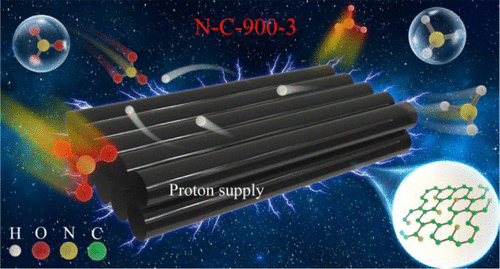
Electrocatalytic reduction of nitrate to ammonia is one potential strategy to remove nitrate and produce ammonia under ambient conditions. The use of carbonaceous materials as metal-free electrocatalysts is crucial for achieving high activity and precise product selectivity. Here, we propose a facile one-step calcination strategy to produce nitrogen-doped carbon (N–C-900–3) electrocatalysts derived from Setaria viridis (SV) for highly efficient nitrate-to-ammonia reduction (NO3RR). Benefiting from the high concentration of defects and the high content of graphitic-N moiety, which play a crucial role in promoting the dissociation of water and the N–H bond formation, the resultant N–C-900–3 displays outstanding electrocatalytic performance with a maximum NH3 yield rate of 6.23 mg h–1 cm–2 and a Faradaic efficiency (FE) of ca. 97.4%.
Cited By
This article is cited by 1 publications.
- Yuezhu Wang, Xianqiang Yu, Ruikai Qi, Cheng Fan, Mengxiao Zhong, Zhengjie Chen, Xiaofeng Lu. High-efficiency electrocatalytic nitrate-to-ammonia conversion over CoPd alloy nanoparticles embedded within carbon nanofibers. Journal of Colloid and Interface Science 2026, 707 , 139668. https://doi.org/10.1016/j.jcis.2025.139668
Article Views are the COUNTER-compliant sum of full text article downloads since November 2008 (both PDF and HTML) across all institutions and individuals. These metrics are regularly updated to reflect usage leading up to the last few days.
Citations are the number of other articles citing this article, calculated by Crossref and updated daily. Find more information about Crossref citation counts.
The Altmetric Attention Score is a quantitative measure of the attention that a research article has received online. Clicking on the donut icon will load a page at altmetric.com with additional details about the score and the social media presence for the given article. Find more information on the Altmetric Attention Score and how the score is calculated.