




Spectroscopic and Chemometric Techniques for Pharmaceutical Applications
Author(s):
- Gerard G. DumancasAssociate ProfessorUniversity of ScrantonEmail: [email protected]More by Gerard G. Dumancas
- Lakshmi ViswanathAssociate ProfessorUtah Valley UniversityEmail: [email protected]More by Lakshmi Viswanath
- Arnold LubgubanProfessorMindanao State University -Iligan Institute of TechnologyEmail: [email protected]More by Arnold Lubguban
- Beulah SolivioPostdoctoral ScientistNationwide Children’s HospitalEmail: [email protected]More by Beulah Solivio
- Roberto MalaluanProfessorMindanao State University -Iligan Institute of TechnologyEmail: [email protected]More by Roberto Malaluan
- Michael WallerSystems Administration LibrarianLouisiana State University of AlexandriaEmail: [email protected]More by Michael Waller
Publication Date:
May 15, 2023
Copyright ©
2023 American Chemical Society
eISBN:
9780841299726
DOI:
10.1021/acsinfocus.7e7007
Subjects:
Read Time:
three to four hours
Collection:
2
Publisher:
American Chemical Society

Spectroscopic and chemometric methods have become routinely applied tools in pharmaceutical industries because they reduce the analysis time and minimize the use of chemicals. The contents of this digital primer are to help newcomers in the field by providing basic content information about various spectroscopic and chemometric tools used in pharmaceutical analysis.
This book is coming soon. In the meantime, please contact your library or ACS sales representative for purchase options.
Detailed Table of Contents
About the Series
Preface
Chapter 1
Principles and Importance of Vibrational Spectroscopy
1.1
Introduction
1.2
The Electromagnetic Radiation and Various Regions of the Spectrum: Fundamentals of Electromagnetic Radiation
1.3
Importance of Vibrational Spectroscopy
1.4
Principles of Specific Spectroscopic Techniques
1.4.1
Infrared Spectroscopy
1.4.2
Raman Spectroscopy
1.4.3
Nuclear Magnetic Resonance (NMR) Spectroscopy
1.4.4
Atomic Emission Spectroscopy (AES)
1.4.5
Ultraviolet–Visible (UV–vis) Spectroscopy
1.5
That’s a Wrap
1.6
Read These Next
Chapter 2
Spectroscopic Sampling Techniques and Instrumental Analysis
2.1
Introduction
2.2
Infrared Spectroscopy
2.2.1
Infrared Sampling Techniques
2.2.1.1
Transmission
2.2.1.2
Reflection
2.3
Raman Sampling Techniques
2.3.1
Surface-Enhanced Raman Spectroscopy (SERS)
2.3.2
Confocal Raman Spectroscopy (CRS)
2.3.3
Resonance Raman Spectroscopy (RRS)
2.3.4
Stimulated Raman Spectroscopy (SRS)
2.3.5
Coherent Anti-Stokes Raman Spectroscopy (CARS)
2.3.6
Tip-Enhanced Raman Spectroscopy (TERS)
2.4.
Ultraviolet–Visible (UV–Vis)
2.4.1
Transmission
2.4.2
Diffuse Reflectance
2.4.3
Absorption
2.5
Nuclear Magnetic Resonance (NMR)
2.5.1
1H NMR
2.5.2
13C NMR
2.6
Fluorescence
2.6.1
Time-Resolved Fluorescence
2.6.2
Fluorescence Resonance Energy Transfer (FRET)
2.6.3
3D Fluorescence Spectroscopy
2.7
Atomic Emission Spectroscopy (AES)
2.7.1
Flame Atomic Emission Spectroscopy (AES)
2.7.2
Plasma Atomic Emission Spectroscopy
2.7.3
Arc and Spark Atomic Emission Spectroscopy
2.8
That’s a Wrap
2.9
Read These Next
Chapter 3
Experimental Design, Data Pretreatment, and Model Calibration
3.1
Introduction
3.2
Calibration
3.2.1
Design of Experiments (DOEs)
3.2.1.1
Full Factorial Designs (FFDs)
3.2.1.2
Central Composite Designs (CCDs) and Box–Behnken Designs (BBDs)
3.2.1.3
Robust Parameter Designs (RPDs)
3.2.1.4
Space Filling Designs
3.2.2
Data Preprocessing
3.2.3
Missing Data
3.3
Development of a Spectroscopic Calibration Model
3.3.1
Sources of Error
3.4
That’s a Wrap
3.5
Read These Next
Chapter 4
Multivariate Analysis Techniques Used in Pharmaceutical Applications: Theories and Processes
4.1
Introduction
4.2
Pattern Recognition Techniques
4.2.1
Factor Analysis
4.2.2
Principal Component Analysis (PCA)
4.2.3
Discriminant Analysis
4.3
Multivariate Regression Techniques
4.3.1
Inverse Least Squares (ILS) or P-Matrix
4.3.2
Classical Least Squares (CLS) or K-Matrix
4.3.3
Partial Least Squares (PLS)
4.3.4
Principal Component Regression (PCR)
4.3.5
Artificial Neural Networks (ANNs)
4.3.6
Multiway Models
4.3.6.1
Parallel Factor Analysis (PARAFAC)
4.3.6.2
N-Way Partial Least Squares (N-PLS)
4.4
Variable Selection Methods
4.4.1
Genetic Algorithm (GA)
4.4.2
Simulated Annealing
4.5
That’s a Wrap
4.6
Read These Next
Chapter 5
Pharmaceutical Applications of Spectroscopic Techniques
5.1
Introduction
5.2
Infrared Spectroscopy
5.3
Raman Spectroscopy
5.4
UV–Vis Spectroscopy
5.5
Nuclear Magnetic Resonance (NMR) Spectroscopy
5.6
That’s a Wrap
5.7
Read These Next
Chapter 6
Perspectives and Future Directions
6.1
Introduction
6.2
Counterfeit Pharmaceutical Products
6.3
Authentication of Herbal Medicines
6.4
Quantification of API Polymorphic Forms in Pharmaceutical Products
6.5
Analysis of the API Distribution and Excipients in Pharmaceutical Products
6.6
That’s a Wrap
6.7
Read These Next
Bibliography
Glossary
Index
Reviewer quotes
A nice introductory overview of the potential of chemometrics for pharmaceutical analysis, which couples a wide overview of the instrumental possibilities and, at the same time, of the possible applications. Good for people who don’t want to struggle much with the theory while focusing on the practical use of the techniques.
Gerard G. Dumancas is an Associate Professor in the Department of Chemistry and the Director of the NSF Robert Noyce Teacher Scholarship Program, and a Community-Based Learning Faculty Fellow at the University of Scranton in Scranton, Pa. He received his BS in Chemistry from the University of the Philippines in 2005 and his Ph.D. in Analytical Chemistry (Chemometrics) from Oklahoma State University in 2012. He completed his postdoctoral training at the Oklahoma Medical Research Foundation in the area of statistical genetics and bioinformatics. His research has been recognized by the American Oil Chemists’ Society, the Society for Laboratory Automation and Screening, the NSF Noyce Scholarship Program, the NSF S-STEM Program, and the LSU LIFT2. He was previously named as an NSF Program to Empower Partnerships with Industry Fellow as well as a Visiting Scientist of the Department of Energy’s Joint Bioenergy Institute and the National Renewable Energy Laboratory.

Lakshmi Viswanath is an Associate Professor in the Department of Chemistry at Utah Valley University. She received her BS in Chemistry from the University of Madras in 2004 and completed her MS in Applied Chemistry in Anna University, India (2006). She also served as the senior research officer for Sanmar Specialty Chemicals in Chennai, India, before pursuing her doctoral degree in 2009. She completed her Ph.D. in Organic Chemistry from Oklahoma State University in 2013. Soon after that, she started her career in teaching. She has published many articles in international journals, has been a journal reviewer for many journals, and actively participates in ACS regional and national conferences.

Arnold Lubguban currently holds an appointment as a professor and senior researcher at the Mindanao State University – Iligan Institute of Technology’s (MSU-IIT) in the Philippines. Before joining MSU-IIT in 2015, he had a short-term Balik-Scientist stint with the Philippines’ Department of Science and Technology (DOST) in 2014, giving lectures and training on bio-based polymer processing to academe and local industries. He received his B.S. in 1999 at the University of the Philippines – Los Baños (UPLB) and the University of Missouri’s MS and Ph.D. programs in chemical engineering in 2005 and 2009, respectively. He did a postdoc in industrial polymer processing in 2009 at the Ohio State University, focusing on biomass conversion into polyols and polyurethanes. He led several research programs and project leadership under the USAID-STRIDE and DOST-PCIEERD on processing sustainable polymers for industrial applications.
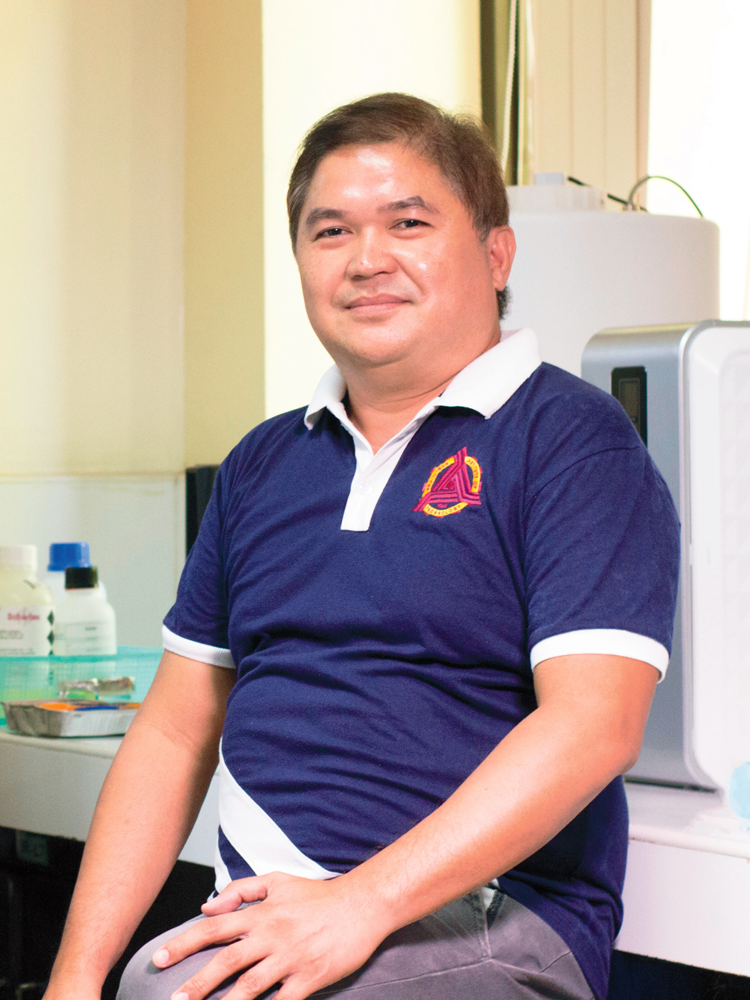
Beulah Solivio is a postdoctoral scientist at Nationwide Children’s Hospital in Columbus, Ohio. She studies rare genetic diseases and seeks to understand their molecular mechanisms. Before this, she worked as a Research Fellow at Cincinnati Children’s Hospital Medical Center. She received her Ph.D. in Chemistry at the University of Cincinnati in 2019. Before moving to the US, she worked as a research assistant at the Marine Science Institute and the National Institute of Geology at the University of the Philippines. She received her bachelor’s degree in chemistry at the University of the Philippines in 2010.

Roberto M. Malaluan was born in San Jose, Batangas, Philippines, and attended the Mindanao State University - Marawi, receiving a B.S. in 1983. He worked as an engineering instructor at Mindanao State University – Iligan Institute of Technology (MSU-IIT) for several years before attending Tohoku University in Sendai, Japan, where he received his Ph.D. under the guidance of Kunio Arai in 1995. He became a full professor of chemical engineering at MSU-IIT in 2004. He led several project leadership positions on supercritical carbon dioxide extraction of selected natural products and indigenous species for drug discovery and industrial applications under the Philippines’ Department of Agriculture (DA) and the Department of Science and Technology (DOST). He works as a senior faculty member doing instruction and research on sustainable polymers.

Michael Waller is an Assistant Librarian at Louisiana State University of Alexandria. He received his MLIS from the School of Library and Information Science at LSU in 2007. He served as the Technical Services Librarian at St. John’s College in Annapolis before joining the LSUA faculty in 2018. His work in higher education has focused on systems administration as well as educational and visual design. He is responsible for the graphic and visual design of Analytical Chemistry Lecture and Analytical Chemistry Lab, textbooks published through an LA Board of Regents Course Transformation Grant. In 2021 he was selected as open textbooks pilot cohort leader in a Department of Education funded grant.
