




This publication is Open Access under the license indicated. Learn More

ACS Editors' Choice® is a collection designed to feature scientific articles of broad public interest. Read the latest articles
Self-Consistent GW via Conservation of Spectral MomentsClick to copy article linkArticle link copied!
- Oliver J. BackhouseOliver J. BackhouseDepartment of Physics, King’s College London, Strand, London WC2R 2LS, U.K.More by Oliver J. Backhouse
- Marcus K. AllenMarcus K. AllenDepartment of Physics, King’s College London, Strand, London WC2R 2LS, U.K.More by Marcus K. Allen
- Charles J. C. ScottCharles J. C. ScottDepartment of Physics, King’s College London, Strand, London WC2R 2LS, U.K.More by Charles J. C. Scott
- George H. Booth*George H. Booth*Email: [email protected]Department of Physics, King’s College London, Strand, London WC2R 2LS, U.K.More by George H. Booth
Journal of Chemical Theory and Computation
Copyright © 2025 The Authors. Published by American Chemical Society. This publication is licensed under
License Summary*
You are free to share (copy and redistribute) this article in any medium or format and to adapt (remix, transform, and build upon) the material for any purpose, even commercially within the parameters below:

Creative Commons (CC): This is a Creative Commons license.

Attribution (BY): Credit must be given to the creator.
*Disclaimer
This summary highlights only some of the key features and terms of the actual license. It is not a license and has no legal value. Carefully review the actual license before using these materials.
Abstract
We expand on a recently introduced alternate framework for GW simulation of charged excitations [
This publication is licensed under
License Summary*
You are free to share(copy and redistribute) this article in any medium or format and to adapt(remix, transform, and build upon) the material for any purpose, even commercially within the parameters below:
Creative Commons (CC): This is a Creative Commons license.
Attribution (BY): Credit must be given to the creator.
*Disclaimer
This summary highlights only some of the key features and terms of the actual license. It is not a license and has no legal value. Carefully review the actual license before using these materials.
License Summary*
You are free to share(copy and redistribute) this article in any medium or format and to adapt(remix, transform, and build upon) the material for any purpose, even commercially within the parameters below:
Creative Commons (CC): This is a Creative Commons license.
Attribution (BY): Credit must be given to the creator.
*Disclaimer
This summary highlights only some of the key features and terms of the actual license. It is not a license and has no legal value. Carefully review the actual license before using these materials.
License Summary*
You are free to share(copy and redistribute) this article in any medium or format and to adapt(remix, transform, and build upon) the material for any purpose, even commercially within the parameters below:
Creative Commons (CC): This is a Creative Commons license.
Attribution (BY): Credit must be given to the creator.
*Disclaimer
This summary highlights only some of the key features and terms of the actual license. It is not a license and has no legal value. Carefully review the actual license before using these materials.
1. Introduction
2. Moment-Conserved GW
2.1. Screened Coulomb Interaction Moments and Natural Auxiliary Functions
Figure 1
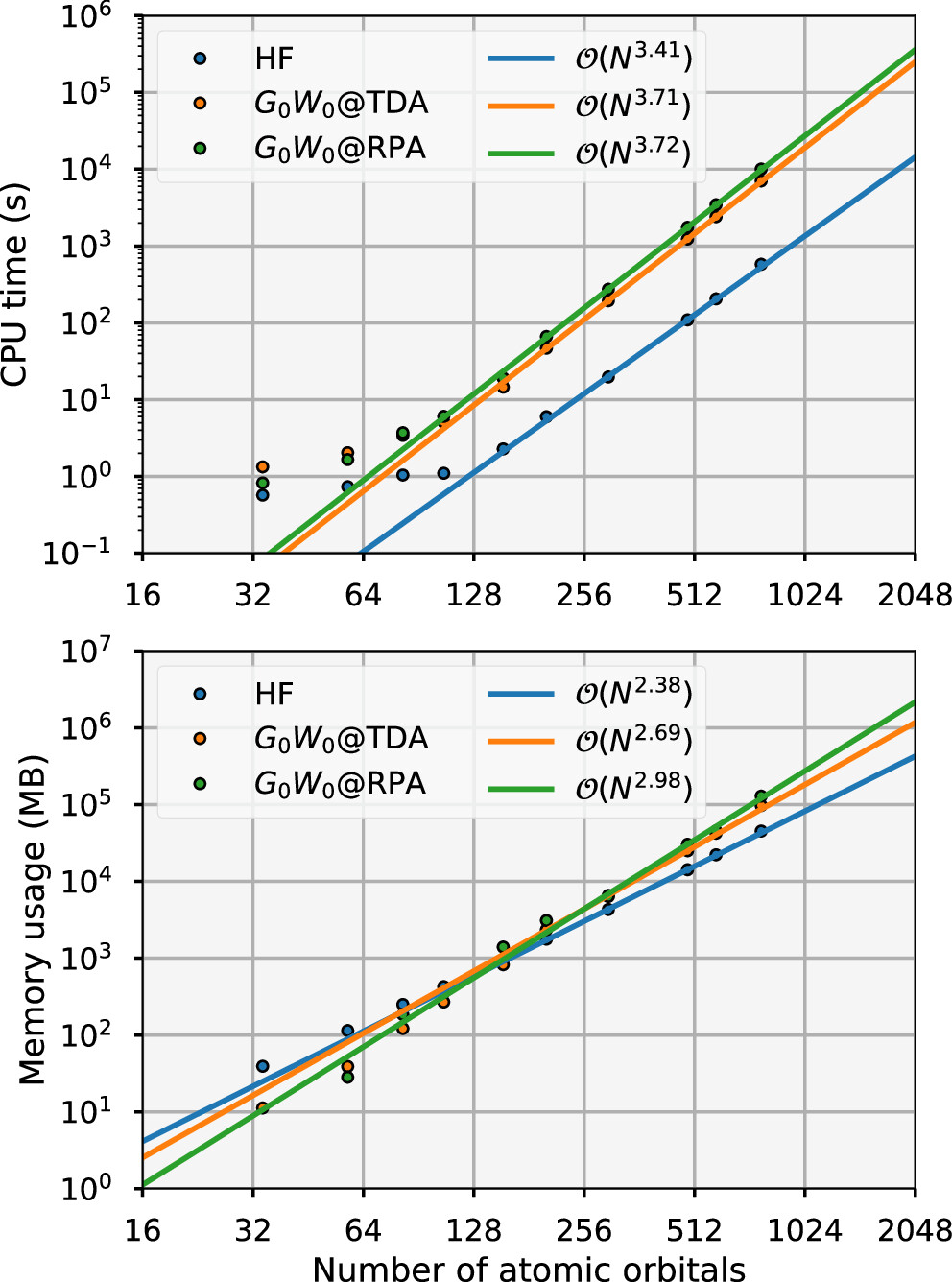
Figure 1. Performance benchmark for the moment-conserving G0W0 implementation, indicating CPU time (top) and memory usage (bottom) for increasing numbers of atomic orbitals in linear alkane chains up to C32H66 in a cc-pVDZ basis, with maximum moment order nmommax = 7, obtaining the full G0W0 spectrum for each calculation. No natural auxiliary orbital compression was used in this consideration of resource scaling. Lines are shown for both TDA and RPA screening, and for Hartree–Fock via PySCF for comparison.
2.2. RPA Screening
2.3. Tamm–Dancoff Screening
2.4. Computational Scaling Benchmarks
3. Self-Consistency
3.1. One-Shot G0W0
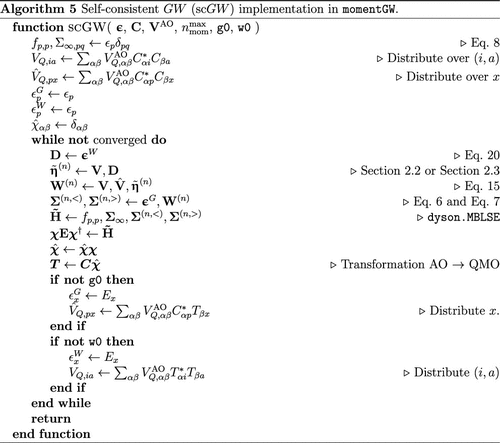
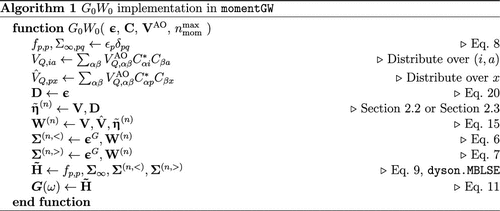 The overall G0W0 algorithm is sketched schematically in Alg. 1, whose input is a set of orbital energies from a DFT or Hartree–Fock reference, ϵ, the transformation from atomic (AO) to molecular orbitals (MO), C, the factorized bare Coulomb interaction in the AO and NAF basis, VAO, and the maximum order to which the self-energy moments will be computed, nmommax. Note that in the algorithm, two copies of the three-index Coulomb interaction are transformed in order to facilitate the parallelism of the algorithm. The first, VQ,ia, only contains the interaction in the particle-hole channel, and is distributed over MPI threads by the compound index (i, a), while the second which we denote V̂Q,px spans the entire MO product space, and is distributed over MPI threads via the x index which labels the index contracted with the Green’s function in the final convolution with the screened Coulomb moments (eq 15) in eqs 6–7.
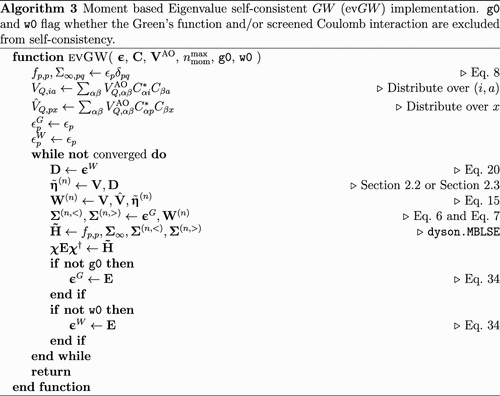
3.2. Eigenvalue Self-Consistent GW
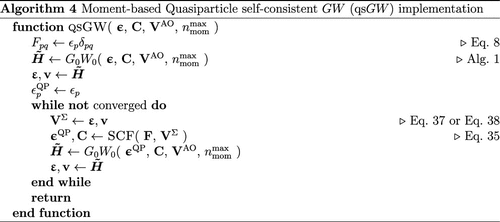
3.3. Quasiparticle Self-Consistent GW
3.4. Self-Consistent GW
3.5. Electron Number Conservation
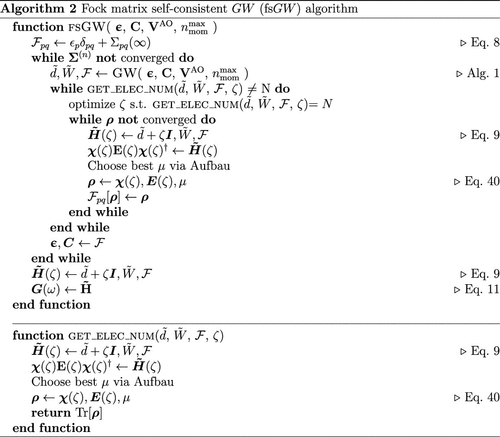
3.6. Fock Matrix Self-Consistent GW
4. GW100 Benchmark
4.1. Exemplar Molecule: Borane
Figure 2
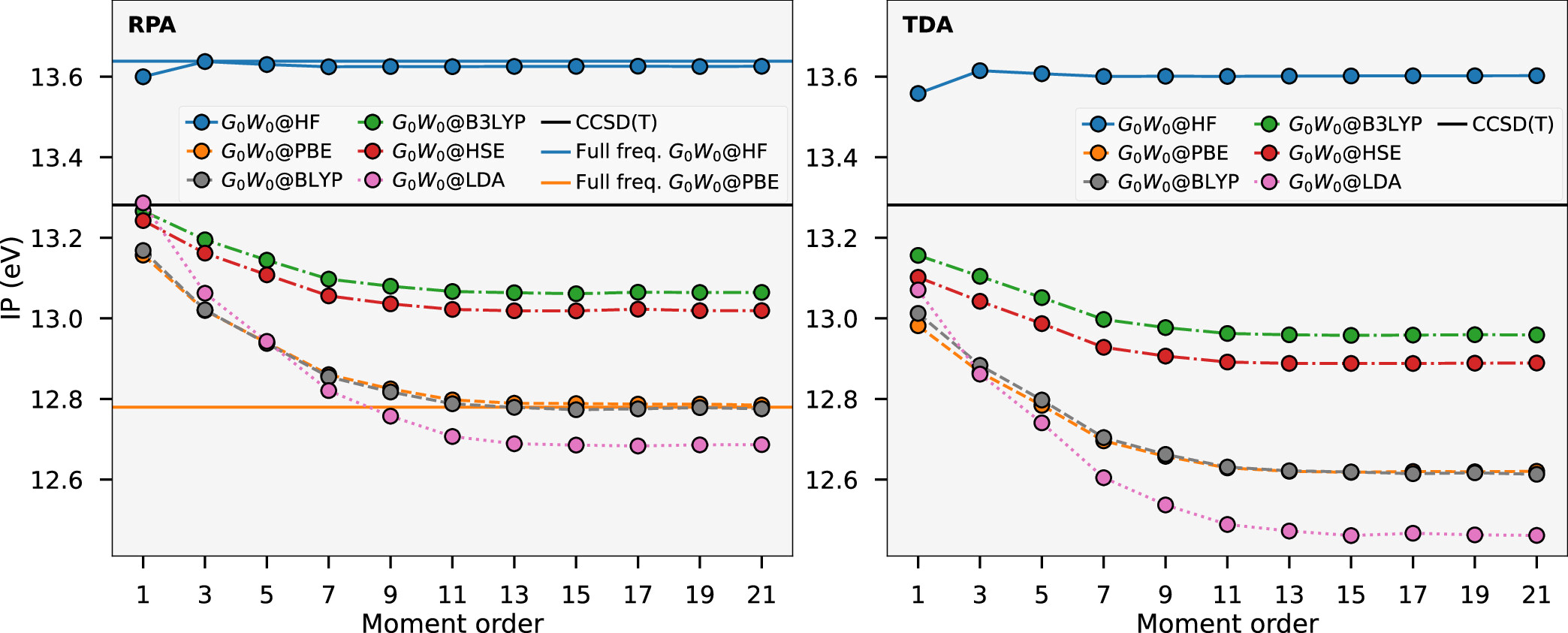
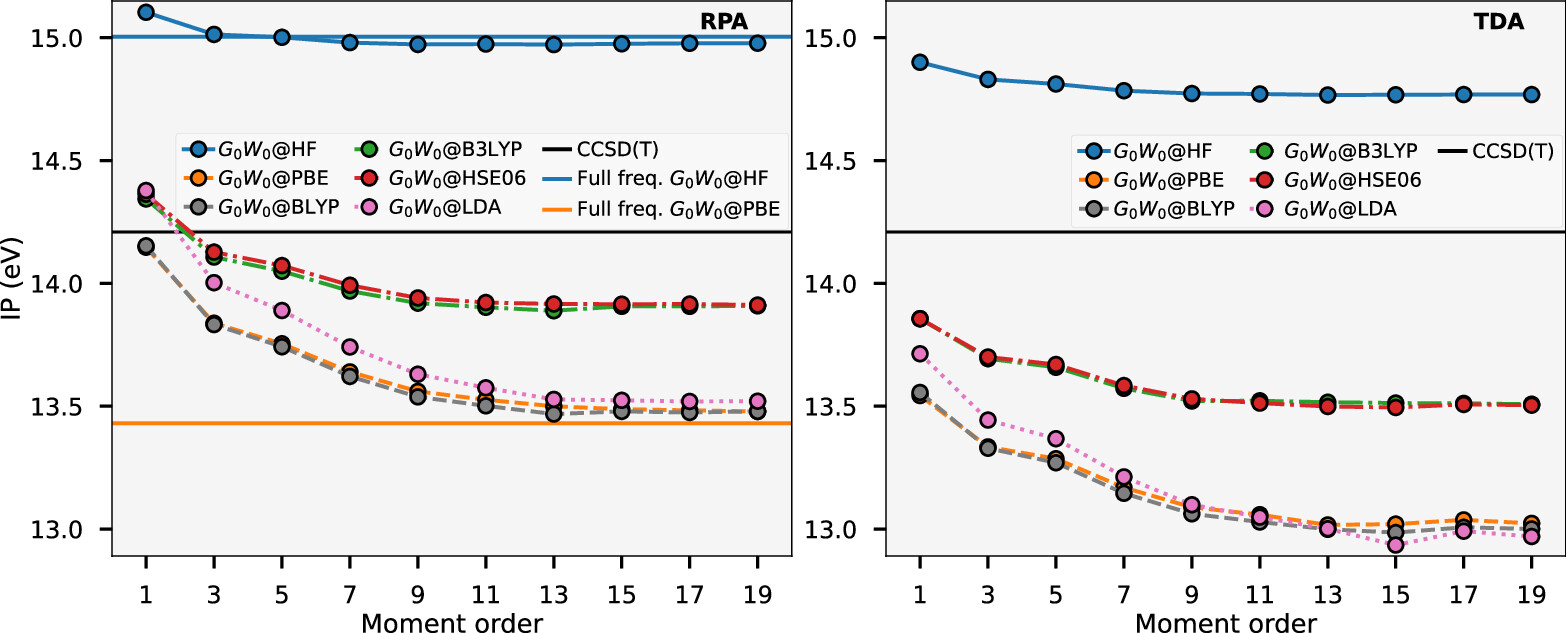
Figure 2. Convergence of the IP of Borane (BH3) with respect to the number of conserved moments (nmommax) of the self-energy in a def2-TZVPP basis set for single-shot G0W0, with RPA screening (left) and TDA (right). A range of mean-field starting points are considered, as well as reference values for RPA screening from PySCF, implementing an full-frequency algorithm to remove any grid approximations. (89) The remaining discrepancy likely comes from the diagonal approximation to the self-energy enforced in the reference values.
Figure 3
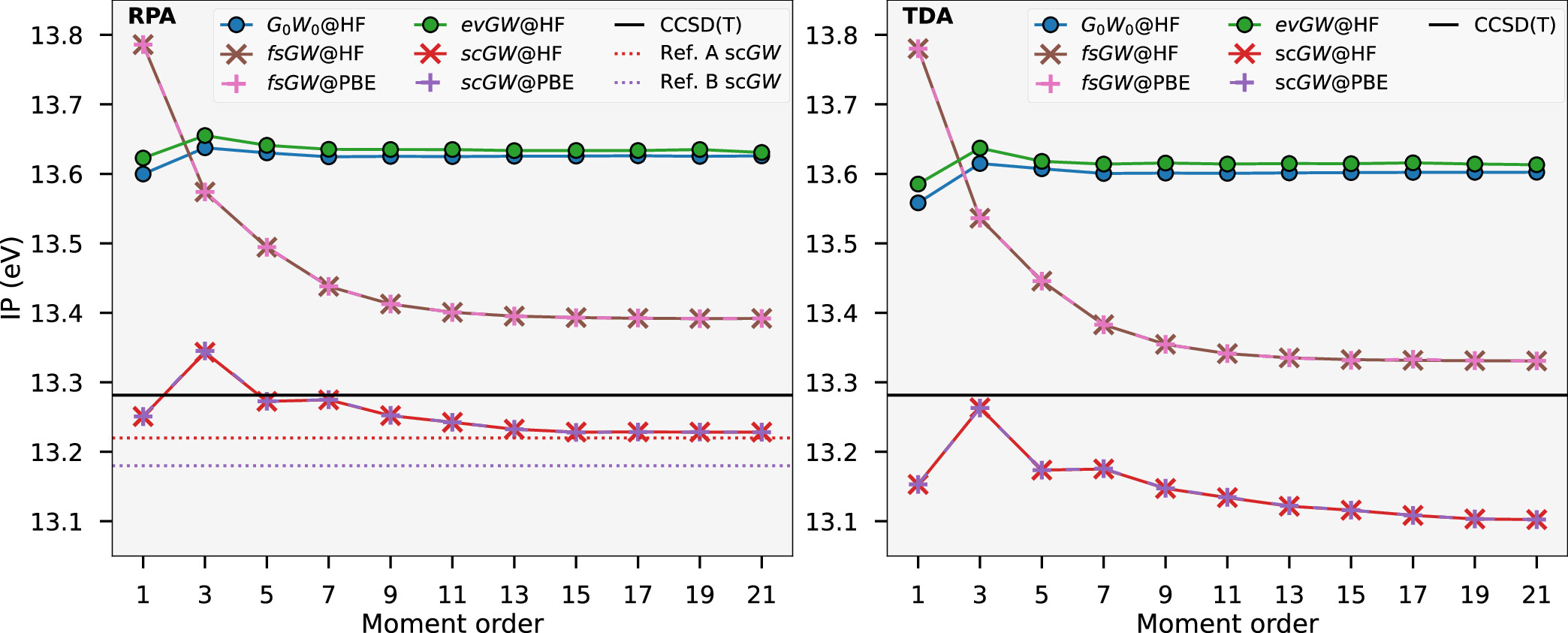
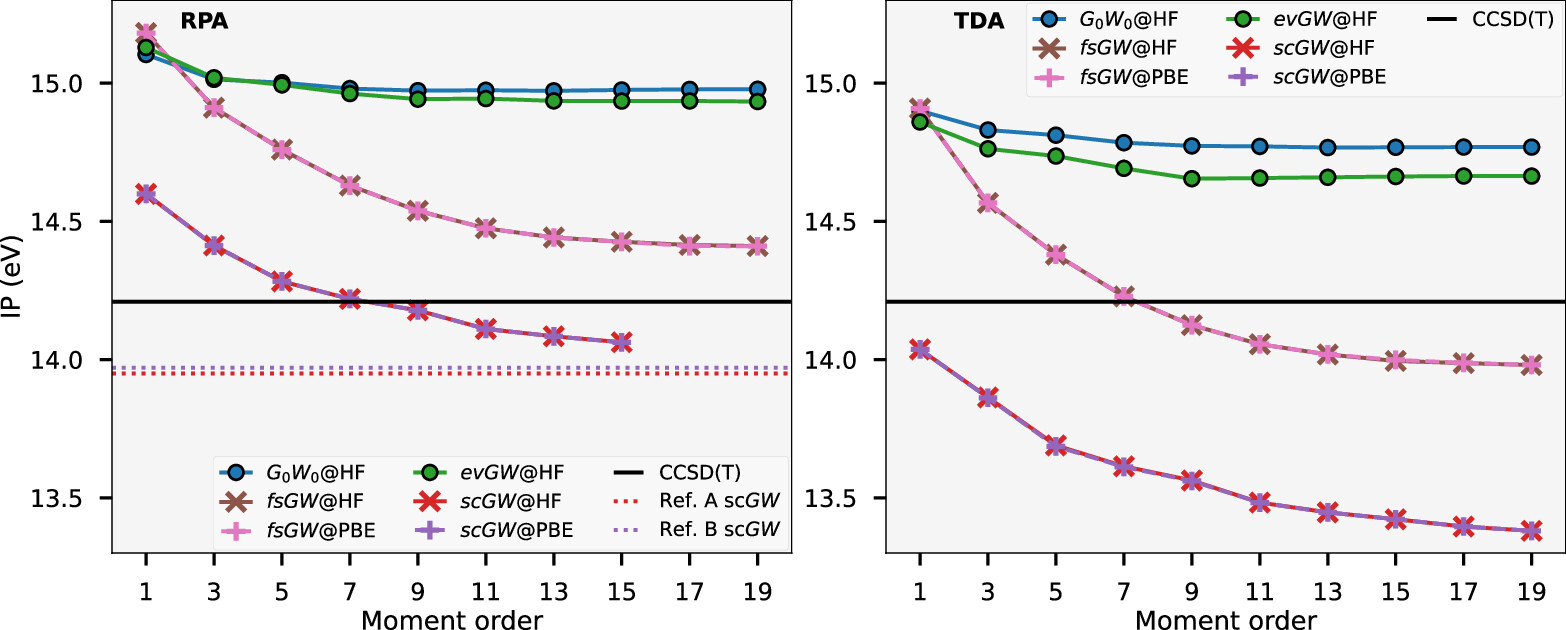
Figure 3. Convergence of the IP of borane (BH3) with respect to the number of conserved moments (nmommax) for self-consistent implementations of moment-conserved GW across HF and PBE reference states. We consider RPA (left) and TDA (right) screening on a def2-TZVPP basis. Reference fully self-consistent scGW values are included from Caruso et al. (90) (ref A) and Wen et al. (91) (ref B), relying on self-consistency on the Matsubara axis, followed by analytic continuation.
4.2. Computational Details
4.3. GW100 Results
Figure 4
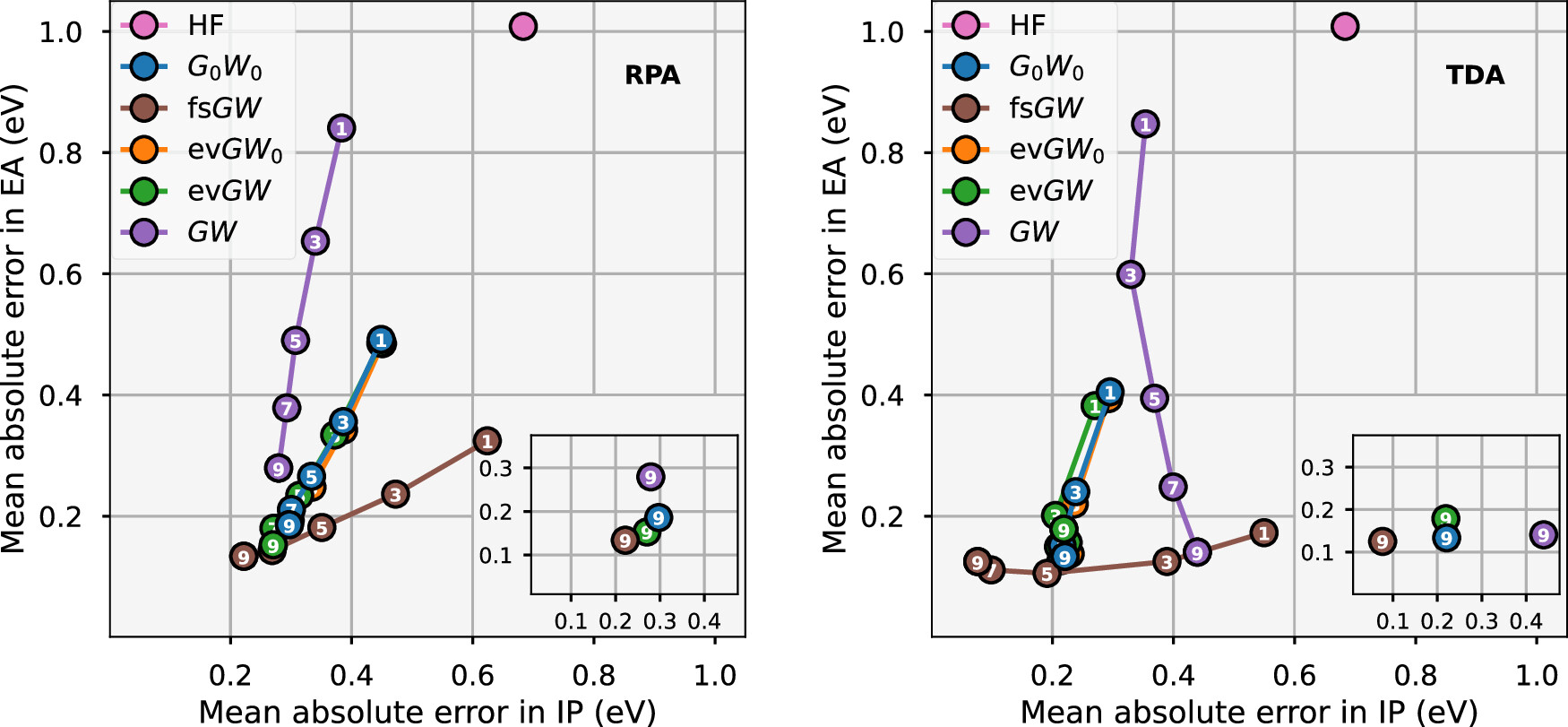
Figure 4. Convergence of the MAE for IP (x-axis) and EA (y-axis) across the GW100 test set with respect to CCSD(T) reference values for many of the self-consistent GW approaches considered. Numbers in the circles represent the maximum order of the conserved self-energy moments for each method, showing convergence to the full-frequency limit. The left plot shows the aggregated results for RPA screening, while the right plot is for TDA screening. The inset of each plot depicts the aggregated MAE for moment order 7 across the different moment-conserving GW variants.
Figure 5
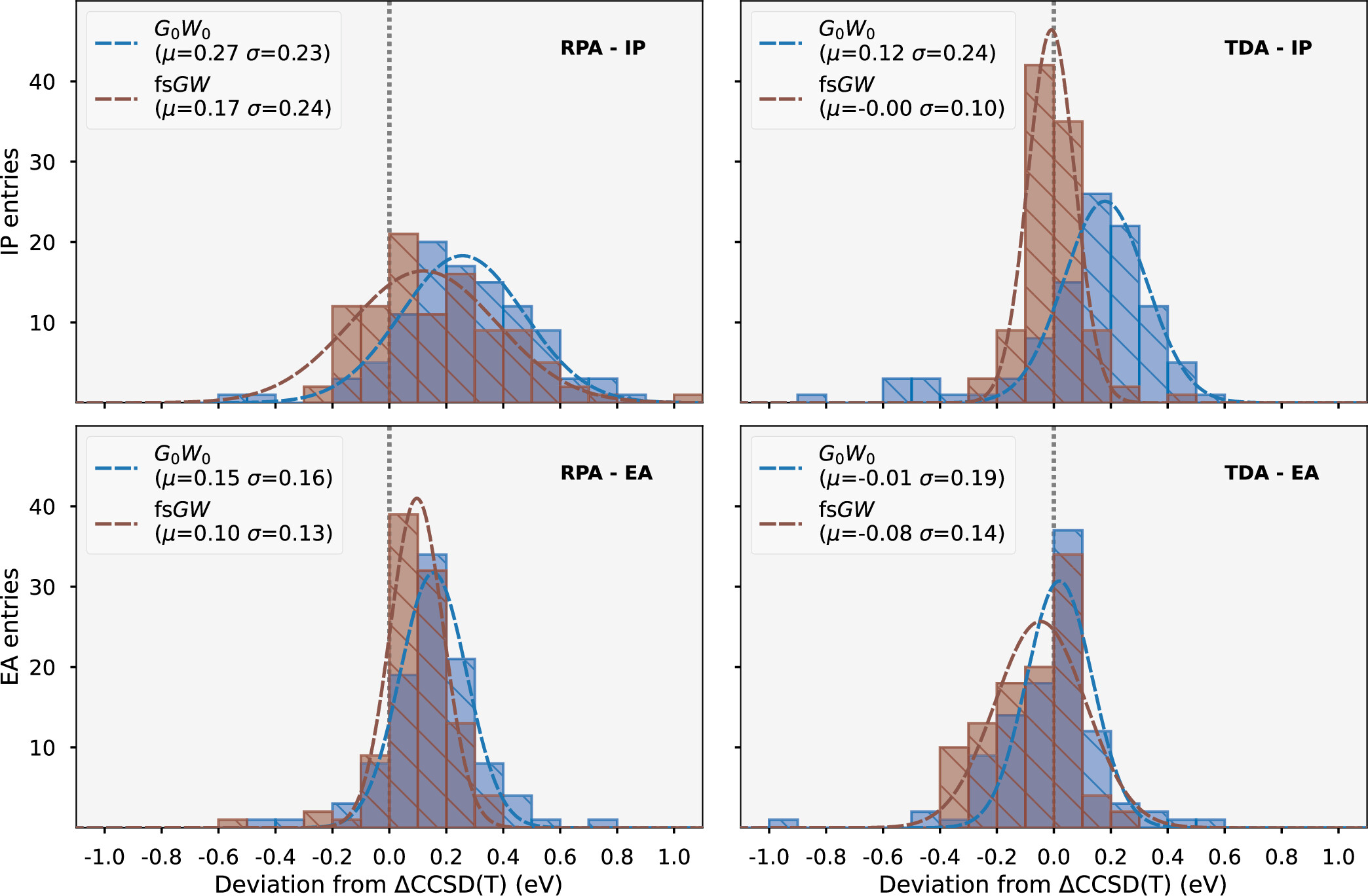
Figure 5. Histograms of the signed errors for IP and EA with G0W0 and fsGW relative to CCSD(T) over the GW100 set. Results presented for maximum moment order of 9 with Gaussians fit to the error distribution shown as dashed lines. The left plot shows RPA screening, right shows TDA screening with IP results shown top and EA bottom. The mean signed error (μ) and standard deviation (σ) for each method are shown in the legend.
| IP | EA | |||||
|---|---|---|---|---|---|---|
| RPA | MAE | MSE | STD | MAE | MSE | STD |
| G0W0 | 297 | 266 | 233 | 186 | 153 | 163 |
| fsGW | 222 | 168 | 238 | 134 | 99 | 131 |
| evGW | 271 | 235 | 215 | 153 | 153 | 169 |
| scGW | 279 | –157 | 301 | 279 | 271 | 166 |
| IP | EA | |||||
|---|---|---|---|---|---|---|
| TDA | MAE | MSE | STD | MAE | MSE | STD |
| G0W0 | 221 | 119 | 239 | 134 | –12 | 190 |
| fsGW | 77 | 0 | 103 | 125 | –83 | 142 |
| evGW | 219 | 38 | 264 | 179 | –108 | 213 |
| scGW | 439 | –439 | 227 | 141 | 112 | 142 |
All results are shown in meV at nmommax = 9.
5. Chlorophyll A Molecular Chromophore
Figure 6
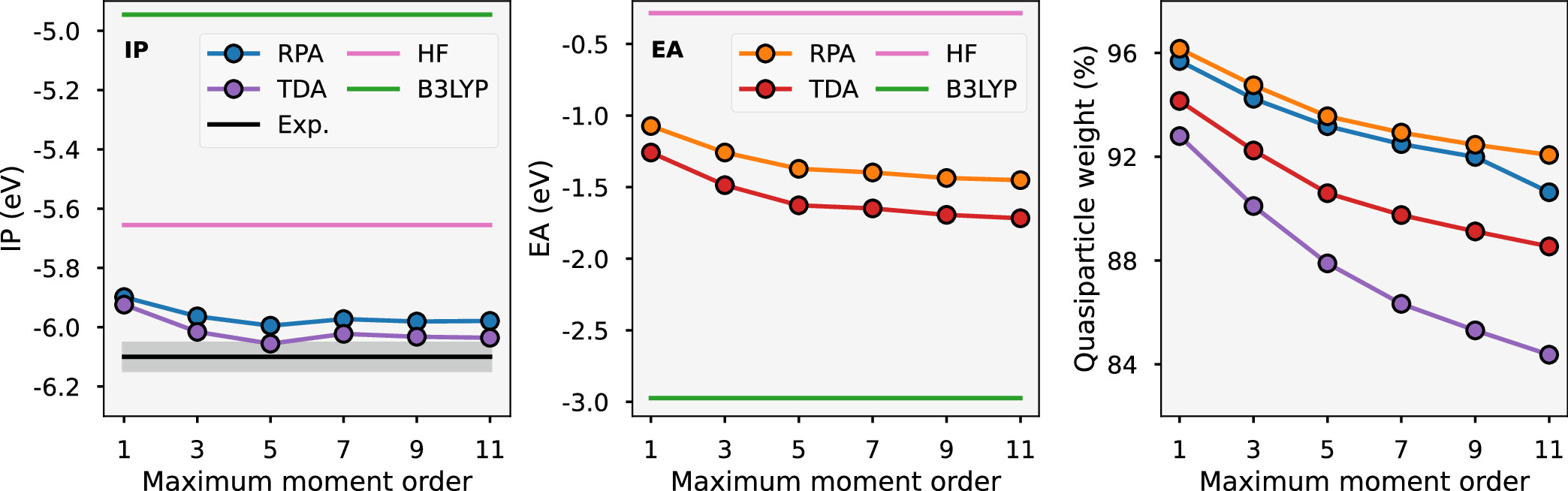
Figure 6. Convergence of the moment-conserving G0W0 IP (left) and EA (middle) and their quasiparticle weights (right) with increasing conserved moment order for the Chlorophyll A molecule in an aug-cc-pVDZ basis set. Also included are the mean-field orbital energies corresponding to the IP and EA at the level of HF and DFT with a B3LYP functional. In addition, we include an experimental estimate of the IP energy from ref (96), with associated experimental uncertainty shown by the gray shaded region.
Figure 7
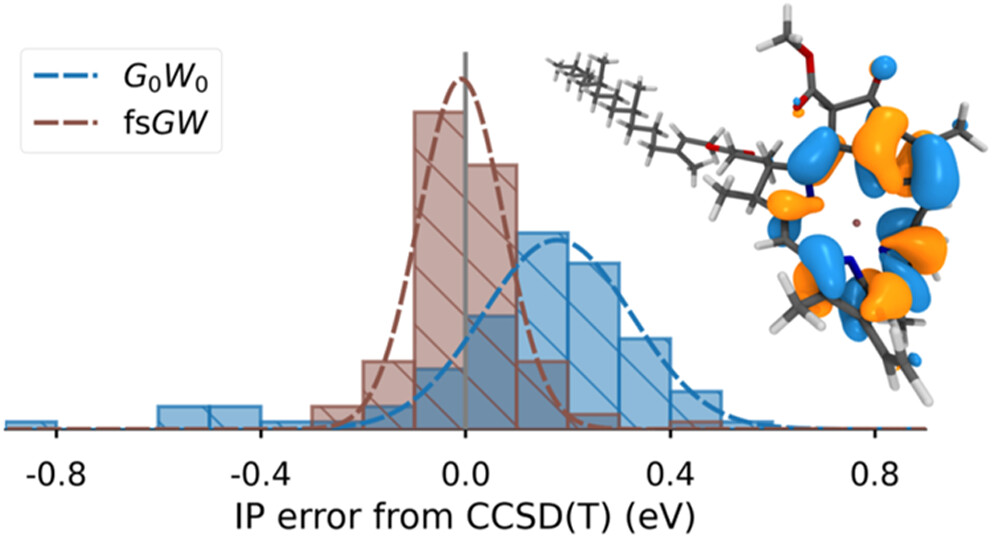
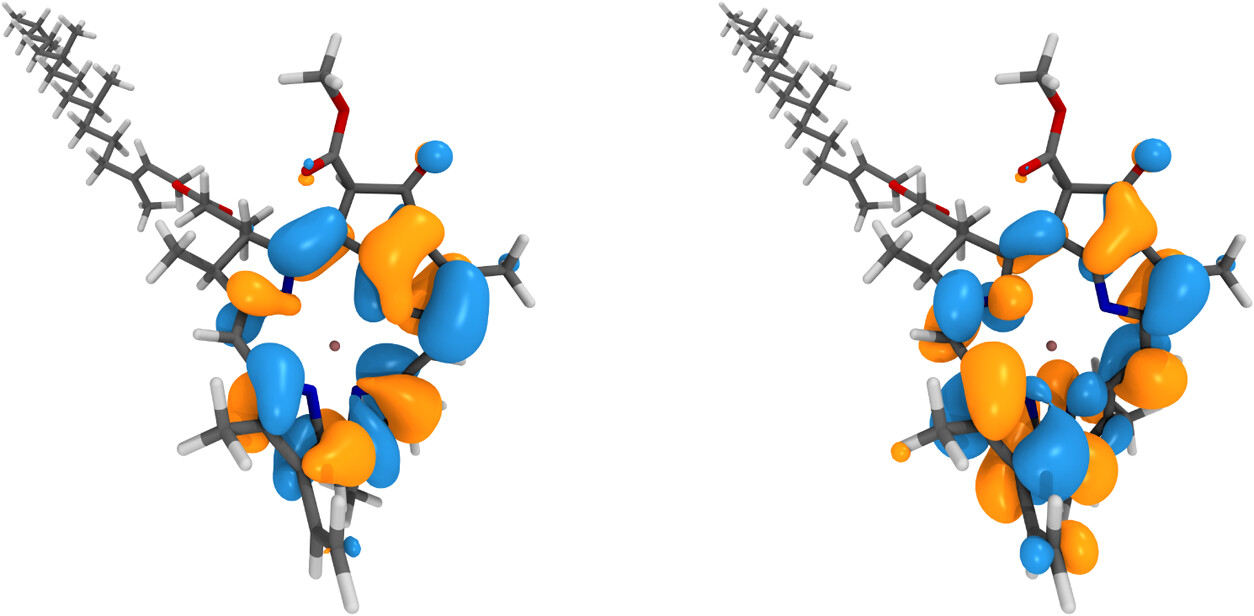
Figure 7. Dyson orbitals for the HOMO (left) and LUMO (right) for chlorophyll in an aug-cc-pVDZ basis set for the moment-conserving G0W0 method, using RPA and TDA screening, with maximum moment order nmommax = 11.
Figure 8
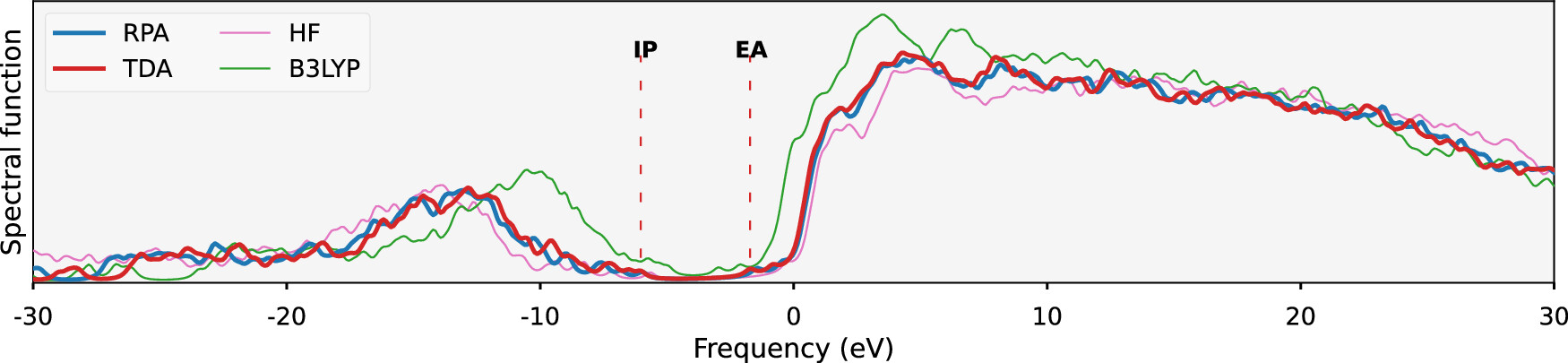
Figure 8. Spectral function for Chlorophyll A in an aug-cc-pVDZ basis set for the moment-conserving GW method, using RPA and TDA screening, with maximum moment order nmommax = 11. Thinner lines show the Hartree–Fock and B3LYP spectral functions. IP and EA locations are shown for the moment-conserving G0W0@TDA.
Figure 9
Figure 9. Convergence of the IP of carbon monoxide (CO) with respect to the number of conserved moments (nmommax) of the self-energy in a def2-TZVPP basis set for single-shot G0W0, with RPA screening (left) and TDA (right). A range of mean-field starting points are considered, as well as reference values for RPA screening from PySCF, implementing an full-frequency algorithm to remove any grid approximations. (89) The remaining discrepancy likely comes from the diagonal approximation to the self-energy enforced in the reference values.
Figure 10
Figure 10. Convergence of the IP of carbon monoxide (CO) using the def2-TZVPP basis set with respect to the number of conserved moments (nmommax) for various self-consistent implementations across HF and PBE starting points, with RPA screening (left) and TDA (right). Reference fully self-consistent GW values are included from Caruso et al. (90) (ref A) and Wen et al. (91) (ref B), where the convergence takes place on the Matsubara axis. The scGW results for RPA screening are limited to 15 moments due to convergence issues for higher moments.
6. Conclusions and Outlook
Data Availability
The code for this project is fully open-source and available at https://github.com/BoothGroup/momentGW, while the dyson package for constructing upfolded moment-conserving Hamiltonians is available at https://github.com/BoothGroup/dyson.
Author Information
- George H. Booth - Department of Physics, King’s College London, Strand, London WC2R 2LS, U.K.;
 https://orcid.org/0000-0003-2503-4904;
O.J.B. and M.K.A. contributed equally to this work and share the first authorship.
Acknowledgments
We sincerely thank Dominika Zgid for discussions on the technical details of particle number conservation in scGW. We thank Kemal Atalar for helpful comments on this manuscript. G.H.B. acknowledges funding from the European Union’s Horizon 2020 research and innovation programme under grant agreement No. 759063. We are also grateful to the UK Materials and Molecular Modelling Hub for computational resources, which is partially funded by EPSRC (EP/P020194/1 and EP/T022213/1).
A Schematic Self-Consistent Moment-GW Algorithms
B Carbon Monoxide Moment Convergence
References
This article references 99 other publications.
- 1Marie, A.; Ammar, A.; Loos, P.-F. Novel Treatments of Strong Correlations; Quintana, R. A. M.; Stanton, J. F., Eds.; Academic Press, 2024; Vol. 90, pp 157– 184 DOI: 10.1016/bs.aiq.2024.04.001 .Google ScholarThere is no corresponding record for this reference.
- 2Reining, L. The GW approximation: content, successes and limitations. WIREs Comput. Mol. Sci. 2018, 8, e1344 DOI: 10.1002/wcms.1344Google ScholarThere is no corresponding record for this reference.
- 3Golze, D.; Dvorak, M.; Rinke, P. The GW Compendium: A Practical Guide to Theoretical Photoemission Spectroscopy. Front. Chem. 2019, 7, 377 DOI: 10.3389/fchem.2019.00377Google ScholarThere is no corresponding record for this reference.
- 4van Setten, M. J.; Weigend, F.; Evers, F. The GW-method for quantum chemistry applications: Theory and implementation. J. Chem. Theory Comput. 2013, 9, 232– 246, DOI: 10.1021/ct300648tGoogle ScholarThere is no corresponding record for this reference.
- 5Hedin, L. New Method for Calculating the One-Particle Green’s Function with Application to the Electron-Gas Problem. Phys. Rev. 1965, 139, A796 DOI: 10.1103/PhysRev.139.A796Google ScholarThere is no corresponding record for this reference.
- 6Hedin, L. On correlation effects in electron spectroscopies and the GW approximation. J. Phys.: Condens. Matter 1999, 11, R489– R528, DOI: 10.1088/0953-8984/11/42/201Google ScholarThere is no corresponding record for this reference.
- 7Monino, E.; Loos, P. F. Connections and performances of Green’s function methods for charged and neutral excitations. J. Chem. Phys. 2023, 159, 34105 DOI: 10.1063/5.0159853Google ScholarThere is no corresponding record for this reference.
- 8Véril, M.; Romaniello, P.; Berger, J. A.; Loos, P. F. Unphysical Discontinuities in GW Methods. J. Chem. Theory Comput. 2018, 14, 5220– 5228, DOI: 10.1021/acs.jctc.8b00745Google ScholarThere is no corresponding record for this reference.
- 9Quintero-Monsebaiz, R.; Monino, E.; Marie, A.; Loos, P.-F. Connections between many-body perturbation and coupled-cluster theories. J. Chem. Phys. 2022, 157, 231102 DOI: 10.1063/5.0130837Google ScholarThere is no corresponding record for this reference.
- 10Bintrim, S. J.; Berkelbach, T. C. Full-frequency GW without frequency. J. Chem. Phys. 2021, 154, 041101 DOI: 10.1063/5.0035141Google ScholarThere is no corresponding record for this reference.
- 11Pokhilko, P.; Zgid, D. Interpretation of multiple solutions in fully iterative GF2 and GW schemes using local analysis of two-particle density matrices. J. Chem. Phys. 2021, 155, 024101 DOI: 10.1063/5.0055191Google ScholarThere is no corresponding record for this reference.
- 12Duchemin, I.; Blase, X. Robust Analytic-Continuation Approach to Many-Body GW Calculations. J. Chem. Theory Comput. 2020, 16, 1742– 1756, DOI: 10.1021/acs.jctc.9b01235Google ScholarThere is no corresponding record for this reference.
- 13Bruneval, F. Ionization energy of atoms obtained from GW self-energy or from random phase approximation total energies. J. Chem. Phys. 2012, 136, 194107 DOI: 10.1063/1.4718428Google ScholarThere is no corresponding record for this reference.
- 14Foerster, D.; Koval, P.; Snchez-Portal, D. An O(N3) implementation of Hedins GW approximation for molecules. J. Chem. Phys. 2011, 135, 074105 DOI: 10.1063/1.3624731Google ScholarThere is no corresponding record for this reference.
- 15Liu, P.; Kaltak, M.; Klimeš, J. c. v.; Kresse, G. Cubic scaling GW: Towards fast quasiparticle calculations. Phys. Rev. B 2016, 94, 165109 DOI: 10.1103/PhysRevB.94.165109Google ScholarThere is no corresponding record for this reference.
- 16Ma, H.; Wang, L.; Wan, L.; Li, J.; Qin, X.; Liu, J.; Hu, W.; Lin, L.; Yang, C.; Yang, J. Realizing Effective Cubic-Scaling Coulomb Hole plus Screened Exchange Approximation in Periodic Systems via Interpolative Separable Density Fitting with a Plane-Wave Basis Set. J. Phys. Chem. A 2021, 125, 7545– 7557, DOI: 10.1021/acs.jpca.1c03762Google ScholarThere is no corresponding record for this reference.
- 17Duchemin, I.; Blase, X. Cubic-Scaling All-Electron GW Calculations with a Separable Density-Fitting Space-Time Approach. J. Chem. Theory Comput. 2021, 17, 2383– 2393, DOI: 10.1021/acs.jctc.1c00101Google ScholarThere is no corresponding record for this reference.
- 18Yeh, C.-N.; Morales, M. A. Low-Scaling Algorithm for the Random Phase Approximation Using Tensor Hypercontraction with k-point Sampling. J. Chem. Theory Comput. 2023, 19, 6197– 6207, DOI: 10.1021/acs.jctc.3c00615Google ScholarThere is no corresponding record for this reference.
- 19Kutepov, A. Self-consistent GW method: O(N) algorithm for polarizability and self energy. Comput. Phys. Commun. 2020, 257, 107502 DOI: 10.1016/j.cpc.2020.107502Google ScholarThere is no corresponding record for this reference.
- 20Schurkus, H. F.; Ochsenfeld, C. Communication: An effective linear-scaling atomic-orbital reformulation of the random-phase approximation using a contracted double-Laplace transformation. J. Chem. Phys. 2016, 144, 031101 DOI: 10.1063/1.4939841Google ScholarThere is no corresponding record for this reference.
- 21Tölle, J.; Chan, G. K.-L. AB-G0W0: A practical G0W0 method without frequency integration based on an auxiliary boson expansion. J. Chem. Phys. 2024, 160, 164108 DOI: 10.1063/5.0195934Google ScholarThere is no corresponding record for this reference.
- 22Li, D.; Polizzi, E. Nonlinear eigenvalue algorithm for GW quasiparticle equations. Phys. Rev. B 2025, 111, 045137 DOI: 10.1103/PhysRevB.111.045137Google ScholarThere is no corresponding record for this reference.
- 23Tölle, J.; Niemeyer, N.; Neugebauer, J. Accelerating Analytic-Continuation GW Calculations with a Laplace Transform and Natural Auxiliary Functions. J. Chem. Theory Comput. 2024, 20, 2022– 2032, DOI: 10.1021/acs.jctc.3c01264Google ScholarThere is no corresponding record for this reference.
- 24Tölle, J.; Chan, G. K.-L. Exact relationships between the GW approximation and equation-of-motion coupled-cluster theories through the quasi-boson formalism. J. Chem. Phys. 2023, 158, 124123 DOI: 10.1063/5.0139716Google ScholarThere is no corresponding record for this reference.
- 25Gao, W.; Tang, Z.; Zhao, J.; Chelikowsky, J. R. Efficient Full-Frequency GW Calculations Using a Lanczos Method. Phys. Rev. Lett. 2024, 132, 126402 DOI: 10.1103/PhysRevLett.132.126402Google ScholarThere is no corresponding record for this reference.
- 26Backhouse, O. J.; Booth, G. H. Constructing “Full-Frequency” Spectra via Moment Constraints for Coupled Cluster Green’s Functions. J. Chem. Theory Comput. 2022, 18, 6622– 6636, DOI: 10.1021/acs.jctc.2c00670Google ScholarThere is no corresponding record for this reference.
- 27Scott, C. J. C.; Backhouse, O. J.; Booth, G. H. A “moment-conserving” reformulation of GW theory. J. Chem. Phys. 2023, 158, 124102 DOI: 10.1063/5.0143291Google ScholarThere is no corresponding record for this reference.
- 28Rebolini, E.; Toulouse, J. Range-separated time-dependent density-functional theory with a frequency-dependent second-order Bethe-Salpeter correlation kernel. J. Chem. Phys. 2016, 144, 094107 DOI: 10.1063/1.4943003Google ScholarThere is no corresponding record for this reference.
- 29Véril, M.; Scemama, A.; Caffarel, M.; Lipparini, F.; Boggio-Pasqua, M.; Jacquemin, D.; Loos, P. F. QUESTDB: A database of highly accurate excitation energies for the electronic structure community. WIREs Comput. Mol. Sci. 2021, 11, e1517 DOI: 10.1002/wcms.1517Google ScholarThere is no corresponding record for this reference.
- 30Gazizova, D.; Zhang, L.; Gull, E.; Leblanc, J. P. Feynman diagrammatics based on discrete pole representations: A path to renormalized perturbation theories. Phys. Rev. B 2024, 110, 075158 DOI: 10.1103/PhysRevB.110.075158Google ScholarThere is no corresponding record for this reference.
- 31Yeh, C. N.; Iskakov, S.; Zgid, D.; Gull, E. Fully self-consistent finite-temperature GW in Gaussian Bloch orbitals for solids. Phys. Rev. B 2022, 106, 235104 DOI: 10.1103/PhysRevB.106.235104Google ScholarThere is no corresponding record for this reference.
- 32Sriluckshmy, P. V.; Nusspickel, M.; Fertitta, E.; Booth, G. H. Fully algebraic and self-consistent effective dynamics in a static quantum embedding. Phys. Rev. B 2021, 103, 085131 DOI: 10.1103/PhysRevB.103.085131Google ScholarThere is no corresponding record for this reference.
- 33Weiße, A.; Wellein, G.; Alvermann, A.; Fehske, H. The kernel polynomial method. Rev. Mod. Phys. 2006, 78, 275 DOI: 10.1103/RevModPhys.78.275Google ScholarThere is no corresponding record for this reference.
- 34Backhouse, O. J.; Nusspickel, M.; Booth, G. H. Wave Function Perspective and Efficient Truncation of Renormalized Second-Order Perturbation Theory. J. Chem. Theory Comput. 2020, 16, 1090– 1104, DOI: 10.1021/acs.jctc.9b01182Google ScholarThere is no corresponding record for this reference.
- 35Backhouse, O. J.; Booth, G. H. Efficient Excitations and Spectra within a Perturbative Renormalization Approach. J. Chem. Theory Comput. 2020, 16, 6294– 6304, DOI: 10.1021/acs.jctc.0c00701Google ScholarThere is no corresponding record for this reference.
- 36Backhouse, O. J.; Santana-Bonilla, A.; Booth, G. H. Scalable and Predictive Spectra of Correlated Molecules with Moment Truncated Iterated Perturbation Theory. J. Phys. Chem. Lett. 2021, 12, 7650– 7658, DOI: 10.1021/acs.jpclett.1c02383Google ScholarThere is no corresponding record for this reference.
- 37Nusspickel, M.; Booth, G. H. Frequency-dependent and algebraic bath states for a dynamical mean-field theory with compact support. Phys. Rev. B 2020, 101, 045126 DOI: 10.1103/PhysRevB.101.045126Google ScholarThere is no corresponding record for this reference.
- 38Fertitta, E.; Booth, G. H. Rigorous wave function embedding with dynamical fluctuations. Phys. Rev. B 2018, 98, 235132 DOI: 10.1103/PhysRevB.98.235132Google ScholarThere is no corresponding record for this reference.
- 39Scott, C. J. C.; Booth, G. H. Extending density matrix embedding: A static two-particle theory. Phys. Rev. B 2021, 104, 245114 DOI: 10.1103/PhysRevB.104.245114Google ScholarThere is no corresponding record for this reference.
- 40Scott, C. J.; Booth, G. H. Rigorous Screened Interactions for Realistic Correlated Electron Systems. Phys. Rev. Lett. 2024, 132, 076401 DOI: 10.1103/PhysRevLett.132.076401Google ScholarThere is no corresponding record for this reference.
- 41Schambeck, M.; Golze, D.; Wilhelm, J. Solving multipole challenges in the GW100 benchmark enables precise low-scaling GW calculations. Phys. Rev. B 2024, 110, 125146 DOI: 10.1103/PhysRevB.110.125146Google ScholarThere is no corresponding record for this reference.
- 42Kotani, T.; Schilfgaarde, M. V.; Faleev, S. V. Quasiparticle self-consistent GW method: A basis for the independent-particle approximation. Phys. Rev. B 2007, 76, 165106 DOI: 10.1103/PhysRevB.76.165106Google ScholarThere is no corresponding record for this reference.
- 43Stan, A.; Dahlen, N. E.; van Leeuwen, R. Levels of self-consistency in the GW approximation. J. Chem. Phys. 2009, 130, 114105 DOI: 10.1063/1.3089567Google ScholarThere is no corresponding record for this reference.
- 44Pokhilko, P.; Yeh, C. N.; Morales, M. A.; Zgid, D. Tensor hypercontraction for fully self-consistent imaginary-time GF2 and GWSOX methods: Theory, implementation, and role of the Green’s function second-order exchange for intermolecular interactions. J. Chem. Phys. 2024, 161, 84108 DOI: 10.1063/5.0215954Google ScholarThere is no corresponding record for this reference.
- 45Bruneval, F.; Marques, M. A. L. Benchmarking the Starting Points of the GW Approximation for Molecules. J. Chem. Theory Comput. 2013, 9, 324– 329, DOI: 10.1021/ct300835hGoogle ScholarThere is no corresponding record for this reference.
- 46Pokhilko, P.; Zgid, D. Broken-symmetry self-consistent GW approach: Degree of spin contamination and evaluation of effective exchange couplings in solid antiferromagnets. J. Chem. Phys. 2022, 157, 144101 DOI: 10.1063/5.0114080Google ScholarThere is no corresponding record for this reference.
- 47Ammar, A.; Marie, A.; Rodríguez-Mayorga, M.; Burton, H. G.; Loos, P. F. Can GW handle multireference systems?. J. Chem. Phys. 2024, 160, 114101 DOI: 10.1063/5.0196561Google ScholarThere is no corresponding record for this reference.
- 48Duchemin, I.; Blase, X. Joint approximate diagonalization approach to quasiparticle self-consistent GW calculations. J. Chem. Phys. 2025, 162, 054121 DOI: 10.1063/5.0250929Google ScholarThere is no corresponding record for this reference.
- 49Loos, P.-F.; Romaniello, P.; Berger, J. A. Green Functions and Self-Consistency: Insights From the Spherium Model. J. Chem. Theory Comput. 2018, 14, 3071– 3082, DOI: 10.1021/acs.jctc.8b00260Google ScholarThere is no corresponding record for this reference.
- 50Fukaya, T.; Nakatsukasa, Y.; Yanagisawa, Y.; Yamamoto, Y. In CholeskyQR2: A Simple and Communication-Avoiding Algorithm for Computing a Tall-Skinny QR Factorization on a Large-Scale Parallel System, 2014 5th Workshop on Latest Advances in Scalable Algorithms for Large-Scale Systems; IEEE, 2014; pp 31– 38.Google ScholarThere is no corresponding record for this reference.
- 51Fukaya, T.; Kannan, R.; Nakatsukasa, Y.; Yamamoto, Y.; Yanagisawa, Y.; Shifted Cholesky, Q. R. for Computing the QR Factorization of Ill-Conditioned Matrices. SIAM J. Sci. Comput. 2020, 42, A477– A503, DOI: 10.1137/18M1218212Google ScholarThere is no corresponding record for this reference.
- 52Kállay, M. A systematic way for the cost reduction of density fitting methods. J. Chem. Phys. 2014, 141, 244113 DOI: 10.1063/1.4905005Google ScholarThere is no corresponding record for this reference.
- 53Heßelmann, A.; Görling, A. Random phase approximation correlation energies with exact Kohn–Sham exchange. Mol. Phys. 2010, 108, 359– 372, DOI: 10.1080/00268970903476662Google ScholarThere is no corresponding record for this reference.
- 54Chen, G. P.; Voora, V. K.; Agee, M. M.; Balasubramani, S. G.; Furche, F. Random-Phase Approximation Methods. Annu. Rev. Phys. Chem. 2017, 68, 421– 445, DOI: 10.1146/annurev-physchem-040215-112308Google ScholarThere is no corresponding record for this reference.
- 55Furche, F. Developing the random phase approximation into a practical post-Kohn–Sham correlation model. J. Chem. Phys. 2008, 129, 114105 DOI: 10.1063/1.2977789Google ScholarThere is no corresponding record for this reference.
- 56Eshuis, H.; Yarkony, J.; Furche, F. Fast computation of molecular random phase approximation correlation energies using resolution of the identity and imaginary frequency integration. J. Chem. Phys. 2010, 132, 234114 DOI: 10.1063/1.3442749Google ScholarThere is no corresponding record for this reference.
- 57Sun, Q.; Berkelbach, T. C.; Blunt, N. S.; Booth, G. H.; Guo, S.; Li, Z.; Liu, J.; McClain, J. D.; Sayfutyarova, E. R.; Sharma, S.; Wouters, S.; Chan, G. K.-L. PySCF: the Python-based simulations of chemistry framework. WIREs Comput. Mol. Sci. 2018, 8, e1340 DOI: 10.1002/wcms.1340Google ScholarThere is no corresponding record for this reference.
- 58Sun, Q.; Zhang, X.; Banerjee, S. Recent developments in the PySCF program package. J. Chem. Phys. 2020, 153, 024109 DOI: 10.1063/5.0006074Google ScholarThere is no corresponding record for this reference.
- 59Yeh, C. N.; Morales, M. A. Low-Scaling Algorithms for GW and Constrained Random Phase Approximation Using Symmetry-Adapted Interpolative Separable Density Fitting. J. Chem. Theory Comput. 2024, 20, 3184– 3198, DOI: 10.1021/acs.jctc.4c00085Google ScholarThere is no corresponding record for this reference.
- 60Pokhilko, P.; Yeh, C.-N.; Morales, M. A.; Zgid, D. Tensor hypercontraction for self-consistent vertex corrected GW with static and dynamic screening; applications to molecules and solids with superexchange. J. Chem. Phys. 2025, 162, 244110 DOI: 10.1063/5.0269572Google ScholarThere is no corresponding record for this reference.
- 61Lu, J.; Thicke, K. Cubic scaling algorithms for RPA correlation using interpolative separable density fitting. J. Comput. Phys. 2017, 351, 187– 202, DOI: 10.1016/j.jcp.2017.09.012Google ScholarThere is no corresponding record for this reference.
- 62Lewis, A. M.; Berkelbach, T. C. Vertex Corrections to the Polarizability Do Not Improve the GW Approximation for the Ionization Potential of Molecules. J. Chem. Theory Comput. 2019, 15, 2925– 2932, DOI: 10.1021/acs.jctc.8b00995Google ScholarThere is no corresponding record for this reference.
- 63Förster, A.; Visscher, L. Exploring the statically screened G3W2 correction to the GW self-energy: Charged excitations and total energies of finite systems. Phys. Rev. B 2022, 105, 125121 DOI: 10.1103/PhysRevB.105.125121Google ScholarThere is no corresponding record for this reference.
- 64Bruneval, F.; Förster, A. Fully Dynamic G3W2 Self-Energy for Finite Systems: Formulas and Benchmark. J. Chem. Theory Comput. 2024, 20, 3218– 3230, DOI: 10.1021/acs.jctc.4c00090Google ScholarThere is no corresponding record for this reference.
- 65von Barth, U.; Holm, B. Self-consistent GW0 results for the electron gas: Fixed screened potential W0 within the random-phase approximation. Phys. Rev. B 1996, 54, 8411 DOI: 10.1103/PhysRevB.54.8411Google ScholarThere is no corresponding record for this reference.
- 66Harsha, G.; Abraham, V.; Wen, M.; Zgid, D. Quasiparticle and fully self-consistent GW methods: an unbiased analysis using Gaussian orbitals. Phys. Rev. B 2024, 110, 235146 DOI: 10.1103/PhysRevB.110.235146Google ScholarThere is no corresponding record for this reference.
- 67Ren, X.; Merz, F.; Jiang, H.; Yao, Y.; Rampp, M.; Lederer, H.; Blum, V.; Scheffler, M. All-electron periodic G0W0 implementation with numerical atomic orbital basis functions: Algorithm and benchmarks. Phys. Rev. Mater. 2021, 5, 013807 DOI: 10.1103/PhysRevMaterials.5.013807Google ScholarThere is no corresponding record for this reference.
- 68Bruneval, F.; Rodriguez-Mayorga, M.; Rinke, P.; Dvorak, M. Improved One-Shot Total Energies from the Linearized GW Density Matrix. J. Chem. Theory Comput. 2021, 17, 2126– 2136, DOI: 10.1021/acs.jctc.0c01264Google ScholarThere is no corresponding record for this reference.
- 69Hybertsen, M. S.; Louie, S. G. First-Principles Theory of Quasiparticles: Calculation of Band Gaps in Semiconductors and Insulators. Phys. Rev. Lett. 1985, 55, 1418– 1421, DOI: 10.1103/PhysRevLett.55.1418Google ScholarThere is no corresponding record for this reference.
- 70Faleev, S. V.; van Schilfgaarde, M.; Kotani, T. All-electron self-consistent GW approximation: Application to Si, MnO, and NiO. Phys. Rev. Lett. 2004, 93, 126406 DOI: 10.1103/PhysRevLett.93.126406Google ScholarThere is no corresponding record for this reference.
- 71Shishkin, M.; Kresse, G. Self-consistent GW calculations for semiconductors and insulators. Phys. Rev. B 2007, 75, 235102 DOI: 10.1103/PhysRevB.75.235102Google ScholarThere is no corresponding record for this reference.
- 72Blase, X.; Attaccalite, C.; Olevano, V. First-principles GW calculations for fullerenes, porphyrins, phtalocyanine, and other molecules of interest for organic photovoltaic applications. Phys. Rev. B 2011, 83, 115103 DOI: 10.1103/PhysRevB.83.115103Google ScholarThere is no corresponding record for this reference.
- 73Kaplan, F.; Weigend, F.; Evers, F.; Setten, M. J. V. Off-diagonal self-energy terms and partially self-consistency in GW calculations for single molecules: Efficient implementation and quantitative effects on ionization potentials. J. Chem. Theory Comput. 2015, 11, 5152– 5160, DOI: 10.1021/acs.jctc.5b00394Google ScholarThere is no corresponding record for this reference.
- 74van Schilfgaarde, M.; Kotani, T.; Faleev, S. Quasiparticle Self-Consistent GW Theory. Phys. Rev. Lett. 2006, 96, 226402 DOI: 10.1103/PhysRevLett.96.226402Google ScholarThere is no corresponding record for this reference.
- 75Kotani, T.; Schilfgaarde, M.; Faleev, S. V.; Chantis, A. Quasiparticle self-consistent GW method: a short summary. J. Phys.: Condens. Matter 2007, 19, 365236 DOI: 10.1088/0953-8984/19/36/365236Google ScholarThere is no corresponding record for this reference.
- 76Kutepov, A.; Haule, K.; Savrasov, S. Y.; Kotliar, G. Electronic structure of Pu and Am metals by self-consistent relativistic GW method. Phys. Rev. B 2012, 85, 155129 DOI: 10.1103/PhysRevB.85.155129Google ScholarThere is no corresponding record for this reference.
- 77Koval, P.; Foerster, D.; Sánchez-Portal, D. Fully self-consistent GW and quasiparticle self-consistent GW for molecules. Phys. Rev. B 2014, 89, 155417 DOI: 10.1103/PhysRevB.89.155417Google ScholarThere is no corresponding record for this reference.
- 78Monino, E.; Loos, P.-F. Unphysical discontinuities, intruder states and regularization in GW methods. J. Chem. Phys. 2022, 156, 231101 DOI: 10.1063/5.0089317Google ScholarThere is no corresponding record for this reference.
- 79Marie, A.; Loos, P. F. A Similarity Renormalization Group Approach to Green’s Function Methods. J. Chem. Theory Comput. 2023, 19, 3943– 3957, DOI: 10.1021/acs.jctc.3c00281Google ScholarThere is no corresponding record for this reference.
- 80Holm, B.; von Barth, U. Fully self-consistent GW self-energy of the electron gas. Phys. Rev. B 1998, 57, 2108 DOI: 10.1103/PhysRevB.57.2108Google ScholarThere is no corresponding record for this reference.
- 81Stan, A.; Dahlen, N. E.; van Leeuwen, R. Fully self-consistent GW calculations for atoms and molecules. Europhys. Lett. 2006, 76, 298– 304, DOI: 10.1209/epl/i2006-10266-6Google ScholarThere is no corresponding record for this reference.
- 82Caruso, F.; Rinke, P.; Ren, X.; Scheffler, M.; Rubio, A. Unified description of ground and excited states of finite systems: The self-consistent GW approach. Phys. Rev. B 2012, 86, 81102 DOI: 10.1103/PhysRevB.86.081102Google ScholarThere is no corresponding record for this reference.
- 83Grumet, M.; Liu, P.; Kaltak, M.; Klimeš, J.; Kresse, G. Beyond the quasiparticle approximation: Fully self-consistent GW calculations. Phys. Rev. B 2018, 98, 155143 DOI: 10.1103/PhysRevB.98.155143Google ScholarThere is no corresponding record for this reference.
- 84Pulay, P. Convergence acceleration of iterative sequences. the case of scf iteration. Chem. Phys. Lett. 1980, 73, 393– 398, DOI: 10.1016/0009-2614(80)80396-4Google ScholarThere is no corresponding record for this reference.
- 85Pulay, P. Improved SCF convergence acceleration. J. Comput. Chem. 1982, 3, 556– 560, DOI: 10.1002/jcc.540030413Google ScholarThere is no corresponding record for this reference.
- 86Bruneval, F.; Dattani, N.; van Setten, M. J. The GW Miracle in Many-Body Perturbation Theory for the Ionization Potential of Molecules. Front. Chem. 2021, 9, 749779 DOI: 10.3389/fchem.2021.749779Google ScholarThere is no corresponding record for this reference.
- 87Denawi, A. H.; Bruneval, F.; Torrent, M.; Rodríguez-Mayorga, M. GW density matrix for estimation of self-consistent GW total energies in solids. Phys. Rev. B 2023, 108, 125107 DOI: 10.1103/PhysRevB.108.125107Google ScholarThere is no corresponding record for this reference.
- 88van Setten, M. J.; Caruso, F.; Sharifzadeh, S.; Ren, X.; Scheffler, M.; Liu, F.; Lischner, J.; Lin, L.; Deslippe, J. R.; Louie, S. G.; Yang, C.; Weigend, F.; Neaton, J. B.; Evers, F.; Rinke, P. GW100: Benchmarking G0W0 for Molecular Systems. J. Chem. Theory Comput. 2015, 11, 5665– 5687, DOI: 10.1021/acs.jctc.5b00453Google ScholarThere is no corresponding record for this reference.
- 89Zhu, T.; Chan, G. K.-L. All-Electron Gaussian-Based G0W0 for Valence and Core Excitation Energies of Periodic Systems. J. Chem. Theory Comput. 2021, 17, 727– 741, DOI: 10.1021/acs.jctc.0c00704Google ScholarThere is no corresponding record for this reference.
- 90Caruso, F.; Dauth, M.; van Setten, M. J.; Rinke, P. Benchmark of GW Approaches for the GW100 Test Set. J. Chem. Theory Comput. 2016, 12, 5076– 5087, DOI: 10.1021/acs.jctc.6b00774Google ScholarThere is no corresponding record for this reference.
- 91Wen, M.; Abraham, V.; Harsha, G.; Shee, A.; Whaley, K. B.; Zgid, D. Comparing Self-Consistent GW and Vertex-Corrected G0W0 (G0W0Γ) Accuracy for Molecular Ionization Potentials. J. Chem. Theory Comput. 2024, 20, 3109– 3120, DOI: 10.1021/acs.jctc.3c01279Google ScholarThere is no corresponding record for this reference.
- 92Neese, F.; Wennmohs, F.; Becker, U.; Riplinger, C. The ORCA quantum chemistry program package. J. Chem. Phys. 2020, 152, 224108 DOI: 10.1063/5.0004608Google ScholarThere is no corresponding record for this reference.
- 93Krause, K.; Harding, M. E.; Klopper, W. Coupled-cluster reference values for the GW27 and GW100 test sets for the assessment of GW methods. Mol. Phys. 2015, 113, 1952– 1960, DOI: 10.1080/00268976.2015.1025113Google ScholarThere is no corresponding record for this reference.
- 94Lange, M. F.; Berkelbach, T. C. On the Relation between Equation-of-Motion Coupled-Cluster Theory and the GW Approximation. J. Chem. Theory Comput. 2018, 14, 4224– 4236, DOI: 10.1021/acs.jctc.8b00455Google ScholarThere is no corresponding record for this reference.
- 95Bauschlicher, C. W. The convergence of the coupled cluster approach for MgO. Chem. Phys. Lett. 2018, 711, 27– 31, DOI: 10.1016/j.cplett.2018.09.010Google ScholarThere is no corresponding record for this reference.
- 96Shafizadeh, N.; Ha-Thi, M. H.; Soep, B.; Gaveau, M. A.; Piuzzi, F.; Pothier, C. Spectral characterization in a supersonic beam of neutral chlorophyll a evaporated from spinach leaves. J. Chem. Phys. 2011, 135, 114303 DOI: 10.1063/1.3637048Google ScholarThere is no corresponding record for this reference.
- 97Loos, P. F.; Pradines, B.; Scemama, A.; Giner, E.; Toulouse, J. Density-Based Basis-Set Incompleteness Correction for GW Methods. J. Chem. Theory Comput. 2020, 16, 1018– 1028, DOI: 10.1021/acs.jctc.9b01067Google ScholarThere is no corresponding record for this reference.
- 98Hashemi, Z.; Leppert, L. Assessment of the ab initio Bethe-Salpeter equation approach for the low-lying excitation energies of bacteriochlorophylls and chlorophylls. J. Phys. Chem. A 2021, 125, 2163– 2172, DOI: 10.1021/acs.jpca.1c01240Google ScholarThere is no corresponding record for this reference.
- 99Förster, A.; Visscher, L. Quasiparticle Self-Consistent GW-Bethe-Salpeter Equation Calculations for Large Chromophoric Systems. J. Chem. Theory Comput. 2022, 18, 6779– 6793, DOI: 10.1021/acs.jctc.2c00531Google ScholarThere is no corresponding record for this reference.
Cited By
This article is cited by 1 publications.
- Andrew Zhu, Arman Nejad, Poramas Komonvasee, Kesha Sorathia, David P. Tew. DLPNO-MP2 for periodic systems. II. Megacell embedding. The Journal of Chemical Physics 2025, 163
(21)
https://doi.org/10.1063/5.0290819

Journal of Chemical Theory and Computation
Copyright © 2025 The Authors. Published by American Chemical Society. This publication is licensed under
License Summary*
You are free to share (copy and redistribute) this article in any medium or format and to adapt (remix, transform, and build upon) the material for any purpose, even commercially within the parameters below:
Creative Commons (CC): This is a Creative Commons license.
Attribution (BY): Credit must be given to the creator.
*Disclaimer
This summary highlights only some of the key features and terms of the actual license. It is not a license and has no legal value. Carefully review the actual license before using these materials.
Article Views are the COUNTER-compliant sum of full text article downloads since November 2008 (both PDF and HTML) across all institutions and individuals. These metrics are regularly updated to reflect usage leading up to the last few days.
Citations are the number of other articles citing this article, calculated by Crossref and updated daily. Find more information about Crossref citation counts.
The Altmetric Attention Score is a quantitative measure of the attention that a research article has received online. Clicking on the donut icon will load a page at altmetric.com with additional details about the score and the social media presence for the given article. Find more information on the Altmetric Attention Score and how the score is calculated.
Recommended Articles
Abstract
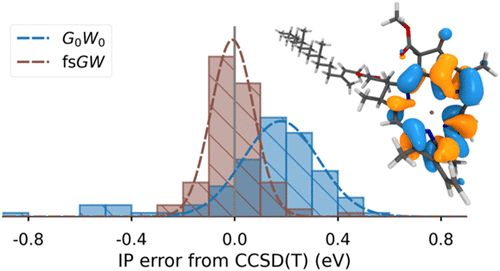
Figure 1
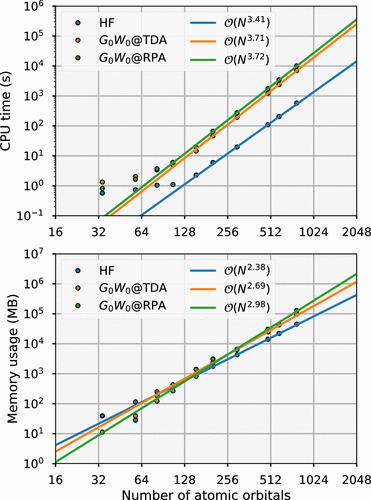
Figure 1. Performance benchmark for the moment-conserving G0W0 implementation, indicating CPU time (top) and memory usage (bottom) for increasing numbers of atomic orbitals in linear alkane chains up to C32H66 in a cc-pVDZ basis, with maximum moment order nmommax = 7, obtaining the full G0W0 spectrum for each calculation. No natural auxiliary orbital compression was used in this consideration of resource scaling. Lines are shown for both TDA and RPA screening, and for Hartree–Fock via PySCF for comparison.
Figure 2
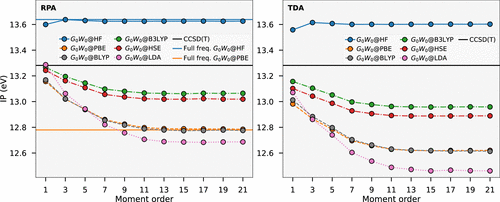
Figure 2. Convergence of the IP of Borane (BH3) with respect to the number of conserved moments (nmommax) of the self-energy in a def2-TZVPP basis set for single-shot G0W0, with RPA screening (left) and TDA (right). A range of mean-field starting points are considered, as well as reference values for RPA screening from PySCF, implementing an full-frequency algorithm to remove any grid approximations. (89) The remaining discrepancy likely comes from the diagonal approximation to the self-energy enforced in the reference values.
Figure 3
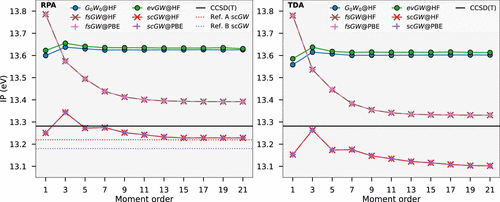
Figure 3. Convergence of the IP of borane (BH3) with respect to the number of conserved moments (nmommax) for self-consistent implementations of moment-conserved GW across HF and PBE reference states. We consider RPA (left) and TDA (right) screening on a def2-TZVPP basis. Reference fully self-consistent scGW values are included from Caruso et al. (90) (ref A) and Wen et al. (91) (ref B), relying on self-consistency on the Matsubara axis, followed by analytic continuation.
Figure 4
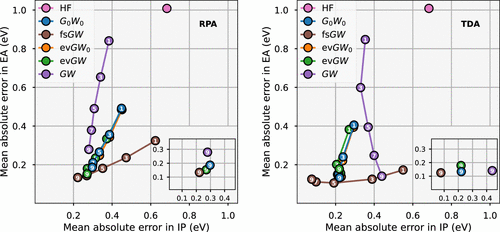
Figure 4. Convergence of the MAE for IP (x-axis) and EA (y-axis) across the GW100 test set with respect to CCSD(T) reference values for many of the self-consistent GW approaches considered. Numbers in the circles represent the maximum order of the conserved self-energy moments for each method, showing convergence to the full-frequency limit. The left plot shows the aggregated results for RPA screening, while the right plot is for TDA screening. The inset of each plot depicts the aggregated MAE for moment order 7 across the different moment-conserving GW variants.
Figure 5
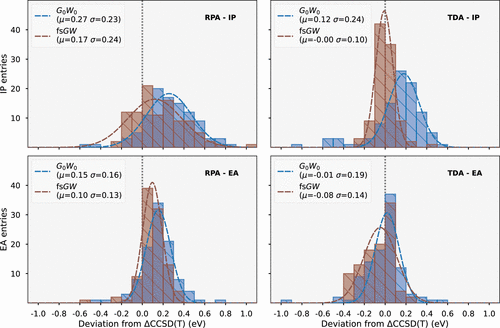
Figure 5. Histograms of the signed errors for IP and EA with G0W0 and fsGW relative to CCSD(T) over the GW100 set. Results presented for maximum moment order of 9 with Gaussians fit to the error distribution shown as dashed lines. The left plot shows RPA screening, right shows TDA screening with IP results shown top and EA bottom. The mean signed error (μ) and standard deviation (σ) for each method are shown in the legend.
Figure 6
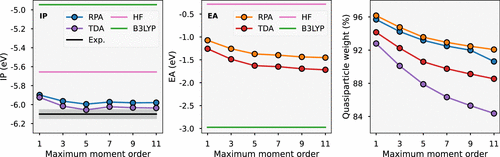
Figure 6. Convergence of the moment-conserving G0W0 IP (left) and EA (middle) and their quasiparticle weights (right) with increasing conserved moment order for the Chlorophyll A molecule in an aug-cc-pVDZ basis set. Also included are the mean-field orbital energies corresponding to the IP and EA at the level of HF and DFT with a B3LYP functional. In addition, we include an experimental estimate of the IP energy from ref (96), with associated experimental uncertainty shown by the gray shaded region.
Figure 7
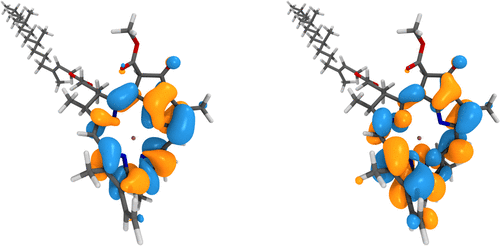
Figure 7. Dyson orbitals for the HOMO (left) and LUMO (right) for chlorophyll in an aug-cc-pVDZ basis set for the moment-conserving G0W0 method, using RPA and TDA screening, with maximum moment order nmommax = 11.
Figure 8
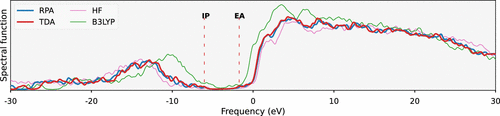
Figure 8. Spectral function for Chlorophyll A in an aug-cc-pVDZ basis set for the moment-conserving GW method, using RPA and TDA screening, with maximum moment order nmommax = 11. Thinner lines show the Hartree–Fock and B3LYP spectral functions. IP and EA locations are shown for the moment-conserving G0W0@TDA.
Figure 9
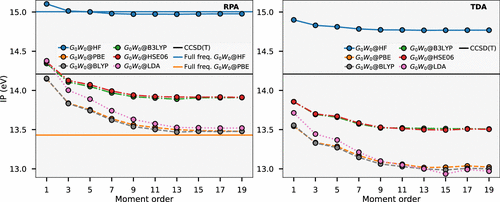
Figure 9. Convergence of the IP of carbon monoxide (CO) with respect to the number of conserved moments (nmommax) of the self-energy in a def2-TZVPP basis set for single-shot G0W0, with RPA screening (left) and TDA (right). A range of mean-field starting points are considered, as well as reference values for RPA screening from PySCF, implementing an full-frequency algorithm to remove any grid approximations. (89) The remaining discrepancy likely comes from the diagonal approximation to the self-energy enforced in the reference values.
Figure 10
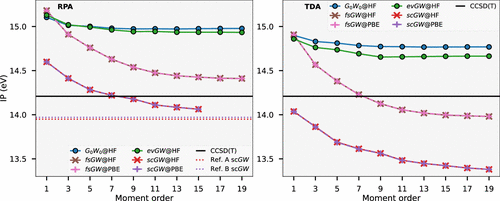
Figure 10. Convergence of the IP of carbon monoxide (CO) using the def2-TZVPP basis set with respect to the number of conserved moments (nmommax) for various self-consistent implementations across HF and PBE starting points, with RPA screening (left) and TDA (right). Reference fully self-consistent GW values are included from Caruso et al. (90) (ref A) and Wen et al. (91) (ref B), where the convergence takes place on the Matsubara axis. The scGW results for RPA screening are limited to 15 moments due to convergence issues for higher moments.
References
This article references 99 other publications.
- 1Marie, A.; Ammar, A.; Loos, P.-F. Novel Treatments of Strong Correlations; Quintana, R. A. M.; Stanton, J. F., Eds.; Academic Press, 2024; Vol. 90, pp 157– 184 DOI: 10.1016/bs.aiq.2024.04.001 .There is no corresponding record for this reference.
- 2Reining, L. The GW approximation: content, successes and limitations. WIREs Comput. Mol. Sci. 2018, 8, e1344 DOI: 10.1002/wcms.1344There is no corresponding record for this reference.
- 3Golze, D.; Dvorak, M.; Rinke, P. The GW Compendium: A Practical Guide to Theoretical Photoemission Spectroscopy. Front. Chem. 2019, 7, 377 DOI: 10.3389/fchem.2019.00377There is no corresponding record for this reference.
- 4van Setten, M. J.; Weigend, F.; Evers, F. The GW-method for quantum chemistry applications: Theory and implementation. J. Chem. Theory Comput. 2013, 9, 232– 246, DOI: 10.1021/ct300648tThere is no corresponding record for this reference.
- 5Hedin, L. New Method for Calculating the One-Particle Green’s Function with Application to the Electron-Gas Problem. Phys. Rev. 1965, 139, A796 DOI: 10.1103/PhysRev.139.A796There is no corresponding record for this reference.
- 6Hedin, L. On correlation effects in electron spectroscopies and the GW approximation. J. Phys.: Condens. Matter 1999, 11, R489– R528, DOI: 10.1088/0953-8984/11/42/201There is no corresponding record for this reference.
- 7Monino, E.; Loos, P. F. Connections and performances of Green’s function methods for charged and neutral excitations. J. Chem. Phys. 2023, 159, 34105 DOI: 10.1063/5.0159853There is no corresponding record for this reference.
- 8Véril, M.; Romaniello, P.; Berger, J. A.; Loos, P. F. Unphysical Discontinuities in GW Methods. J. Chem. Theory Comput. 2018, 14, 5220– 5228, DOI: 10.1021/acs.jctc.8b00745There is no corresponding record for this reference.
- 9Quintero-Monsebaiz, R.; Monino, E.; Marie, A.; Loos, P.-F. Connections between many-body perturbation and coupled-cluster theories. J. Chem. Phys. 2022, 157, 231102 DOI: 10.1063/5.0130837There is no corresponding record for this reference.
- 10Bintrim, S. J.; Berkelbach, T. C. Full-frequency GW without frequency. J. Chem. Phys. 2021, 154, 041101 DOI: 10.1063/5.0035141There is no corresponding record for this reference.
- 11Pokhilko, P.; Zgid, D. Interpretation of multiple solutions in fully iterative GF2 and GW schemes using local analysis of two-particle density matrices. J. Chem. Phys. 2021, 155, 024101 DOI: 10.1063/5.0055191There is no corresponding record for this reference.
- 12Duchemin, I.; Blase, X. Robust Analytic-Continuation Approach to Many-Body GW Calculations. J. Chem. Theory Comput. 2020, 16, 1742– 1756, DOI: 10.1021/acs.jctc.9b01235There is no corresponding record for this reference.
- 13Bruneval, F. Ionization energy of atoms obtained from GW self-energy or from random phase approximation total energies. J. Chem. Phys. 2012, 136, 194107 DOI: 10.1063/1.4718428There is no corresponding record for this reference.
- 14Foerster, D.; Koval, P.; Snchez-Portal, D. An O(N3) implementation of Hedins GW approximation for molecules. J. Chem. Phys. 2011, 135, 074105 DOI: 10.1063/1.3624731There is no corresponding record for this reference.
- 15Liu, P.; Kaltak, M.; Klimeš, J. c. v.; Kresse, G. Cubic scaling GW: Towards fast quasiparticle calculations. Phys. Rev. B 2016, 94, 165109 DOI: 10.1103/PhysRevB.94.165109There is no corresponding record for this reference.
- 16Ma, H.; Wang, L.; Wan, L.; Li, J.; Qin, X.; Liu, J.; Hu, W.; Lin, L.; Yang, C.; Yang, J. Realizing Effective Cubic-Scaling Coulomb Hole plus Screened Exchange Approximation in Periodic Systems via Interpolative Separable Density Fitting with a Plane-Wave Basis Set. J. Phys. Chem. A 2021, 125, 7545– 7557, DOI: 10.1021/acs.jpca.1c03762There is no corresponding record for this reference.
- 17Duchemin, I.; Blase, X. Cubic-Scaling All-Electron GW Calculations with a Separable Density-Fitting Space-Time Approach. J. Chem. Theory Comput. 2021, 17, 2383– 2393, DOI: 10.1021/acs.jctc.1c00101There is no corresponding record for this reference.
- 18Yeh, C.-N.; Morales, M. A. Low-Scaling Algorithm for the Random Phase Approximation Using Tensor Hypercontraction with k-point Sampling. J. Chem. Theory Comput. 2023, 19, 6197– 6207, DOI: 10.1021/acs.jctc.3c00615There is no corresponding record for this reference.
- 19Kutepov, A. Self-consistent GW method: O(N) algorithm for polarizability and self energy. Comput. Phys. Commun. 2020, 257, 107502 DOI: 10.1016/j.cpc.2020.107502There is no corresponding record for this reference.
- 20Schurkus, H. F.; Ochsenfeld, C. Communication: An effective linear-scaling atomic-orbital reformulation of the random-phase approximation using a contracted double-Laplace transformation. J. Chem. Phys. 2016, 144, 031101 DOI: 10.1063/1.4939841There is no corresponding record for this reference.
- 21Tölle, J.; Chan, G. K.-L. AB-G0W0: A practical G0W0 method without frequency integration based on an auxiliary boson expansion. J. Chem. Phys. 2024, 160, 164108 DOI: 10.1063/5.0195934There is no corresponding record for this reference.
- 22Li, D.; Polizzi, E. Nonlinear eigenvalue algorithm for GW quasiparticle equations. Phys. Rev. B 2025, 111, 045137 DOI: 10.1103/PhysRevB.111.045137There is no corresponding record for this reference.
- 23Tölle, J.; Niemeyer, N.; Neugebauer, J. Accelerating Analytic-Continuation GW Calculations with a Laplace Transform and Natural Auxiliary Functions. J. Chem. Theory Comput. 2024, 20, 2022– 2032, DOI: 10.1021/acs.jctc.3c01264There is no corresponding record for this reference.
- 24Tölle, J.; Chan, G. K.-L. Exact relationships between the GW approximation and equation-of-motion coupled-cluster theories through the quasi-boson formalism. J. Chem. Phys. 2023, 158, 124123 DOI: 10.1063/5.0139716There is no corresponding record for this reference.
- 25Gao, W.; Tang, Z.; Zhao, J.; Chelikowsky, J. R. Efficient Full-Frequency GW Calculations Using a Lanczos Method. Phys. Rev. Lett. 2024, 132, 126402 DOI: 10.1103/PhysRevLett.132.126402There is no corresponding record for this reference.
- 26Backhouse, O. J.; Booth, G. H. Constructing “Full-Frequency” Spectra via Moment Constraints for Coupled Cluster Green’s Functions. J. Chem. Theory Comput. 2022, 18, 6622– 6636, DOI: 10.1021/acs.jctc.2c00670There is no corresponding record for this reference.
- 27Scott, C. J. C.; Backhouse, O. J.; Booth, G. H. A “moment-conserving” reformulation of GW theory. J. Chem. Phys. 2023, 158, 124102 DOI: 10.1063/5.0143291There is no corresponding record for this reference.
- 28Rebolini, E.; Toulouse, J. Range-separated time-dependent density-functional theory with a frequency-dependent second-order Bethe-Salpeter correlation kernel. J. Chem. Phys. 2016, 144, 094107 DOI: 10.1063/1.4943003There is no corresponding record for this reference.
- 29Véril, M.; Scemama, A.; Caffarel, M.; Lipparini, F.; Boggio-Pasqua, M.; Jacquemin, D.; Loos, P. F. QUESTDB: A database of highly accurate excitation energies for the electronic structure community. WIREs Comput. Mol. Sci. 2021, 11, e1517 DOI: 10.1002/wcms.1517There is no corresponding record for this reference.
- 30Gazizova, D.; Zhang, L.; Gull, E.; Leblanc, J. P. Feynman diagrammatics based on discrete pole representations: A path to renormalized perturbation theories. Phys. Rev. B 2024, 110, 075158 DOI: 10.1103/PhysRevB.110.075158There is no corresponding record for this reference.
- 31Yeh, C. N.; Iskakov, S.; Zgid, D.; Gull, E. Fully self-consistent finite-temperature GW in Gaussian Bloch orbitals for solids. Phys. Rev. B 2022, 106, 235104 DOI: 10.1103/PhysRevB.106.235104There is no corresponding record for this reference.
- 32Sriluckshmy, P. V.; Nusspickel, M.; Fertitta, E.; Booth, G. H. Fully algebraic and self-consistent effective dynamics in a static quantum embedding. Phys. Rev. B 2021, 103, 085131 DOI: 10.1103/PhysRevB.103.085131There is no corresponding record for this reference.
- 33Weiße, A.; Wellein, G.; Alvermann, A.; Fehske, H. The kernel polynomial method. Rev. Mod. Phys. 2006, 78, 275 DOI: 10.1103/RevModPhys.78.275There is no corresponding record for this reference.
- 34Backhouse, O. J.; Nusspickel, M.; Booth, G. H. Wave Function Perspective and Efficient Truncation of Renormalized Second-Order Perturbation Theory. J. Chem. Theory Comput. 2020, 16, 1090– 1104, DOI: 10.1021/acs.jctc.9b01182There is no corresponding record for this reference.
- 35Backhouse, O. J.; Booth, G. H. Efficient Excitations and Spectra within a Perturbative Renormalization Approach. J. Chem. Theory Comput. 2020, 16, 6294– 6304, DOI: 10.1021/acs.jctc.0c00701There is no corresponding record for this reference.
- 36Backhouse, O. J.; Santana-Bonilla, A.; Booth, G. H. Scalable and Predictive Spectra of Correlated Molecules with Moment Truncated Iterated Perturbation Theory. J. Phys. Chem. Lett. 2021, 12, 7650– 7658, DOI: 10.1021/acs.jpclett.1c02383There is no corresponding record for this reference.
- 37Nusspickel, M.; Booth, G. H. Frequency-dependent and algebraic bath states for a dynamical mean-field theory with compact support. Phys. Rev. B 2020, 101, 045126 DOI: 10.1103/PhysRevB.101.045126There is no corresponding record for this reference.
- 38Fertitta, E.; Booth, G. H. Rigorous wave function embedding with dynamical fluctuations. Phys. Rev. B 2018, 98, 235132 DOI: 10.1103/PhysRevB.98.235132There is no corresponding record for this reference.
- 39Scott, C. J. C.; Booth, G. H. Extending density matrix embedding: A static two-particle theory. Phys. Rev. B 2021, 104, 245114 DOI: 10.1103/PhysRevB.104.245114There is no corresponding record for this reference.
- 40Scott, C. J.; Booth, G. H. Rigorous Screened Interactions for Realistic Correlated Electron Systems. Phys. Rev. Lett. 2024, 132, 076401 DOI: 10.1103/PhysRevLett.132.076401There is no corresponding record for this reference.
- 41Schambeck, M.; Golze, D.; Wilhelm, J. Solving multipole challenges in the GW100 benchmark enables precise low-scaling GW calculations. Phys. Rev. B 2024, 110, 125146 DOI: 10.1103/PhysRevB.110.125146There is no corresponding record for this reference.
- 42Kotani, T.; Schilfgaarde, M. V.; Faleev, S. V. Quasiparticle self-consistent GW method: A basis for the independent-particle approximation. Phys. Rev. B 2007, 76, 165106 DOI: 10.1103/PhysRevB.76.165106There is no corresponding record for this reference.
- 43Stan, A.; Dahlen, N. E.; van Leeuwen, R. Levels of self-consistency in the GW approximation. J. Chem. Phys. 2009, 130, 114105 DOI: 10.1063/1.3089567There is no corresponding record for this reference.
- 44Pokhilko, P.; Yeh, C. N.; Morales, M. A.; Zgid, D. Tensor hypercontraction for fully self-consistent imaginary-time GF2 and GWSOX methods: Theory, implementation, and role of the Green’s function second-order exchange for intermolecular interactions. J. Chem. Phys. 2024, 161, 84108 DOI: 10.1063/5.0215954There is no corresponding record for this reference.
- 45Bruneval, F.; Marques, M. A. L. Benchmarking the Starting Points of the GW Approximation for Molecules. J. Chem. Theory Comput. 2013, 9, 324– 329, DOI: 10.1021/ct300835hThere is no corresponding record for this reference.
- 46Pokhilko, P.; Zgid, D. Broken-symmetry self-consistent GW approach: Degree of spin contamination and evaluation of effective exchange couplings in solid antiferromagnets. J. Chem. Phys. 2022, 157, 144101 DOI: 10.1063/5.0114080There is no corresponding record for this reference.
- 47Ammar, A.; Marie, A.; Rodríguez-Mayorga, M.; Burton, H. G.; Loos, P. F. Can GW handle multireference systems?. J. Chem. Phys. 2024, 160, 114101 DOI: 10.1063/5.0196561There is no corresponding record for this reference.
- 48Duchemin, I.; Blase, X. Joint approximate diagonalization approach to quasiparticle self-consistent GW calculations. J. Chem. Phys. 2025, 162, 054121 DOI: 10.1063/5.0250929There is no corresponding record for this reference.
- 49Loos, P.-F.; Romaniello, P.; Berger, J. A. Green Functions and Self-Consistency: Insights From the Spherium Model. J. Chem. Theory Comput. 2018, 14, 3071– 3082, DOI: 10.1021/acs.jctc.8b00260There is no corresponding record for this reference.
- 50Fukaya, T.; Nakatsukasa, Y.; Yanagisawa, Y.; Yamamoto, Y. In CholeskyQR2: A Simple and Communication-Avoiding Algorithm for Computing a Tall-Skinny QR Factorization on a Large-Scale Parallel System, 2014 5th Workshop on Latest Advances in Scalable Algorithms for Large-Scale Systems; IEEE, 2014; pp 31– 38.There is no corresponding record for this reference.
- 51Fukaya, T.; Kannan, R.; Nakatsukasa, Y.; Yamamoto, Y.; Yanagisawa, Y.; Shifted Cholesky, Q. R. for Computing the QR Factorization of Ill-Conditioned Matrices. SIAM J. Sci. Comput. 2020, 42, A477– A503, DOI: 10.1137/18M1218212There is no corresponding record for this reference.
- 52Kállay, M. A systematic way for the cost reduction of density fitting methods. J. Chem. Phys. 2014, 141, 244113 DOI: 10.1063/1.4905005There is no corresponding record for this reference.
- 53Heßelmann, A.; Görling, A. Random phase approximation correlation energies with exact Kohn–Sham exchange. Mol. Phys. 2010, 108, 359– 372, DOI: 10.1080/00268970903476662There is no corresponding record for this reference.
- 54Chen, G. P.; Voora, V. K.; Agee, M. M.; Balasubramani, S. G.; Furche, F. Random-Phase Approximation Methods. Annu. Rev. Phys. Chem. 2017, 68, 421– 445, DOI: 10.1146/annurev-physchem-040215-112308There is no corresponding record for this reference.
- 55Furche, F. Developing the random phase approximation into a practical post-Kohn–Sham correlation model. J. Chem. Phys. 2008, 129, 114105 DOI: 10.1063/1.2977789There is no corresponding record for this reference.
- 56Eshuis, H.; Yarkony, J.; Furche, F. Fast computation of molecular random phase approximation correlation energies using resolution of the identity and imaginary frequency integration. J. Chem. Phys. 2010, 132, 234114 DOI: 10.1063/1.3442749There is no corresponding record for this reference.
- 57Sun, Q.; Berkelbach, T. C.; Blunt, N. S.; Booth, G. H.; Guo, S.; Li, Z.; Liu, J.; McClain, J. D.; Sayfutyarova, E. R.; Sharma, S.; Wouters, S.; Chan, G. K.-L. PySCF: the Python-based simulations of chemistry framework. WIREs Comput. Mol. Sci. 2018, 8, e1340 DOI: 10.1002/wcms.1340There is no corresponding record for this reference.
- 58Sun, Q.; Zhang, X.; Banerjee, S. Recent developments in the PySCF program package. J. Chem. Phys. 2020, 153, 024109 DOI: 10.1063/5.0006074There is no corresponding record for this reference.
- 59Yeh, C. N.; Morales, M. A. Low-Scaling Algorithms for GW and Constrained Random Phase Approximation Using Symmetry-Adapted Interpolative Separable Density Fitting. J. Chem. Theory Comput. 2024, 20, 3184– 3198, DOI: 10.1021/acs.jctc.4c00085There is no corresponding record for this reference.
- 60Pokhilko, P.; Yeh, C.-N.; Morales, M. A.; Zgid, D. Tensor hypercontraction for self-consistent vertex corrected GW with static and dynamic screening; applications to molecules and solids with superexchange. J. Chem. Phys. 2025, 162, 244110 DOI: 10.1063/5.0269572There is no corresponding record for this reference.
- 61Lu, J.; Thicke, K. Cubic scaling algorithms for RPA correlation using interpolative separable density fitting. J. Comput. Phys. 2017, 351, 187– 202, DOI: 10.1016/j.jcp.2017.09.012There is no corresponding record for this reference.
- 62Lewis, A. M.; Berkelbach, T. C. Vertex Corrections to the Polarizability Do Not Improve the GW Approximation for the Ionization Potential of Molecules. J. Chem. Theory Comput. 2019, 15, 2925– 2932, DOI: 10.1021/acs.jctc.8b00995There is no corresponding record for this reference.
- 63Förster, A.; Visscher, L. Exploring the statically screened G3W2 correction to the GW self-energy: Charged excitations and total energies of finite systems. Phys. Rev. B 2022, 105, 125121 DOI: 10.1103/PhysRevB.105.125121There is no corresponding record for this reference.
- 64Bruneval, F.; Förster, A. Fully Dynamic G3W2 Self-Energy for Finite Systems: Formulas and Benchmark. J. Chem. Theory Comput. 2024, 20, 3218– 3230, DOI: 10.1021/acs.jctc.4c00090There is no corresponding record for this reference.
- 65von Barth, U.; Holm, B. Self-consistent GW0 results for the electron gas: Fixed screened potential W0 within the random-phase approximation. Phys. Rev. B 1996, 54, 8411 DOI: 10.1103/PhysRevB.54.8411There is no corresponding record for this reference.
- 66Harsha, G.; Abraham, V.; Wen, M.; Zgid, D. Quasiparticle and fully self-consistent GW methods: an unbiased analysis using Gaussian orbitals. Phys. Rev. B 2024, 110, 235146 DOI: 10.1103/PhysRevB.110.235146There is no corresponding record for this reference.
- 67Ren, X.; Merz, F.; Jiang, H.; Yao, Y.; Rampp, M.; Lederer, H.; Blum, V.; Scheffler, M. All-electron periodic G0W0 implementation with numerical atomic orbital basis functions: Algorithm and benchmarks. Phys. Rev. Mater. 2021, 5, 013807 DOI: 10.1103/PhysRevMaterials.5.013807There is no corresponding record for this reference.
- 68Bruneval, F.; Rodriguez-Mayorga, M.; Rinke, P.; Dvorak, M. Improved One-Shot Total Energies from the Linearized GW Density Matrix. J. Chem. Theory Comput. 2021, 17, 2126– 2136, DOI: 10.1021/acs.jctc.0c01264There is no corresponding record for this reference.
- 69Hybertsen, M. S.; Louie, S. G. First-Principles Theory of Quasiparticles: Calculation of Band Gaps in Semiconductors and Insulators. Phys. Rev. Lett. 1985, 55, 1418– 1421, DOI: 10.1103/PhysRevLett.55.1418There is no corresponding record for this reference.
- 70Faleev, S. V.; van Schilfgaarde, M.; Kotani, T. All-electron self-consistent GW approximation: Application to Si, MnO, and NiO. Phys. Rev. Lett. 2004, 93, 126406 DOI: 10.1103/PhysRevLett.93.126406There is no corresponding record for this reference.
- 71Shishkin, M.; Kresse, G. Self-consistent GW calculations for semiconductors and insulators. Phys. Rev. B 2007, 75, 235102 DOI: 10.1103/PhysRevB.75.235102There is no corresponding record for this reference.
- 72Blase, X.; Attaccalite, C.; Olevano, V. First-principles GW calculations for fullerenes, porphyrins, phtalocyanine, and other molecules of interest for organic photovoltaic applications. Phys. Rev. B 2011, 83, 115103 DOI: 10.1103/PhysRevB.83.115103There is no corresponding record for this reference.
- 73Kaplan, F.; Weigend, F.; Evers, F.; Setten, M. J. V. Off-diagonal self-energy terms and partially self-consistency in GW calculations for single molecules: Efficient implementation and quantitative effects on ionization potentials. J. Chem. Theory Comput. 2015, 11, 5152– 5160, DOI: 10.1021/acs.jctc.5b00394There is no corresponding record for this reference.
- 74van Schilfgaarde, M.; Kotani, T.; Faleev, S. Quasiparticle Self-Consistent GW Theory. Phys. Rev. Lett. 2006, 96, 226402 DOI: 10.1103/PhysRevLett.96.226402There is no corresponding record for this reference.
- 75Kotani, T.; Schilfgaarde, M.; Faleev, S. V.; Chantis, A. Quasiparticle self-consistent GW method: a short summary. J. Phys.: Condens. Matter 2007, 19, 365236 DOI: 10.1088/0953-8984/19/36/365236There is no corresponding record for this reference.
- 76Kutepov, A.; Haule, K.; Savrasov, S. Y.; Kotliar, G. Electronic structure of Pu and Am metals by self-consistent relativistic GW method. Phys. Rev. B 2012, 85, 155129 DOI: 10.1103/PhysRevB.85.155129There is no corresponding record for this reference.
- 77Koval, P.; Foerster, D.; Sánchez-Portal, D. Fully self-consistent GW and quasiparticle self-consistent GW for molecules. Phys. Rev. B 2014, 89, 155417 DOI: 10.1103/PhysRevB.89.155417There is no corresponding record for this reference.
- 78Monino, E.; Loos, P.-F. Unphysical discontinuities, intruder states and regularization in GW methods. J. Chem. Phys. 2022, 156, 231101 DOI: 10.1063/5.0089317There is no corresponding record for this reference.
- 79Marie, A.; Loos, P. F. A Similarity Renormalization Group Approach to Green’s Function Methods. J. Chem. Theory Comput. 2023, 19, 3943– 3957, DOI: 10.1021/acs.jctc.3c00281There is no corresponding record for this reference.
- 80Holm, B.; von Barth, U. Fully self-consistent GW self-energy of the electron gas. Phys. Rev. B 1998, 57, 2108 DOI: 10.1103/PhysRevB.57.2108There is no corresponding record for this reference.
- 81Stan, A.; Dahlen, N. E.; van Leeuwen, R. Fully self-consistent GW calculations for atoms and molecules. Europhys. Lett. 2006, 76, 298– 304, DOI: 10.1209/epl/i2006-10266-6There is no corresponding record for this reference.
- 82Caruso, F.; Rinke, P.; Ren, X.; Scheffler, M.; Rubio, A. Unified description of ground and excited states of finite systems: The self-consistent GW approach. Phys. Rev. B 2012, 86, 81102 DOI: 10.1103/PhysRevB.86.081102There is no corresponding record for this reference.
- 83Grumet, M.; Liu, P.; Kaltak, M.; Klimeš, J.; Kresse, G. Beyond the quasiparticle approximation: Fully self-consistent GW calculations. Phys. Rev. B 2018, 98, 155143 DOI: 10.1103/PhysRevB.98.155143There is no corresponding record for this reference.
- 84Pulay, P. Convergence acceleration of iterative sequences. the case of scf iteration. Chem. Phys. Lett. 1980, 73, 393– 398, DOI: 10.1016/0009-2614(80)80396-4There is no corresponding record for this reference.
- 85Pulay, P. Improved SCF convergence acceleration. J. Comput. Chem. 1982, 3, 556– 560, DOI: 10.1002/jcc.540030413There is no corresponding record for this reference.
- 86Bruneval, F.; Dattani, N.; van Setten, M. J. The GW Miracle in Many-Body Perturbation Theory for the Ionization Potential of Molecules. Front. Chem. 2021, 9, 749779 DOI: 10.3389/fchem.2021.749779There is no corresponding record for this reference.
- 87Denawi, A. H.; Bruneval, F.; Torrent, M.; Rodríguez-Mayorga, M. GW density matrix for estimation of self-consistent GW total energies in solids. Phys. Rev. B 2023, 108, 125107 DOI: 10.1103/PhysRevB.108.125107There is no corresponding record for this reference.
- 88van Setten, M. J.; Caruso, F.; Sharifzadeh, S.; Ren, X.; Scheffler, M.; Liu, F.; Lischner, J.; Lin, L.; Deslippe, J. R.; Louie, S. G.; Yang, C.; Weigend, F.; Neaton, J. B.; Evers, F.; Rinke, P. GW100: Benchmarking G0W0 for Molecular Systems. J. Chem. Theory Comput. 2015, 11, 5665– 5687, DOI: 10.1021/acs.jctc.5b00453There is no corresponding record for this reference.
- 89Zhu, T.; Chan, G. K.-L. All-Electron Gaussian-Based G0W0 for Valence and Core Excitation Energies of Periodic Systems. J. Chem. Theory Comput. 2021, 17, 727– 741, DOI: 10.1021/acs.jctc.0c00704There is no corresponding record for this reference.
- 90Caruso, F.; Dauth, M.; van Setten, M. J.; Rinke, P. Benchmark of GW Approaches for the GW100 Test Set. J. Chem. Theory Comput. 2016, 12, 5076– 5087, DOI: 10.1021/acs.jctc.6b00774There is no corresponding record for this reference.
- 91Wen, M.; Abraham, V.; Harsha, G.; Shee, A.; Whaley, K. B.; Zgid, D. Comparing Self-Consistent GW and Vertex-Corrected G0W0 (G0W0Γ) Accuracy for Molecular Ionization Potentials. J. Chem. Theory Comput. 2024, 20, 3109– 3120, DOI: 10.1021/acs.jctc.3c01279There is no corresponding record for this reference.
- 92Neese, F.; Wennmohs, F.; Becker, U.; Riplinger, C. The ORCA quantum chemistry program package. J. Chem. Phys. 2020, 152, 224108 DOI: 10.1063/5.0004608There is no corresponding record for this reference.
- 93Krause, K.; Harding, M. E.; Klopper, W. Coupled-cluster reference values for the GW27 and GW100 test sets for the assessment of GW methods. Mol. Phys. 2015, 113, 1952– 1960, DOI: 10.1080/00268976.2015.1025113There is no corresponding record for this reference.
- 94Lange, M. F.; Berkelbach, T. C. On the Relation between Equation-of-Motion Coupled-Cluster Theory and the GW Approximation. J. Chem. Theory Comput. 2018, 14, 4224– 4236, DOI: 10.1021/acs.jctc.8b00455There is no corresponding record for this reference.
- 95Bauschlicher, C. W. The convergence of the coupled cluster approach for MgO. Chem. Phys. Lett. 2018, 711, 27– 31, DOI: 10.1016/j.cplett.2018.09.010There is no corresponding record for this reference.
- 96Shafizadeh, N.; Ha-Thi, M. H.; Soep, B.; Gaveau, M. A.; Piuzzi, F.; Pothier, C. Spectral characterization in a supersonic beam of neutral chlorophyll a evaporated from spinach leaves. J. Chem. Phys. 2011, 135, 114303 DOI: 10.1063/1.3637048There is no corresponding record for this reference.
- 97Loos, P. F.; Pradines, B.; Scemama, A.; Giner, E.; Toulouse, J. Density-Based Basis-Set Incompleteness Correction for GW Methods. J. Chem. Theory Comput. 2020, 16, 1018– 1028, DOI: 10.1021/acs.jctc.9b01067There is no corresponding record for this reference.
- 98Hashemi, Z.; Leppert, L. Assessment of the ab initio Bethe-Salpeter equation approach for the low-lying excitation energies of bacteriochlorophylls and chlorophylls. J. Phys. Chem. A 2021, 125, 2163– 2172, DOI: 10.1021/acs.jpca.1c01240There is no corresponding record for this reference.
- 99Förster, A.; Visscher, L. Quasiparticle Self-Consistent GW-Bethe-Salpeter Equation Calculations for Large Chromophoric Systems. J. Chem. Theory Comput. 2022, 18, 6779– 6793, DOI: 10.1021/acs.jctc.2c00531There is no corresponding record for this reference.