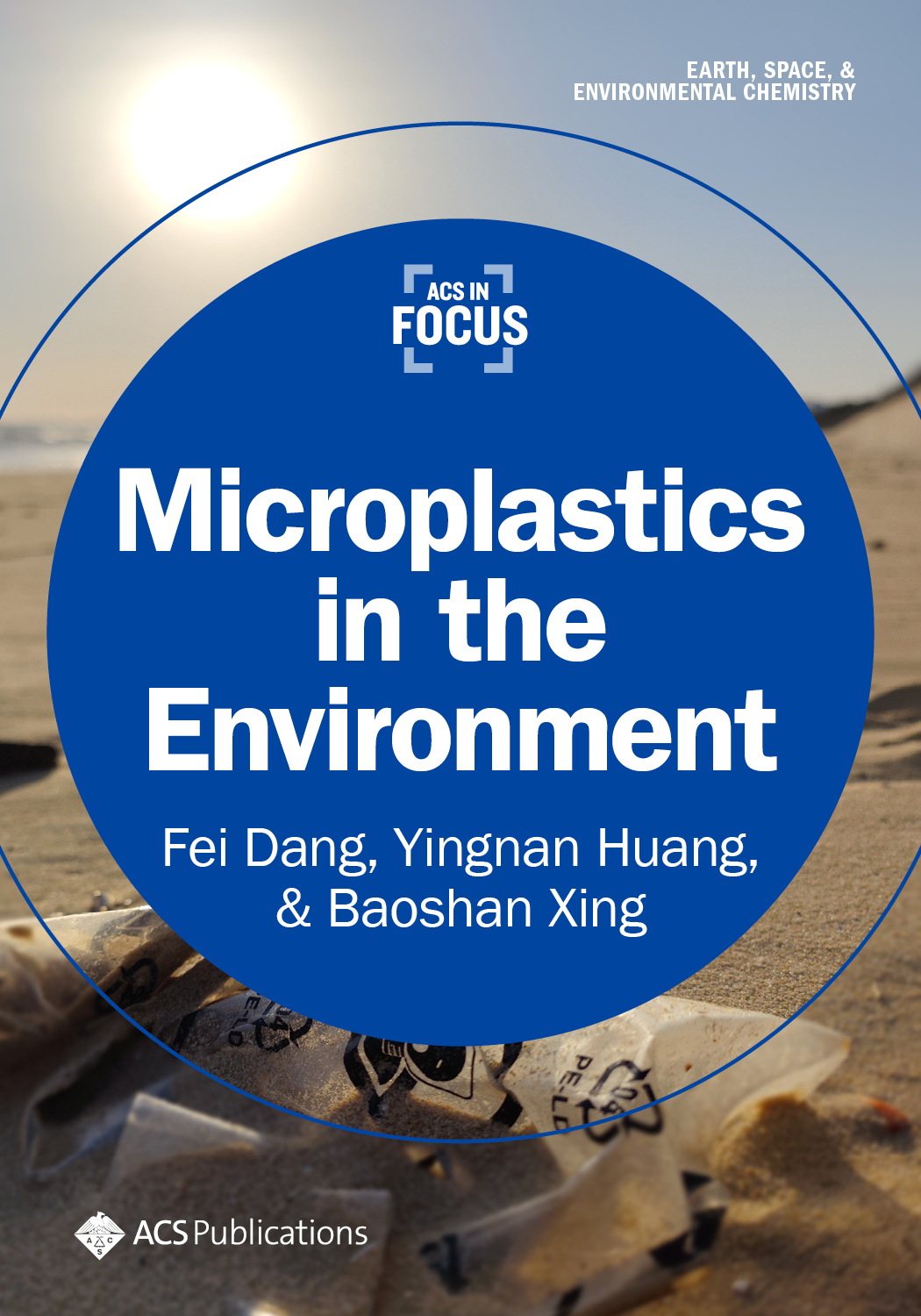


Microplastics in the Environment
Book logo
Book series logo

Microplastics in the Environment

Author(s):
Publication Date:
April 8, 2026
Copyright © 2026 American Chemical Society
eISBN:
‍9780841295285
DOI:
10.1021/acsinfocus.7ea005
Read Time:
two to three hours
Collection:
5
Publisher:
American Chemical Society

Microplastics in the Environment presents the case for micro(nano) plastics (MNPs) as a growing planetary pollutant impacting critical biogeochemical cycles, the fitness of the environment, and human health. Research reviews and case studies are used to highlight the current state of understanding and areas where significant knowledge gaps exist.


Through years of laboratory and field research, the authors have come to understand plastic pollution not merely as a litter issue, but as a pervasive biogeochemical challenge. They have observed how MNPs transform in the environment—weathering into reactive particles, interacting with ecosystems, and disrupting essential biogeochemical processes. Motivated by these insights, the primer is structured as follows:

  • Systematically trace the complete lifecycle of plastics from production to environmental fragmentation and global dispersal,

  • Elucidate how weathering transforms inert plastics into chemically active agents that interfere with elemental cycles and microbial communities, and

  • Synthesize evidence on the cascading biological risks, from ecological impacts to potential human health implications.

Book series logo
Detailed Table of Contents
About the Series
Preface
Chapter 1
Microplastics: A Pressing Global Environmental Concern
1.1
Plastics: Benefit and Burden
1.1.1
From Celluloid to Technopolymers
1.1.2
Production and Composition
1.1.3
The Persistence Paradox: Durable by Design, Disposable by Demand
1.2
From Macro to Micro: Formation and Pathways of Microplastics
1.2.1
Quantification of Micro- and Nanoplastic (MNP) Concentrations: From Particle Isolation to Reporting
1.2.2
Primary Sources and Secondary Fragmentation
1.2.3
Release of Plastic-Derived Chemical Leachates
1.3
Global Distribution of MNPs
1.3.1
Sources and Cross-Compartment Transport of MNPs
1.3.2
MNPs in the Ocean
1.3.3
MNPs in Freshwater
1.3.4
MNPs in Agricultural Soils
1.3.5
MNPs in Groundwater
1.3.6
MNPs in Air
1.4
That’s a Wrap
Chapter 2
Environmental Weathering of Microplastics and Their Impact on Global Biogeochemical Cycles
2.1
Environmental Weathering
2.1.1
Light-Dependent Weathering
2.1.1.1
Weathering
2.1.1.2
Products
2.1.2
Light-Independent Weathering
2.1.2.1
Weathering
2.1.2.2
Products
2.1.3
Microbial Weathering
2.1.3.1
Weathering
2.1.3.2
Products
2.1.4
Digestion by Animals
2.1.4.1
Process
2.1.4.2
Products
2.1.5
Implications of Weathering Processes
2.2
Role of MNPs in Elemental Biogeochemical Cycles
2.2.1
Influence on Metal Cycling
2.2.1.1
Metal Adsorption
2.2.1.2
Metal Transformation
2.2.2
Influences on Organic Pollutant Cycling
2.2.3
Influences on Biogeochemical Cycles of Carbon and Nitrogen
2.2.3.1
Carbon Cycling in Aquatic Systems
2.2.3.2
Carbon Cycling in Terrestrial Systems
2.2.3.3
Nitrogen Cycling in Aquatic Systems
2.2.3.4
Nitrogen Cycling in Terrestrial Systems
2.2.4
Contribution of MNPs to Antimicrobial Resistance
2.3
That’s a Wrap
Chapter 3
Risks of Microplastics: From Ecosystems to Human Health
3.1
Detection in Biological Systems
3.2
Ecotoxicological Impacts
3.2.1
Plant Uptake and Threats
3.2.2
Animal Uptake and Threats
3.2.3
Ecological Risk Assessment
3.3
Impacts on Human Health
3.3.1
Human Exposure Pathways to MNPs
3.3.1.1
Dietary Intake
3.3.1.2
Inhalation
3.3.1.3
Dermal Adsorption
3.3.2
Detection of MNPs in Human Tissues
3.3.3
Adverse Health Impacts of MNPs
3.4
That’s a Wrap
Bibliography
Footnotes
Index
Author Info
Fei Dang
Fei Dang is a professor at the Institute of Soil Science, Chinese Academy of Sciences. She received her Ph.D. from the Hong Kong University of Science and Technology. Her current research focuses on the environmental behaviors and ecotoxicological impacts of microplastics and nanomaterials. She has published nearly 90 peer-reviewed journal articles.
author image
Yingnan Huang
Yingnan Huang is a postdoctoral fellow at the Institute of Soil Science, Chinese Academy of Sciences, where she also received her Ph.D. Her research focuses on environmental behaviors and biological impacts of microplastics.
author image
Baoshan Xing
Baoshan Xing is a university distinguished professor at the University of Massachusetts, Amherst. He is one of the most cited scientists in the field of environmental science. His current research interests include the fate and analysis of micro(nano)plastics, interfacial processes, and food safety. He has published over 700 peer-reviewed journal articles.
author image